

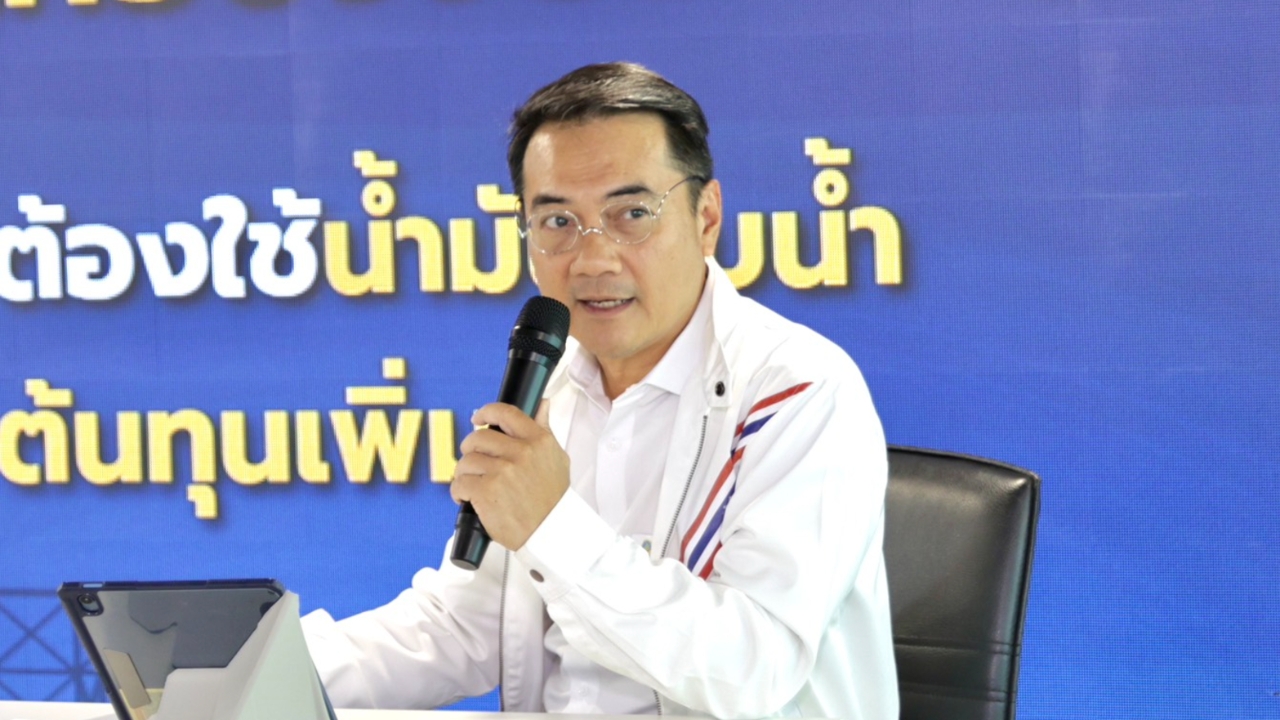
Naraphat, Deputy Leader of the Ruam Thai Sang Chart Party, points out that the energy crisis is further burdening farmers by raising costs throughout the system. He urges the government to "reform energy and revive the National Fertilizer" program, highlighting a model that reduces costs while increasing income to establish Thailand as the world's kitchen.
7 April 2026 GMT+7 Mr. Naraphat Kaewthong, Deputy Leader of the Ruam Thai Sang Chart Party, delivered a special lecture at the first 2026 training program on energy and law. The program titled “Thailand’s Energy Crisis: Rising Cost of Living, Stagnant Income, Who Controls the Game” organized by the Ruam Thai Sang Chart Party. He stated that the energy crisis trend will impact the majority of the country’s population, especially farmers, who face continuously rising costs.
Currently, energy costs, especially rising oil prices, directly increase fertilizer costs because fertilizer production depends on natural gas and energy. He emphasized that "energy is the cost of life." When energy prices rise, living expenses increase accordingly. Energy is also a production cost for all occupations, particularly farmers who rely on energy to produce agricultural goods. At the national level, energy is a critical factor in competitiveness; if costs are high, Thai products become expensive and lose ground in global markets, especially compared to neighboring countries like Vietnam, which benefits from lower costs and can sell goods cheaper, surpassing Thailand in the rice market. Additionally, the energy crisis forces the government to allocate hundreds of billions of baht to mitigate and stabilize the situation.
Mr. Naraphat also discussed fertilizer, the heart of farming, noting that Thailand imports over 90% of its fertilizer despite being an agricultural country. He questioned why the country does not produce fertilizer domestically. Historically, Thailand had a “National Fertilizer” program since 1982, but it was affected by the 1997 Asian financial crisis and faced opposition from fertilizer importers, leading to its closure.
Learning from this, the Ruam Thai Sang Chart Party’s “National Fertilizer” policy aims to produce fertilizer domestically to reduce costs by using natural gas from the Gulf of Thailand to produce urea, one of the main fertilizer components (N-P-K). N stands for nitrogen derived from natural gas; P is phosphorus, which must still be imported but in small amounts; K is potassium, sourced domestically in areas like Chaiyaphum and Nakhon Ratchasima, where the state holds a 20% stake in projects but has not funded investments, causing delays. He proposed two approaches: the government should either inject budget funds or withdraw shares to allow private sector investment. Producing at least two of the three main fertilizers—nitrogen and potassium—could reduce farmers’ costs and potentially enable fertilizer exports, especially potassium with a value around 400 billion baht.
Regarding water management, Mr. Naraphat divided water into three categories: atmospheric water, surface water, and groundwater. He noted that current rainfall measurement is inaccurate, recommending the development of Weather Radar systems to forecast water volume and prepare for floods. At the same time, irrigation systems do not cover all agricultural areas, and pumping water from surface and underground sources requires energy. He suggested promoting solar energy for water pumping to lower costs.
Additionally, Mr. Naraphat addressed the cost of agricultural machinery such as tractors and harvesters, which use low-speed engines. He proposed using “pyrolysis” oil produced from waste and advocated for a “free solar” policy to help reduce farmers’ energy expenses. Drawing from experience in the Ministry of Agriculture, he observed that budget support of three million baht per farmer under the large-scale farm project often leads to redundant machinery purchases, resulting in inefficiency. He therefore suggested pooling resources across multiple plots to jointly invest in facilities like rice mills, dryers, or processing systems to improve efficiency and proposed “machine centers” where farmers can rent equipment instead of buying, reducing financial burdens.
On income, he stressed the need to increase earnings alongside cost reduction. He proposed that farmers process their own products; for example, 20 tons of paddy rice can yield about 10,000-12,000 kilograms of milled rice. Selling at approximately 30 baht per kilogram would generate around 360,000-380,000 baht, with farmers netting about 300,000 baht or roughly 15,000 baht per ton after expenses. He believes the government need not increase its budget but should reallocate annual subsidies of around 100 billion baht into structural investments that enable the system to sustain itself long-term. By lowering costs, increasing income, and developing farmers into entrepreneurs, the quality of life for over 30 million people in agriculture can improve, restoring Thailand’s status as the world’s kitchen.
Mr. Naraphat emphasized that the country’s direction must benefit the majority, not a privileged few, and that all policies require sincere government commitment to advance despite resistance from vested interests. “Profits may decrease, but the country will improve. It is like Robin Hood, balancing the interests of the rich and poor to strengthen the nation’s foundation. If farmers have stable, sustainable incomes, younger generations will be encouraged to return to farming.”