

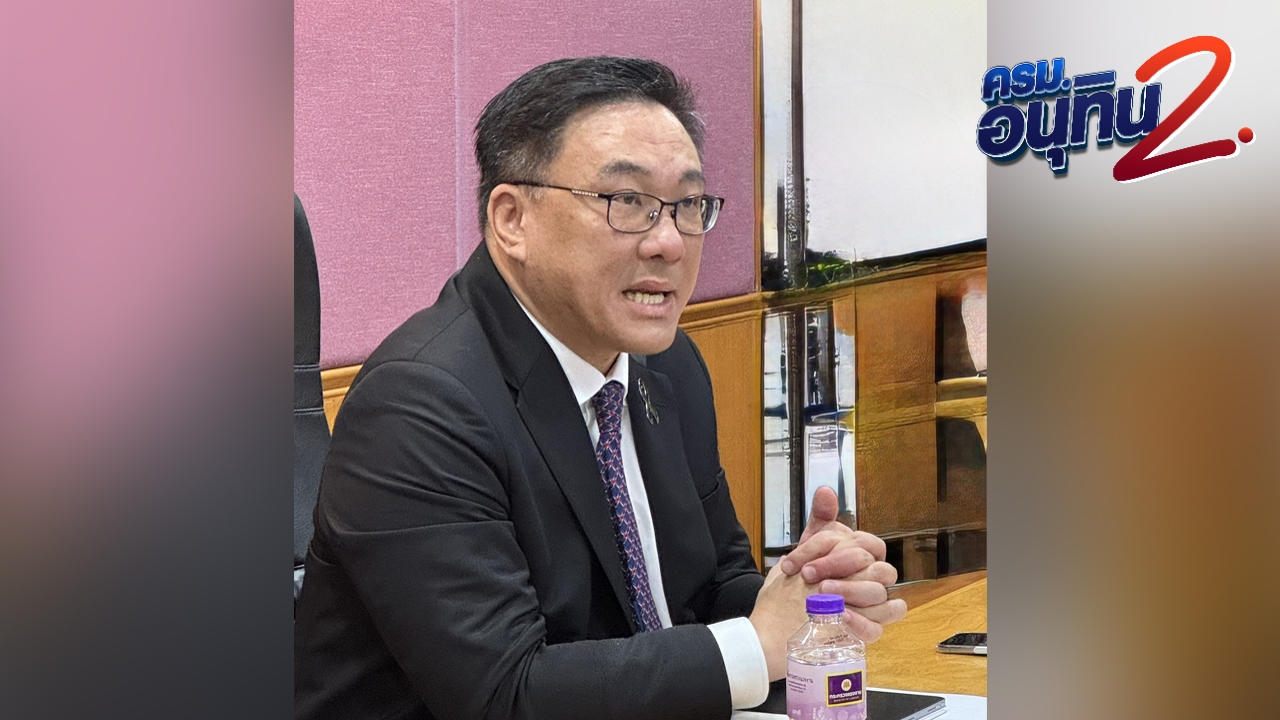
Julphan does not promise a wage increase amid high inflation. He asks the media to set KPIs for evaluating him. His first task will be to reduce employee contribution payments. He is confident that managing the Ministry of Labor is not a difficult job after four ministers changed in one year.
On 7 April 2026, Julphan Amornwiwat, Minister of Labor, spoke to the media after his first day on the job and meeting with ministry executives. A group of protesters awaited to submit a letter and scattered banknotes. “Funeral rites” He said in an interview: “I feel good. I come from politics, so I’m not afraid of protests because I grew up with them. Therefore, I have assigned the Social Security Office and ministry executives to focus on the people who come to demand rights first, as no one is here for personal gain. We have no investment units. People come because of problems, so we must prioritize their demands.” He also instructed the deputy permanent secretary of the Ministry of Labor to appoint inspectors to receive complaints, discuss them with him, track solutions, and develop case-by-case approaches. Regarding groups coming to demand rights, “They are welcome. I am ready.”
Julphan said he wants to discuss before setting KPIs to measure each agency’s performance. If KPIs are based on the budget book or the red-printed white book, all agencies might pass easily. He prefers to review KPIs that fully address public needs. Regarding KPIs for measuring the labor minister’s work, he wants the media to determine them. His first mission is to reduce the burden of employee contributions to the provident fund, which he intends to complete. However, he must first meet with the Social Security board and the ministry. He could not specify when the task would be completed, but the timeline is in his mind. He prefers not to reveal it yet, as external factors like Social Security board meetings and fund stability affect it. Also, submitting proposals to the Cabinet takes time.
Regarding the challenging and discontinuous work of the labor minister, with four ministers in the past year, Julphan joked, “I will be one for four years.” On addressing migrant labor issues, especially Cambodian workers, he said he received concerns from the Chamber of Commerce and Industry Council before his appointment. He understands labor shortages critical to agriculture and some regions. He is aware of the problems and asks for some time to solve them. The issues have two dimensions: the global situation in the Middle East has halted sending Thai workers abroad in some areas, and the second involves neighboring countries’ workers in Thailand. Many specialized workers are hard to replace or retrain. Renewing work permits for workers from three neighboring countries with MOUs—Laos, Myanmar, and Vietnam—has been done but about 200,000 cases may have been missed and are being addressed. Cambodian workers’ cases await Cabinet consideration and input from society and the private sector to reach decisions matching needs.
Regarding the employment situation in Thailand and whether problems are emerging, Julphan said the first priority is assisting workers. Measures to reduce employee contributions to the provident fund will be issued, but no clear timeline exists yet. The plan is to implement it as soon as possible after presenting policies to Parliament. Measures will also prepare for worsening economic conditions to maintain employment. He asks for time to implement this. If necessary, the private sector must maintain employment levels. A drop in employment risks losing skilled workers from the system, who are difficult to regain later, reducing workforce skills and productivity. Therefore, every effort will be made to sustain jobs, possibly by reducing work hours. The government might financially support businesses or workers, similar to practices abroad. Further discussions will follow, as the situation is expected to worsen.
When asked about the government’s work-from-home and work-from-anywhere policies, initially requested for government agencies, but some still require scanning at the department, Julphan said these policies were discussed in the Cabinet and currently are requests for cooperation. Agencies should assess necessity since work nature varies, and not all can work remotely. Those with public service duties must come in. He himself will come in to be recognized as new, but all agencies have received the policy. Energy saving remains a focus, emphasizing work results over formalities. Work should be completed fully on site, but location and efficiency can be flexible. Importantly, this signals to the public that the energy crisis is serious and requires everyone’s energy-saving cooperation.
Regarding whether the minimum wage will increase this year amid inflation, Julphan said he believes everyone wants to raise wages but must consider reality. The current economy cannot support unrealistic targets. He will not make promises but admits intention to raise wages suitably. Discussions include creating mechanisms for automatic wage adjustments with less discretion. He asks to hold off commitments for now.
He explained that economic conditions and upcoming trends must be monitored carefully. Management must enable all parties and systems to move forward together. A single perspective is insufficient; all factors must be laid out and discussed. On the Social Security purchase of the Sky Nine Center building case, Julphan said the permanent secretary of the Ministry of Justice leads the investigation. He stressed seriousness and close monitoring without interference, allowing the process to work. The former labor minister set a four-month deadline for investigation completion, but Julphan said he did not impose this and aims to resolve the matter within four years. He trusts the investigation committee led by the Ministry of Justice’s permanent secretary is sufficient; no further committees are needed. He asks to await reports and says the issue is not mysterious or being hidden.
At the end, Julphan opened up about being assigned to lead the Ministry of Labor, a difficult and complex ministry likened to a hard stone. He said there is no stone or worry too hard. Once assigned, he will do his best. He has tasks and goals, and completion timing depends on circumstances, but he will expedite work given the current situation.
After the interview, Julphan took a photo with the wall displaying former labor ministers’ portraits, especially the picture of Sompong Amornwiwat. He also took a photo of the former labor ministers with his mobile phone, saying, “He is my friend's father,” and noted he knows them all.