

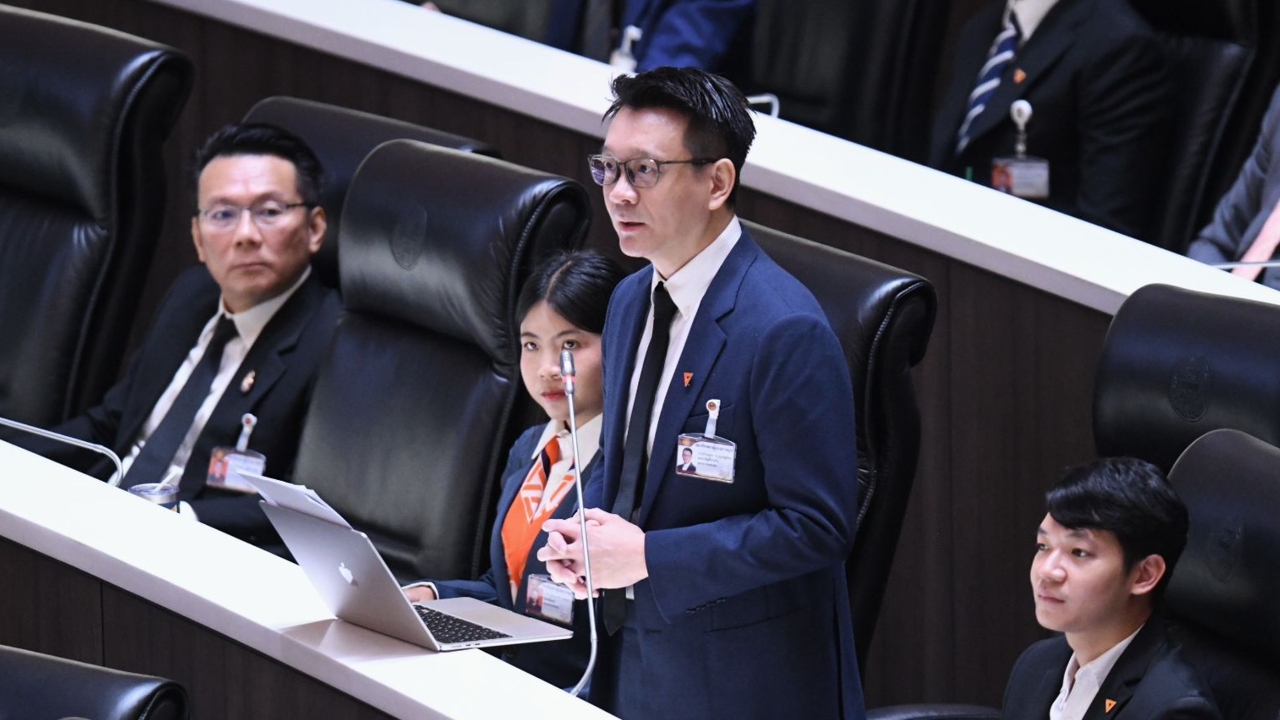
Veerayut Kanchuchat, Deputy Leader of the People’s Party, advised the government that if it plans to use 'Khon La Khrueng Plus,' it should apply it strategically to subsidize the public’s major energy transition rather than using it just to stimulate one-time consumption.
On 8 April 2026, reporters reported that Veerayut Kanchuchat, party-list MP and Deputy Leader of the People’s Party, spoke about the ongoing energy crisis on The Standard Now program on 7 April 2026. Regarding Energy Minister Eknath Promphan’s decision to cut diesel prices for B7 and B20 at the refinery by 2 baht, Veerayut said this idea was a good start. He is currently awaiting details but suspects the idea came from reviewing refinery prices and negotiating a discount, possibly referencing Singapore prices. He understands negotiations likely assessed which costs should be excluded, leading to an agreed 2-baht price cut at the refinery gate. This reduction is a positive first step, but given the current oil price surge and soaring refining fees, additional measures may be necessary.
Veerayut explained that examining government-controlled pricing mechanisms shows that excise tax reductions, as done in 2022, are effective. Currently, excise tax on gasoline is about 7.50 baht, plus a municipal tax automatically calculated at 10% of the excise tax. Thus, gasoline tax totals roughly 8 baht per liter, while diesel tax is about 6.9 baht plus 10%, totaling just over 7 baht. If the government decides to reduce these taxes, fuel prices could be immediately lowered.
Continuing, Veerayut noted that according to the fuel price structure table for Bangkok from 1–7 April, refining fees have skyrocketed to 17.50 baht per liter. In 2024 and 2025, refining fees were only about 1–2 baht per liter. Even in March, fees rose to 7 baht, which was already high, but in the first week of April, they surged sharply to 17.50 baht.
Regarding refinery costs, Veerayut said each refinery’s costs vary. Some suppliers are affected by the Strait of Hormuz, while others have stronger bargaining power, resulting in lower costs. Therefore, refinery costs differ and the reported figures represent gross profits, not net profits, and must consider rising War Premium costs. Normally, refining fees are 1–2 baht per liter, so a jump to 17 baht justifies legitimate government intervention and close monitoring.
On the issue of the government’s inability to compel private refineries to comply—even with the 1973 Emergency Decree on Oil Shortage Prevention or requesting a 2-baht price cut at refinery gates that might concern major and minor shareholders—Veerayut said there are three models under discussion in Thailand to address rising refining fees. The first, mentioned by Deputy Prime Minister and Transport Minister Ekniti Nitithanprapas, is to seek voluntary cooperation and donations from refineries to support the Oil Fund, as was done in 2022 when PTT was reportedly the only company contributing about 3 billion baht.
The second model, proposed last week by the Oil Price Structure Oversight Committee (OPSOC), involves two steps: first, asking for voluntary contributions and cooperation; second, setting refining fees at a fixed 1–3 baht per liter. Veerayut sees the benefit as guaranteeing a minimum refining fee for refineries but notes this may not reflect changes in War Premium costs. For example, refining fees rose to 7 baht in March; capping at 3 baht might reduce private sector incentives to refine. If oil shipments get stuck in the Strait of Hormuz with increased insurance demands, refineries might decide not to import crude at all. Balancing business incentives is necessary. Therefore, Veerayut proposes a third model: implementing a windfall tax, which has been discussed before, including in 2022 alongside excise tax cuts and Treasury studies. After four years, he believes this is the right time to start, as prolonged conflict and future rising oil and electricity prices make it urgent to systematize the approach while fairly assessing refinery costs.
Veerayut mentioned that the advantage of the 1973 Emergency Decree is that it allows government access to refinery cost data. The state should review these costs quarterly—not daily—to avoid reflecting volatile fluctuations and provide a more accurate assessment.
Regarding Ekniti’s view that a windfall tax is inappropriate now because it requires lengthy legislation and suits only assets with steadily rising prices, whereas oil prices are highly volatile, Veerayut explained that the principle of a windfall tax is to collect during price surges when companies earn profits without additional investment as commodity prices suddenly spike.
Windfall taxes have a clear principle and have been implemented in the European Union. Thus, it is theoretically feasible. The ongoing debate should focus on implementation details such as cost calculation methods, tax rates, and collection procedures to ensure fairness.
Veerayut said that windfall taxes are a long-term principle rather than a short-term fix. Assessments can be quarterly or yearly. Last year, among six refineries, some made profits in the billions, some incurred losses, and others earned tens of billions. Therefore, cost assessments and fair treatment are possible given the small number of refineries involved.
Regarding the government's potential use of the 'Khon La Khrueng Plus' policy, Veerayut suggested the government could use it to stimulate the economy but should seize the opportunity to incentivize energy use changes, such as co-payments for the industrial sector to purchase electric machinery instead of oil-powered equipment. This would not only stimulate domestic consumption but also promote a transition to renewable energy and reduce reliance on fossil fuels.
Veerayut emphasized that in a crisis, the government must lead by example, demonstrating careful budget management, detailed administration, energy conservation, and serious promotion of clean energy use. This leadership is the state’s responsibility during challenging times.