

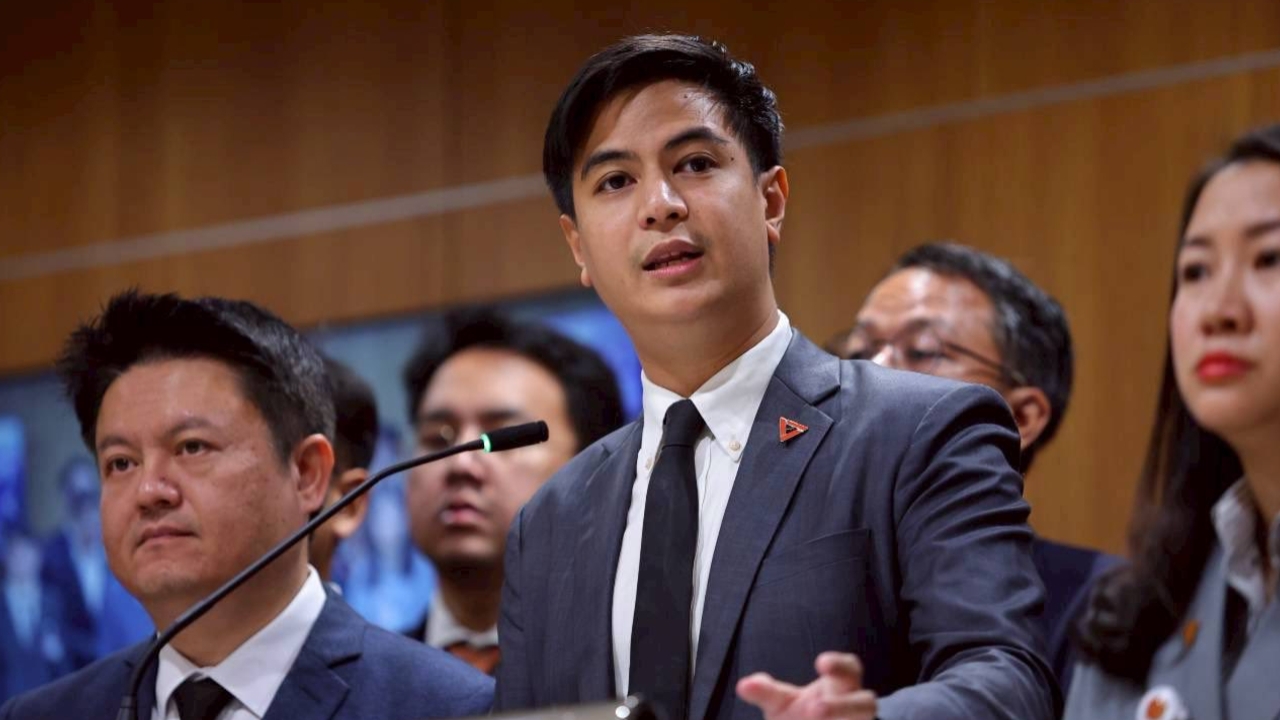
Parit points out that relief measures should have reached the public since the caretaker Cabinet period, following two weeks of a sharp oil price hike. He reveals that the People’s Party is preparing to review and advise the government during the policy debate on 9-10 April.
On 8 April 2026, Mr. Parit Wacharasindhu, a party-list MP and spokesperson for the People’s Party, posted on Facebook questioning why targeted relief and assistance measures for the public have yet to reach them. Today marks two weeks since the government ended the diesel price freeze on 25 March, allowing prices to spike by 6 baht per liter on the first night and accumulate to over 17 baht per liter since.
Mr. Parit said he believes everyone understands that this global crisis inevitably pushes oil prices higher than normal. However, what Thai people question and hope to see is a “fair distribution of burdens and benefits,” not governance that pushes all burdens onto the public while neglecting their hardships.
Certainly, one aspect the public has closely watched—especially in the past 1-2 days—is the new government’s stance on oil price restructuring, reducing refining margins, imposing windfall taxes to collect excess profits, and cutting excise taxes. These steps might be seen as "too little" (for example, the latest Energy Policy Committee resolution to reduce refinery prices by 2 baht per liter) and "too late" (such as the windfall tax study dating back to 2022 during the Russia-Ukraine war).
But another aspect that people have waited for repeatedly amid rising fuel and living costs is “targeted relief measures” for vulnerable groups severely affected by this crisis, such as:
- Low-income groups or households with many children and elderly, whose income does not cover expenses.
- Farmers facing increased costs from fertilizers, transportation, and fuel for equipment and machinery.
- Fishermen who may no longer find their voyages profitable.
- Riders and taxi drivers who rely on fuel for their livelihoods.
- Plastic manufacturers and companies in the supply chain facing shortages of plastic pellets.
- Small business owners and restaurants forced to choose between raising prices and risking losing customers or absorbing all costs themselves.
- The transportation sector, which is heavily impacted and whose struggles could further affect the overall cost of living.
Mr. Parit said he had previously raised concerns two weeks ago, calling it unbelievable that the government allowed a sudden 6 baht per liter price hike that day “without immediate parallel relief measures ready,” even though Deputy Prime Minister Aeknithi had mentioned targeted relief plans on the morning of the same day the price rose at night (https://www.thaipbs.or.th/news/content/503783).
But what is even more unbelievable is that two full weeks have passed with no targeted relief measures launched and no funds reaching the most affected people—considering only the increases beyond existing measures and excluding blanket fuel subsidies. He understands the government’s reasoning that a special Cabinet meeting is scheduled for 11 April to finalize details and budget for these measures. However, what the public has not been told is why they must wait so long—if the measures are finalized on 11 April, that means a full 17 days from the initial 6 baht price hike.
If the Prime Minister claims that the caretaker Cabinet status prevented action, that argument is unconvincing. Article 169 (3) of the Constitution clearly states that the caretaker Cabinet can approve emergency central budget spending to assist the public, and reportedly tens of billions of baht remain available. The only additional step is approval from the Election Commission (EC), which should not be problematic since the election has already passed, meaning no risk of budget use for electioneering.
Therefore, many people’s questions are, “What has Prime Minister Anutin been waiting for?” and “How prepared is the government to handle this crisis?”
Mr. Parit said he understands that the root of this crisis is not domestic but arises amid high geopolitical tensions and uncertainties (including recent worrying messages from Trump on Truth Social before a two-week ceasefire agreement). Amid risks of Thailand’s economy entering stagflation (slow growth plus high inflation), if Thai people are to overcome this crisis, we need a government that “leads ahead” of problems, not one that “lags behind” as before.
The People’s Party will do its utmost to scrutinize and advise the government to protect the public’s interests, starting with the policy statement debate in Parliament on the upcoming Thursday and Friday.