

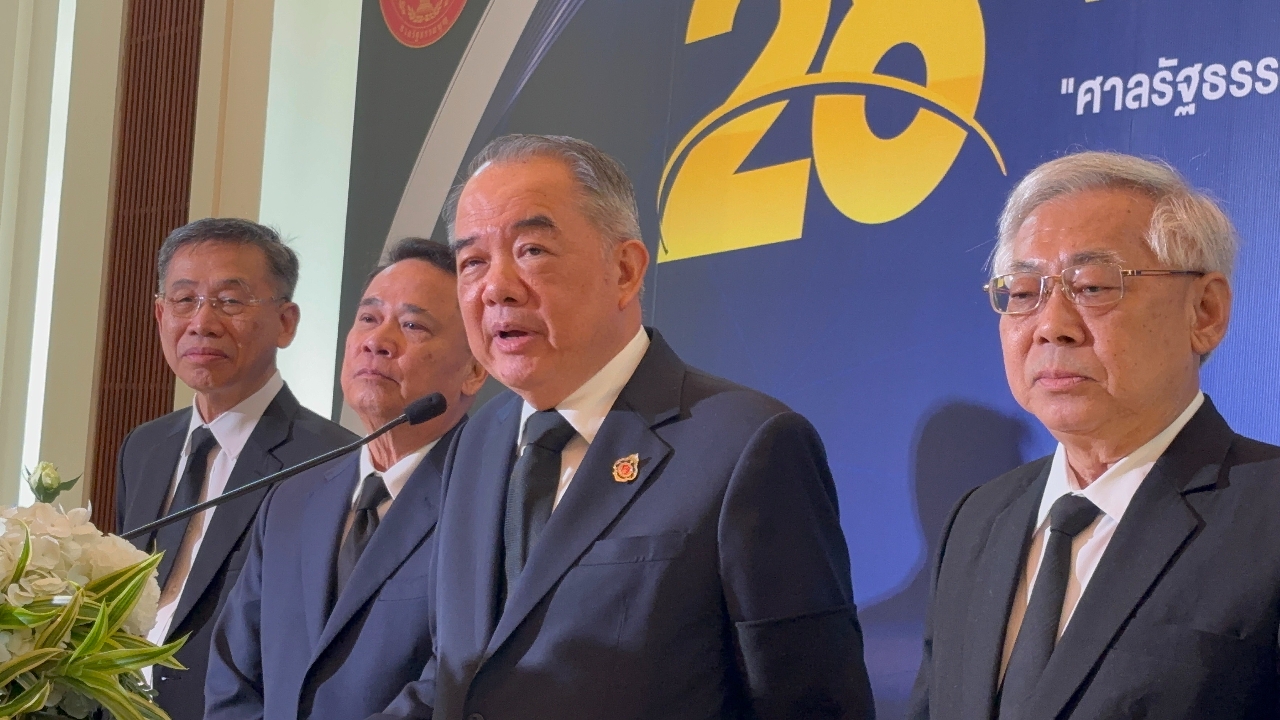
The President of the Constitutional Court acknowledged that social pressure during case deliberations is normal, comparing the court to not being in a lawless jungle; when rulings are issued, both society and the world closely watch.
At 12:30 p.m. on 8 April 2026 at The Peninsula Hotel Bangkok, Nakarin Mektrairat, President of the Constitutional Court, spoke about the court's work as it enters its 29th year, explaining its role in safeguarding the constitution amid the current political situation. He affirmed that the court operates within the framework of the constitution under the rule of law, acting reasonably and listening to all sides, in accordance with the Constitutional Court Procedure Act. He acknowledged it is normal for case deliberations to face social pressure, with society sometimes demanding swift decisions, but emphasized the court must consider all aspects and act in accordance with the constitution and law.
Nakarin added that the Constitutional Court, adhering to the rule of law, must understand both parties involved. The court itself must understand, society must understand, and the media must also understand the court’s procedures. Currently, the Thai Constitutional Court is recognized by an international body, the Venice Commission, which honored the court by attending this event. The court’s work is believed to be closely watched by many countries. He compared the judiciary to not being in a lawless jungle; any decisions made are publicly disclosed. The Venice Commission continuously monitors the court, and international forums facilitate exchanges with other constitutional courts worldwide, which currently number 125 member countries grouped into over 10 clusters. The court exchanges opinions, including on election cases, with other countries. The Venice Commission noted that election issues exist in many countries, such as Romania, Spain, and even developed countries like the United States. Therefore, constitutional disputes are not surprising and must be adjudicated by an appropriate authority.
“The 28 years of the Constitutional Court and public confidence represent an evolution, and I believe Thai society has matured to understand the purpose of this institution. Meanwhile, the court has proven itself through consistent work, citing rulings that must be explainable and understandable. The court must adapt to changing contexts and situations. It explained its role in safeguarding social rules—that is, the constitution—because although everyone reads and understands the text individually, the court’s rulings are made collectively by the bench, not by any single person.” The President of the Constitutional Court said.