

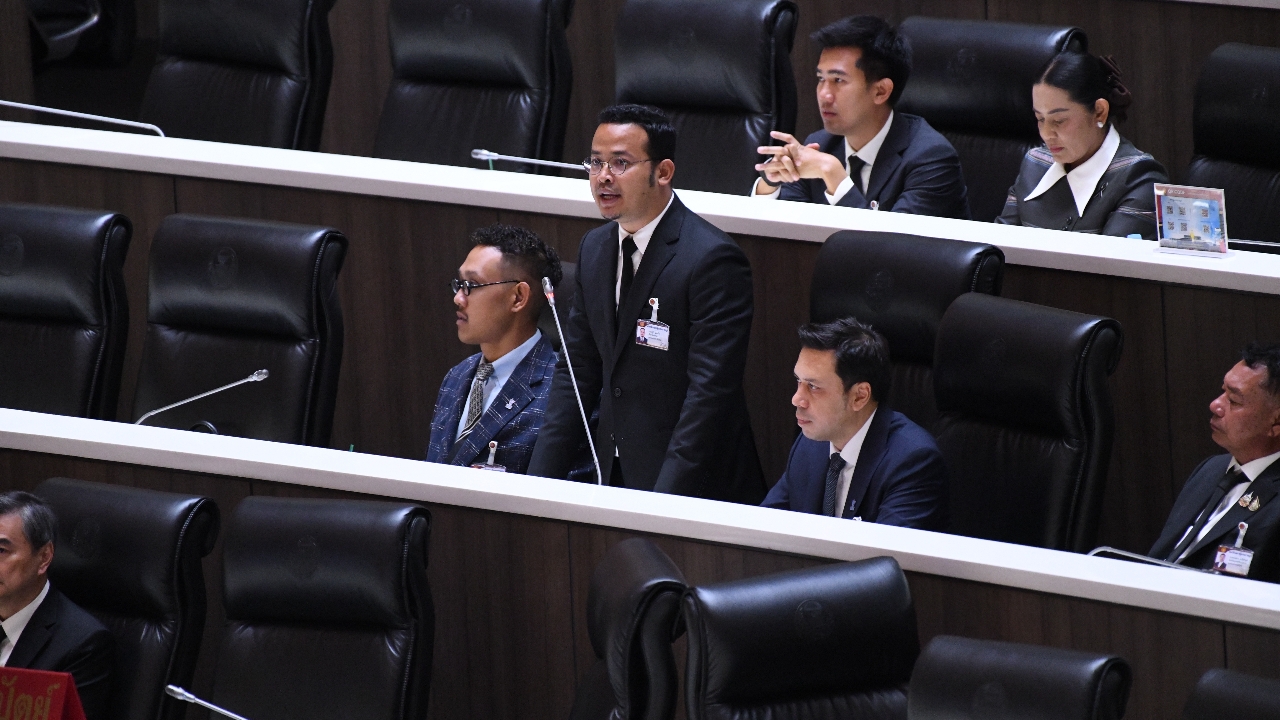
“Juree” exposes the wounds from the Hat Yai floods, revealing a failed warning system and slow relief efforts. Meanwhile, “Kardee” demands reform of the “Hat Yai Model,” warning there are only six months left before another flood disaster.
On 8 April 2026 at the Parliament, Mr. Juree Numkaew, Member of Parliament for Songkhla Province from the Democrat Party, proposed a motion to establish a special committee to study and reform the integrated flood management structure (the “Hat Yai Model”). He revealed the government’s failure in three phases, which damaged the economy by over 20 billion baht and claimed 145 lives, emphasizing that residents are traumatized and no longer willing to wait for chaotic aid.
Mr. Juree, MP for Songkhla from the Democrat Party, spoke emotionally about the major flood event in Hat Yai District at the end of 2025. He noted the widespread damage affecting all groups—from street vendors to business owners, schools, and civil servants. The damage in Hat Yai alone was estimated at over 20 billion baht. He pointed out the government’s management failures divided into three main phases.
Warning system failure, inaccessible to residents.
Mr. Juree said that although Thailand has agencies with good data like the Meteorological Department, the Royal Irrigation Department, and GISTDA, this information was not translated into language easily understood by locals. This led to incidents like “Nong Chom” waking at 2 a.m. to find her house flooded over 3 meters without warning. He proposed the government use Digital Twin technology and AI to provide individual alerts 24 to 48 hours in advance so people can prepare.
Chaotic management abandons the people.
Mr. Juree pointed to a lack of unified aid efforts, comparing the response to “random, uncoordinated actions,” causing communication breakdowns citywide. He also revealed the tragic fact that some officials refused to deploy boats and large vehicles to rescue residents who were waiting for death, claiming they had to standby for the Prime Minister and ministers visiting the area. This contributed to the death toll reaching 145.
Turtle-paced compensation.
The most sensational issue in Parliament was the delayed compensation for home repairs. Mr. Juree compared it to NASA sending people to the moon in just 3 days, whereas the Thai government’s compensation had not reached victims after 150 days. “People ask me every day. Recently, I saw a compensation payment of only 150 baht, while the maximum should be 49,000 baht. I ask, what can they repair with 150 baht?” Mr. Juree said.
Calls to establish the “Hat Yai Model.”
Mr. Juree concluded by urging Parliament to quickly set up the special committee to reform the integrated flood management structure, focusing on three main tasks.
1. Prepare by using modern technology for warnings and adjusting urban planning for drainage.
2. Respond by integrating agencies comprehensively and unifying evacuation efforts.
3. Recover by reforming compensation systems, reducing paperwork, and introducing soft loan measures to support SMEs.
“In just a few months, new floods will come again, but canals are still shallow, and water pumps remain unrepaired. People are truly traumatized; they no longer want to eat fried rice made by the Prime Minister but want sustainable management.” Mr. Juree stated clearly before ending his debate.

Calls to reform the “Hat Yai Model.”
Dr. Kardee Liao-pairoj, list MP from the Democrat Party, supported the motion, highlighting the fragility of crisis management still focused on compensation rather than future prevention. She questioned the progress of the post-December flood lessons learned report, which involved committees, experts, and international organizations. Yet to date, the report has not reached the government for implementation.
“I want to emphasize that we have only six months before the next southern rainy season. The so-called ‘300-year rain’ does not guarantee it will not return for another 300 years; it could happen again this year,” said Dr. Kardee. .
Clear weaknesses.
She also cited information from Prof. Dr. Seri Supharath, pointing out “ clear weaknesses.” Four key issues the government must urgently address without waiting for further studies are:
1. Warning system delays and poor communication causing residents to be caught unprepared.
2. Expired urban plans: Hat Yai’s zoning expired in 2012, currently replaced by Songkhla provincial plans that do not reflect actual conditions.
3. Land-use transitions: City growth moving against natural drainage directions.
4. Lack of unified command: No Single Command Center making decisions based on data rather than political considerations.
Tired of apologies.
“I am utterly exhausted from hearing apologies from the Prime Minister or government admitting management failures. Apologies are acceptable if followed by learning and improvement, but repeated apologies amid recurring failures are unacceptable to the public,” said Dr. Kardee.
She also proposed additional technical solutions (Big Win) including strengthening community defenses and opening waterways with low-cost, quick methods (Street Canal), investing in local smart monitoring systems (Local Alert), and using accurate weather and water forecasting models for policy decisions (Data-Driven Policy).
The government should shift its mindset from focusing on compensation budgets to investing in prevention, as compensation costs are many times higher than prevention.
“Property losses can be easily valued, but loss of life is priceless. Therefore, I urge the government to urgently review the lessons learned and begin investing in budgets to prevent these disasters from recurring for the people of Hat Yai and all of Thailand.” Dr. Kardee concluded.