

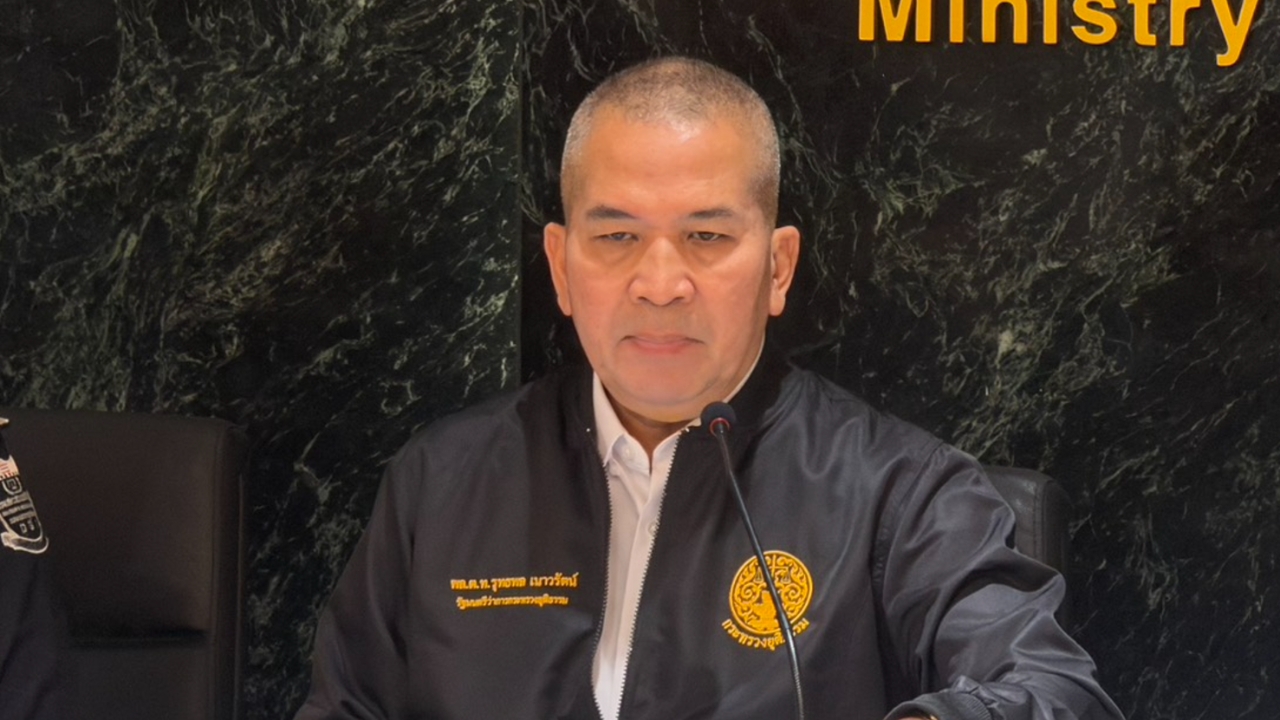
Pol. Lt. Gen. Ruthapol revealed anomalies at four sites—small oil refineries and oil storage companies located in Rayong, Pathum Thani, Samut Sakhon, and Khon Kaen—that may be stockpiling oil, potentially violating the Act on Goods and Services.
At 14:00 on 8 Apr 2026 at the Ministry of Justice, Pol. Lt. Gen. Ruthapol Naowarat, Minister of Justice, Pol. Lt. Col. Yuttana Praedam, Director-General of the Department of Special Investigation (DSI), Pol. Gen. Samran Nualma, Deputy Commissioner of the Royal Thai Police, Mr. Somchai Ratnasupha, Director of the Inspection and Operations Division, Department of Internal Trade, Ministry of Commerce, and Mr. Wutthat Tantives, Deputy Director-General of the Department of Energy Business, Ministry of Energy, jointly announced the results of an operation investigating illegal oil stockpiling. Earlier that morning, they conducted inspections at four targeted sites, which included small oil refineries and oil storage companies in Samut Sakhon, Rayong, Pathum Thani, and Phra Nakhon Si Ayutthaya provinces.
Pol. Lt. Gen. Ruthapol stated that following instructions from Prime Minister Anutin Charnvirakul, the authorities have been investigating oil traders at all levels from the source, led by the DSI, with the Royal Thai Police and the Department of Provincial Administration handling the endpoint inspections. He expressed gratitude for detailed information provided by the Department of Energy Business, Excise Department, Marine Department, and Ministry of Commerce. Today, the task force, led by Pol. Gen. Samran Nualma, conducted four key operations inspecting sites in Rayong, Pathum Thani, Samut Sakhon, and Khon Kaen. Each location exhibited different suspicious behaviors that risk causing oil shortages. From these operations, evidence of wrongdoing and suspicion has been found, and all parties have been asked to submit documentation for further examination. Moving forward, measures will focus on: 1) Strictly preventing delays in sea transport of oil from refineries in Bangkok, Laem Chabang, and Map Ta Phut to large coastal oil depots in Samut Prakan, Samut Sakhon, Phetchaburi, Chumphon, Surat Thani, and Songkhla; 2) Increasing enforcement against delays or refusal to sell oil from large depots to gas stations or end customers; 3) Enhancing monitoring of oil transport diversions intended for stockpiling.
Pol. Gen. Samran explained that the investigation into oil stockpiling involved three scenarios: 1) Estimating the number of trucks receiving oil from depots but not delivering it to gas stations, totaling 11,067 vehicles tracked via GPS. One case involved 10 trucks in Udon Thani province, each carrying approximately 40,000 liters. These trucks displayed pump indicators showing no oil, but on the morning of the operation, two trucks delivered oil en route in Khon Kaen province, transferring it to smaller vehicles. This is a clear violation, and the investigation team is proceeding accordingly. 2) In Rayong province, trucks receiving oil from depots but not delivering to gas stations were found at a depot previously registered as a gas station but deregistered. In a second scenario, 92 oil depots were examined, especially during oil shortages, to identify those not distributing oil and the periods involved. Electricity consumption data was analyzed, notably in Pathum Thani, where normal consumption is about 500 kilowatts, but spikes to 1,300 kilowatts occurred on 9-10 March. On 15-17 March, no power was supplied without obvious irregularities. Between 20-25 March, before oil price increases, power usage on 26 March peaked at 1,600 kilowatts, correlating with an estimated 20 million liters of oil inventory. These electricity usage patterns of all 92 depots will be forwarded to the DSI to verify if power use aligns with oil handling, noting daytime and nighttime consumption patterns and weekend differences.

Pol. Gen. Samran continued that in the third scenario, around 15-17 March, inspections focused on gas stations reporting closures due to oil shortages. Local police were assigned to verify which companies and trucks supplied those stations and whether those trucks continued delivering oil elsewhere. In Samut Sakhon province, deliveries were ongoing, but trucks ceased supplying certain gas stations despite active transport. Among 92 oil depots, investigations will extend to all gas stations and depots. The whereabouts of the 11,067 trucks will be examined further to trace their parking or activity, with ongoing follow-up planned.
Mr. Wutthat Tantives, Deputy Director-General of the Department of Energy Business, stated that in Rayong province, a company formerly registered as an oil trader under Section 10 of the Fuel Trade Act B.E. 2543 (2000) had its registration cancelled around 2018-2019. As a Section 10 trader, they were not subject to routine inspections under the Fuel Trade Act. However, onsite checks found this depot selling industrial substitute fuel products to customers, which constitutes commercial activity. Under Section 10, a trader must either have an annual trade volume exceeding 36 million liters or, if below that volume, have storage capacity over 200,000 liters to require registration. This depot holds a fuel storage license under the Fuel Control Act B.E. 2542 (1999), which defines a fuel depot as having total tank capacity over 500,000 liters. This means the site qualifies as a Section 10 trader. Preliminary checks indicate unauthorized sales of industrial substitute fuel, violating registration requirements and subject to penalties under Section 38, including imprisonment up to six months or fines from 10,000 to 500,000 baht, or both. Further in-depth investigations by the Department of Energy Business will continue.

Mr. Wutthat further noted that the Rayong company also employed transport contractors not registered as fuel transporters under Section 12, punishable under Section 41 by imprisonment up to six months or fines up to 50,000 baht, or both. The Department will review documentation for further investigation. In Samut Sakhon province, the company is a Section 10 oil trader and operates a small refinery primarily producing diesel. Recent inspections requested delivery receipts and oil transaction data, which the company cooperated with, to verify consistency between transport records and oil inventory logs. They also requested vehicle entry logs and CCTV footage to determine if stockpiling or delivery delays occurred. Preliminary findings include onsite violations: the facility houses a gas station with a 40,000-liter diesel tank connected to a single dispenser, but this station lacks permits under the Fuel Control Act, appearing to operate as a Type C fuel service station without authorization, violating Section 65 with penalties up to two years imprisonment and fines up to 200,000 baht, or both. Also, as a Section 10 trader with an onsite gas station, the company failed to notify authorities, violating Section 14 and incurring fines up to 50,000 baht under Section 40. Additionally, the site has several tanks, including a T12-type tank licensed for crude oil storage but used to store diesel without notification of change, violating ministerial regulations under Section 7, punishable under Section 66 by up to one year imprisonment or fines up to 100,000 baht, or both. Diesel samples were collected for laboratory analysis, including B7 diesel used at the station; results are expected within 3-4 days. The company primarily exports diesel produced at the refinery to Myanmar, which is permitted, though exports are not continuous.

Pol. Lt. Col. Yuttana Praedam noted that in Rayong, trucks failing to deliver oil to gas stations often claimed shortages. In Pathum Thani, abnormal electricity consumption matched oil sales volumes, indicating sales stopped when power use ceased, and increased during price hikes. In Samut Sakhon, gas stations reported no oil, yet depots continued shipping oil. All these cases may violate the Act on Goods and Services. Beyond the Department of Energy Business's findings, the law prohibits deliberate actions by businesses to artificially raise or lower prices. Authorities will review past periods of stockpiling to see if oil was held back during low prices to resell at higher prices. All findings will be presented to the Special Case Board on 9 Mar 2026 to consider investigation as special cases covering all suspicious behaviors, focusing on actions causing public harm due to fuel shortages.
