

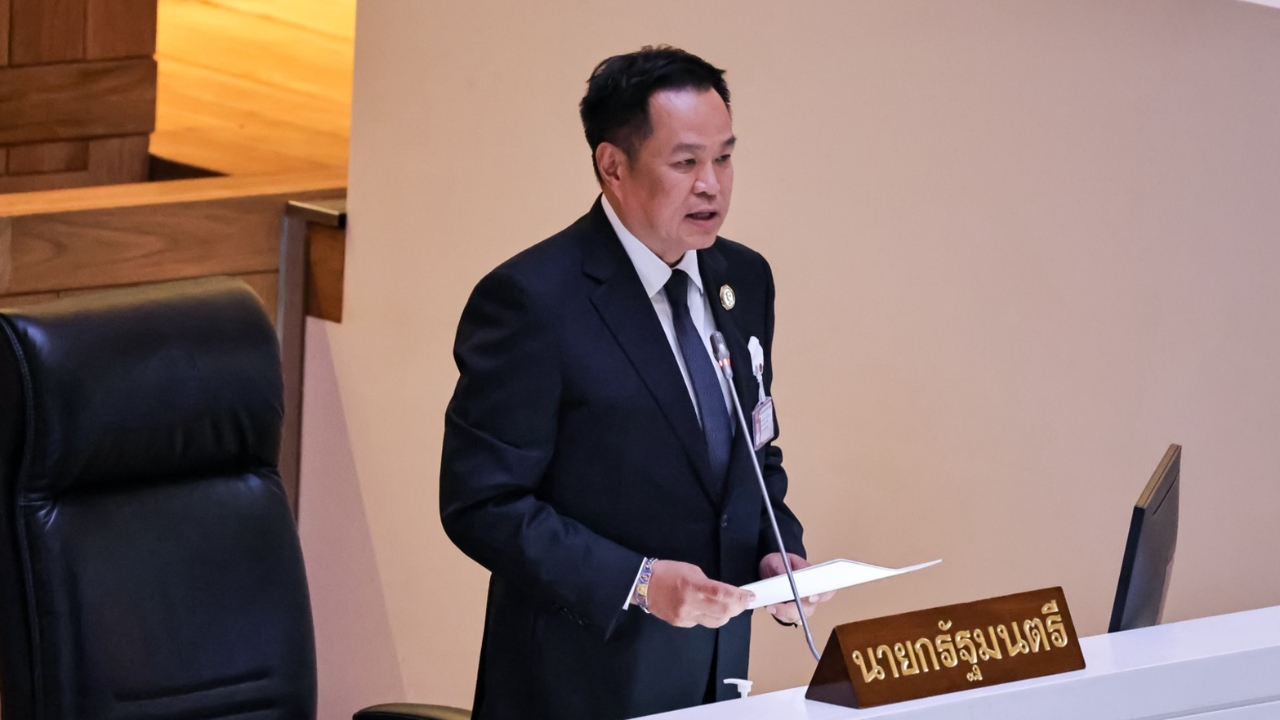
The 21-page policy statement of the Bhumjaithai government highlights five key pillars to drive economic growth, security, social development, and environmental protection. It orders an expedited study to terminate the 2001 Memorandum of Understanding (MOU) between Thailand and Cambodia, plans to review the Free Visa policy, supports civil servants working from anywhere, and affirms readiness to pursue all methods to enable Thai citizens to become self-reliant and stable.
On 9 April 2026 at 9:05 a.m., at the Parliament building, Mr. Anutin Charnvirakul, Prime Minister and Minister of Interior, led the Cabinet in presenting the government policy statement to Parliament, following the oath-taking ceremony for all 35 Cabinet members on 6 April.
Mr. Anutin stated that he would present the government's policy to Parliament and the public, outlining the principles of national administration and key policies. His government would adhere to three fundamental principles:
1. To protect and uphold the nation, religion, and monarchy.
2. To steadfastly maintain governance under a constitutional monarchy with the King as Head of State.
3. To uphold the rule of law, enforce laws fairly, and administer the state based on good governance for the benefit of the people.
Mr. Anutin then discussed policy directions, stating that this administration will build on immediate problem-solving while restructuring the country's economic and social systems. It will transform public administration into an “Integrated Strategic Cluster” system to foster shared mission understanding and unified goals and indicators, focusing primarily on citizens' well-being. The government will unite private sector and public energies to strengthen Thai society, assert a proactive, dignified role globally, protect sovereignty, and promote national interests. It will reposition the public sector as a supporter and facilitator for the public and accelerate digital government development, encouraging civil servants to work from anywhere.

According to reporters, the Anutin 2 government’s policy statement presented to Parliament covers five areas: economic policy; foreign affairs and security; social policy; disaster and environmental policy; and public administration and legal reform. The document totals 21 pages.
1. Economic policy focuses on promoting SME investment, reducing factors that hinder business and Thai potential, modernizing Thailand’s economic structure for the digital era, enhancing competitiveness sustainably, increasing private sector roles and options in infrastructure development, and promoting international trade to integrate Thailand into the global economy with new trade alliances. Agriculture will transition from traditional to precision, stable, and sustainable farming with value addition across supply chains to sustainably improve farmers’ incomes and quality of life. Tourism policy aims to position Thailand as a key regional destination, shifting focus from volume to generating higher value.
2. Foreign affairs and security policy emphasizes securing borders against all threats and addressing cross-border issues collaboratively with neighboring and regional countries. Efforts will continue to resolve the Thailand-Cambodia situation through peaceful bilateral mechanisms, including accelerating studies to terminate the 2001 MOU concerning overlapping continental shelf claims between Thailand and Cambodia. The government will also review the Free Visa policy.
(Continuation of above) It will expedite the study of the cancellation of the 2001 MOU between Thailand and Cambodia regarding overlapping continental shelf claims and promptly complete this process. Additionally, it will review the Free Visa policy.
3. Social policy aims to ensure truly free education, guarantee employment opportunities after schooling, and facilitate learning anywhere, anytime. It will develop the national health insurance system to allow immediate treatment access nationwide, revise social security laws to accommodate modern employment patterns and rapidly changing lifestyles, and upgrade health services with a focus on medical technology and AI applications.
4. Disaster and environmental policy involves systematic water management and disaster prevention by accelerating big data development and using AI for water management and weather forecasting down to the sub-district level. It plans to develop a national disaster insurance system covering all households to provide security and reduce natural disaster risks. The government will push Thailand to achieve net-zero greenhouse gas emissions by 2050, support clean and alternative energy use, and increase domestic greenhouse gas absorption areas.
5. Public administration and legal reform policy will promote legislation facilitating public service and convenience (a "Super license") to be completed and enacted within 180 days. It will expedite an omnibus law package to update outdated laws hindering the economy, aiming for enactment within one year. It also plans to amend public procurement laws and seriously address structural corruption.
In closing, Mr. Anutin stated the government is fully prepared to dedicate all its capabilities to solving citizens’ livelihood issues and leading Thailand toward its full development potential, ensuring every citizen participates and drives the country’s long-term growth.
“I will do everything possible to ensure Thailand is stable internally, that Thai people can stand on their own, that the economy is competitive, and that the world trusts Thailand,” Mr. Anutin declared.


