

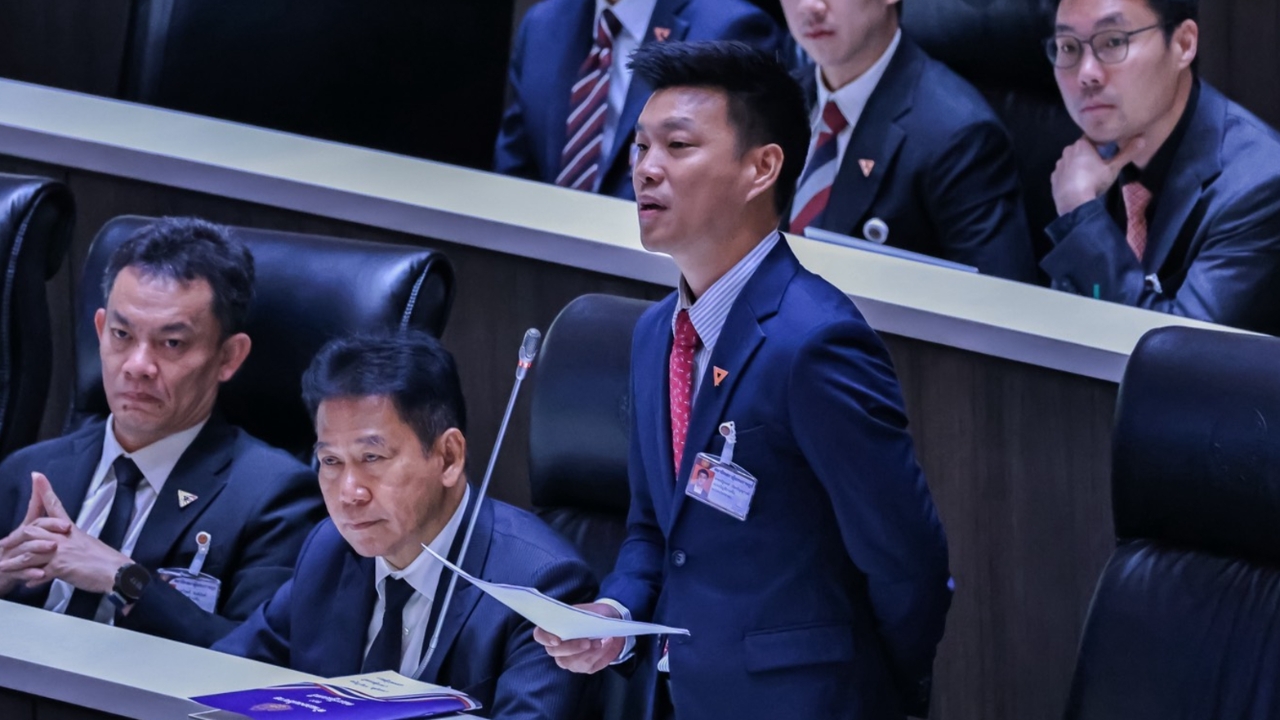
Nattapong, during a government policy debate, exposed five power groups divided by political factions that uphold the government. He accused Pheu Thai of selling their soul by joining the government yet lacking bargaining power as the second-largest party, and told the government to stop favoring cronies.
On 9 April 2026 at 10:16 a.m., in the meeting room on the 2nd floor of the Parliament Building, during the first joint parliamentary session (the first ordinary session of the year) to consider urgent matters, the Cabinet presented its policy statement to Parliament under Section 162 of the Constitution of the Kingdom of Thailand. Sopon Sarum, the President of Parliament, chaired the meeting. Afterward, Prime Minister Anutin Charnvirakul completed his policy statement.
Nattapong Ruangpanyawut, party-list MP and leader of the People’s Party, debated the overall policy and origins of the government. He invited everyone to ask themselves whether, after hearing the government's policy statement, they feel hopeful and see their own future aligned with the country's future—and if not, why.
Nattapong stated that this government is likely one of the most stable in Thai political history not formed by a coup, as it firmly controls power across the upper and lower houses and independent agencies. He explained that power is integrated into five clusters—not administrative clusters, but five power groups formed by coalition factions dividing benefits smoothly. These five clusters include:
1. Various political factions formerly affiliated with other parties who switched to the Bhumjaithai Party. Evidence shows Bhumjaithai, as the top party—not by the number of MPs but by winning elections after MP defections—is the leading party. Forming the government by uniting these factions brings ministers from places like Songkhla, Chonburi, and Suphanburi.
2. The second-largest party currently in government, which can be said to have sold its soul because it cannot negotiate with Bhumjaithai. If the second-largest party ever threatened to leave the coalition, Bhumjaithai need not worry, as it already has a majority of over 290 seats and can immediately attract opposition parties into the government, maintaining a parliamentary majority.
3. Other coalition parties in the current government, which hold crucial balance of power and have completely destroyed the bargaining power of the second-largest party in the coalition. They have more than 20 seats, and without their votes, Bhumjaithai could not continuously pursue its strategy of switching coalition partners.
4. Members of Parliament not elected or other independent agencies appointed by these groups serve as a 'joker card' that the Bhumjaithai-led government can use anytime. This card controls the drafting of a new constitution as desired, attacks opponents—as seen in the cases involving 44 MPs—or protects their own allies, such as the recent approval of election results in Suphanburi’s second district despite numerous allegations, discrepancies in vote counting, and pending constitutional court cases on ballot barcodes. This power balance is key to the government's stability, unmatched by other parties.
5. Certain groups within the country aiming to preserve the existing order. Their role is to protect everyone in the government camp, signal other groups to join their side, assuring them they will be immune to wrongdoing. This group holds what is called the 'second license' and sent signals to Bhumjaithai the night before the election.
This government’s administration, divided into five clusters, excludes the people from the equation. The government was formed through deals among power groups with aligned interests and lacks the will or agenda to push forward as a coalition. This is why, after the Prime Minister’s 23-point policy statement, people still feel that Thailand’s future is uncertain.

Nattapong continued that the Prime Minister outlined three core principles: to protect the nation’s pillars of religion and monarchy, uphold the constitutional monarchy democratic regime, and adhere to the rule of law applied fairly and equally. While any party forming government must accept these principles, people want to know how, under the Prime Minister’s leadership, these principles will guide the country’s direction. After listening to the policy statement, Nattapong saw no clear direction nor a shared mission or agenda for the country.
For example, issues like drafting a new constitution or protecting citizens’ political rights and freedoms were absent from the policy statement. He questioned coalition parties about their political will and democratic values and why these were missing from the document.
Nattapong said the country’s biggest problem may not be external crises but internal ones. Regardless of external pressures, if the government stands with the people, there is some foundation. Crises like the oil crisis, social issues involving shadow capital and scammers, security conflicts with neighbors, and cross-border dust pollution all relate to domestic people. Yet the government consistently protects those close to it rather than the public first.
For example, during the oil crisis, despite a stable government and balanced power, the people do not feel more secure. They lack confidence that the government will regulate domestic oil refinery prices fairly, reflecting real costs and not exploiting citizens. Likewise, during the PM2.5 dust crisis—after losing two volunteer firefighters and with millions affected—the stable government has not made citizens feel confident it will use all mechanisms to swiftly pass clean air laws.
Nattapong added that with the Prime Minister’s absolute power, the government can accomplish anything if it has political determination and courage. This is what people seek from the Prime Minister and Cabinet—a government that can turn wrongs into rights, not the reverse. The current crisis reflects those in power trying every means to preserve the old order.
The People’s Party’s debates in the next two days will highlight that what the country seeks may not be in this policy statement but rather a government that chooses not to preserve the old order but to build a new future for the people. Enough of a regime that protects self-serving groups. People can no longer bear the multifaceted crises they face. It is time for politics that serve all citizens.
After Nattapong’s debate, Julpan Amornwiwat, party-list MP and leader of Pheu Thai, protested and demanded Nattapong withdraw his claim that Pheu Thai sold its soul, calling it slander. This led to a back-and-forth dispute between Julpan and People’s Party MPs. Ultimately, Sopon Sarum, the President of Parliament presiding over the session, asked Nattapong to change his words. Nattapong agreed to replace 'selling soul' with 'abandoning original stance.'
