

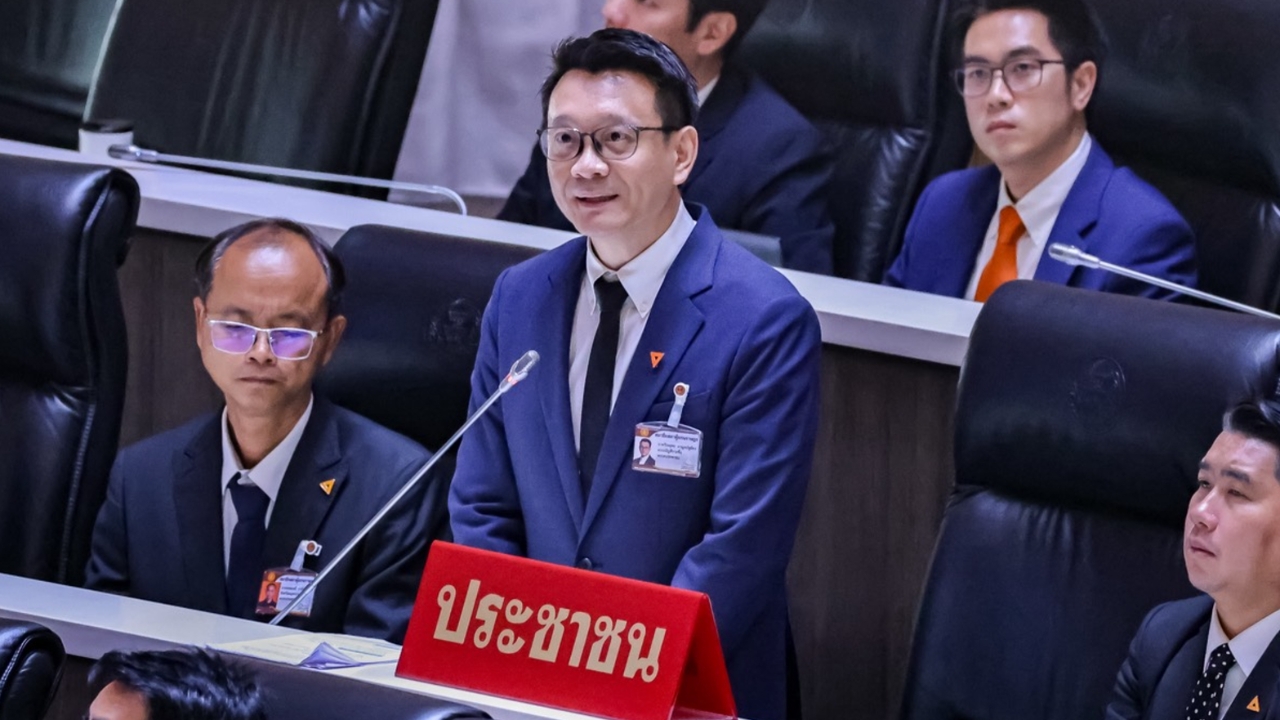
Veerayut, deputy leader of the Prachachon Party, mocked the Bhumjaithai policy announcement, saying if they are going to copy policies, they should copy them entirely. He accused technocrats Suphajee and Ekniti of joining forces with powerful families to create a blindfolded democracy system and criticized the Prime Minister for backing those with conflicting interests in power.
On 9 Apr 2026 GMT+7, at the meeting room of the House of Representatives, 2nd floor of the Parliament Building, during the first joint parliamentary session (the first ordinary session of the year) to consider urgent matters, the Cabinet presented its policy statement under Article 162 of the Constitution of the Kingdom of Thailand. Veerayut Kanchuchat, party-list MP and deputy leader of the Prachachon Party (PCN), in his remarks compared the government's policy drafting to students leaving a group report unfinished. When the world became chaotic, they didn't know how to adjust it, so they added just one paragraph on Middle East conflicts, hoping the teacher would understand. He questioned whether this is the principal’s standard way of working, referring to Bhumjaithai Party (BJT). He said the government remains indifferent to the people's hardships and needs proactive policies. He proposed that the most important mission now is to enhance Thailand’s energy security. Since this policy document already takes much from the PCN, he urged them to also adopt the major theme of increasing energy security. "If you're going to copy, copy it all. Energy security means sufficient, continuous, and affordable energy," he said.
Veerayut further said that the Anutin 2 government is essentially a coalition between powerful families and technocrats, each willing to turn a blind eye to coexist. Traditional powerful families in politics are known for boldness and reliability. If it were solely a powerful family government, he believed they would have dared to reduce excise tax on oil prices by 7 baht already amid high oil costs. But when they yield to technocrats' warnings about revenue collection and fear being labeled as bankrupt, the powerful families settle for simpler measures like lowering refinery gate prices by 1-2 baht. Technocrats, joining with powerful families, also have to turn a blind eye, allowing many questionable projects like the Land Bridge and MotoGP, which focus on just a few provinces. Pure technocrats would not find these projects worthwhile. If Deputy Prime Minister and Commerce Minister Suphajee Suthumpun and Deputy Prime Minister and Finance Minister Ekniti Nitiprapha confirm their value, they should publicly affirm it. But by turning a blind eye to powerful families, such projects proliferate in exchange for technocrats remaining in government. He called this system "blindfolded democracy," which deprives the country of a bold, decisive government like powerful families, yet also lacks principled technocratic governance.
Veerayut cited a clear example causing serious harm to the country: the case of 57 million liters of illicit oil stockpiled and smuggled by sea, and more recently, 11,000 vehicles transporting oil without delivering it to gas stations. This began when the Prime Minister backed someone with allegations of conflicting interests to head operations during the oil price freeze period. The technocrats did not object or challenge this, nor did they fight for real-time GPS tracking transparency of oil transport vehicles and vessels. The result was leakage in the system because this blindfolded democracy merged powerful families and technocrats into one entity.