

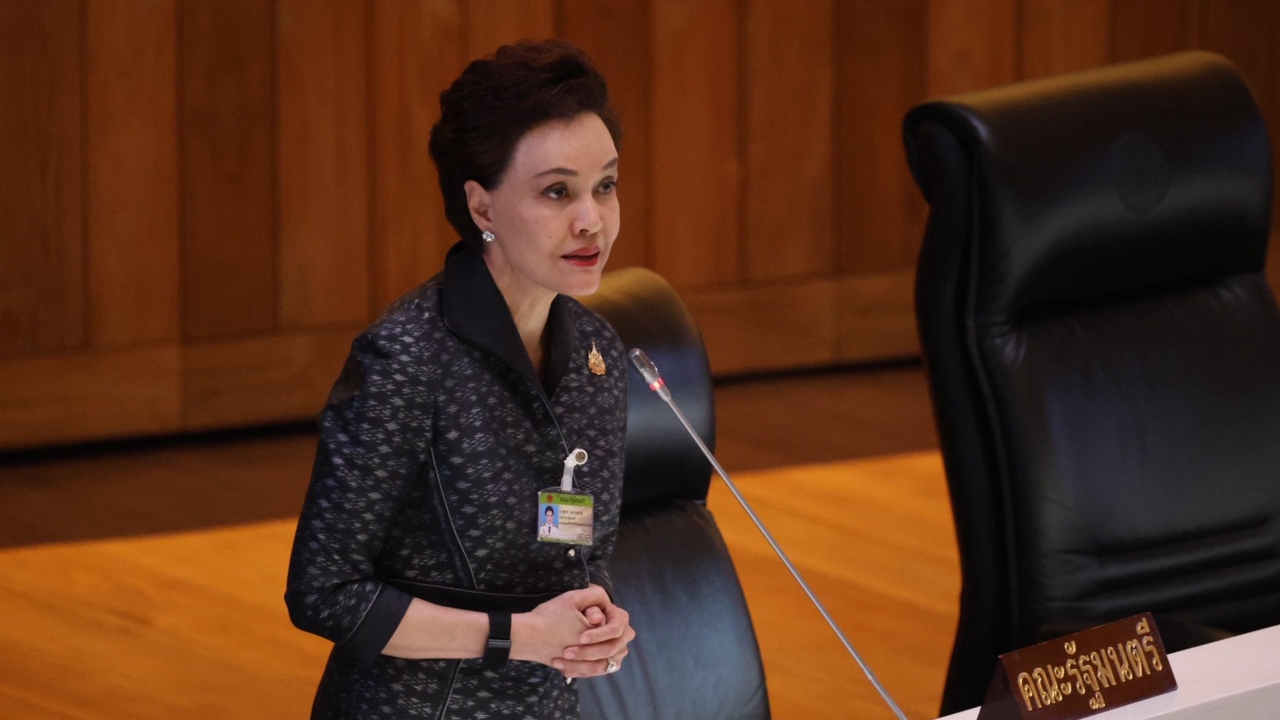
Supachai confirmed the government has not banned palm oil exports but requires permits. No fertilizer price hikes have been requested yet, but she acknowledged concerns as Thailand's supply only lasts until mid-May. She announced the launch of the "Roob Poem Poem" and "Mobile Thong Fah" projects, which will deliver affordable products and fuel cards, with details to be proposed to the Cabinet on 11 Apr 2026 GMT+7.
On 9 Apr 2026 GMT+7, at 20:25, in the meeting room of the House of Representatives, 2nd floor, Parliament Building, during the 1st joint parliamentary session (first regular session) to consider urgent matters, the Cabinet presented its policy to Parliament under Section 162 of the Constitution of the Kingdom of Thailand. Supachai Suthumpun, Deputy Prime Minister and Minister of Commerce, rose to clarify concerns raised by MPs about the government's lack of urgent policy oversight. She affirmed the government is well aware that the current crisis is complex and multi-dimensional, involving geopolitical factors affecting the economic landscape and the domestic economy, necessitating structural adjustments. The government is striving to address these challenges simultaneously.
Supachai continued that the urgent policies under her responsibility concerning cost of living cannot be viewed from a single perspective but must consider expense reduction, income increase, and opportunity distribution. The government will ensure essential consumer goods remain accessible to the public in a timely manner, including the Thai Help Thai project, which offers affordable product choices. Additionally, the government is using this opportunity to boost income by leveraging public sector mechanisms to upgrade community and SME products to meet standards such as TIS and FDA, enabling distribution through online platforms and nationwide retail outlets.
Supachai highlighted the government's past achievements, particularly the Thong Fah project, noting that for citizens in remote areas unable to access Thong Fah products, there will be the “Mobile Thong Fah” or mobile Thong Fah vehicles, along with “Roob Poem Poem” vehicles bringing products directly to communities. These will include special discounted items with reductions up to 58% and fuel cards. Details of this project will be announced after the Cabinet meeting on 11 Apr 2026 GMT+7.
Supachai also explained the Ministry of Commerce's approach to controlled goods, noting multiple measures exist. Some items are strictly controlled, while others are managed through negotiations to prevent price hikes. Managing essential consumer goods must allow market mechanisms to function reasonably and fairly for both producers and consumers, as not all matters can be strictly regulated.
Regarding palm oil, some MPs expressed concern about the Cabinet's resolution to control exports. Supachai clarified that the government has not banned exports but requires permission. The government intends to support biodiesel use from palm oil. Without controlling quantities, shortages could occur. For those worried that palm fruit prices might fall, she confirmed current prices at 8.10 baht, up from last year and on an upward trend.
On price controls for fuel, medicines, transport services, and sugar, the government employs administrative measures rather than direct price regulation, as these four items are governed by specific laws. Thus, the Ministry of Commerce's role is to ensure sales comply with announced prices. Particularly for fuel, the Ministry of Energy oversees pricing mechanisms.
Supachai addressed the domestic fertilizer situation, explaining that the only fertilizer potentially facing shortages is urea, which depends on raw materials currently hindered by transport issues. Other fertilizers remain manageable, with 64% of normal supplies still available. Therefore, the entire fertilizer market is not facing a complete shortage.
She recalled that earlier she had assured that urea fertilizer stocks would suffice until August, based on 340,000 tons in stock and an anticipated 200,000-ton import in April. However, after discussions with the Thai Fertilizer and Agricultural Business Association president, it was found that Thailand's urea supply may only last until mid-May. She considers this worrisome in terms of price and shortage risks. If urea production costs continue rising, market mechanisms will determine if price adjustments are necessary. She emphasized that no operators have yet requested price increases.
Supachai added that five fertilizer transport ships are currently stuck in the Strait of Hormuz. Deputy Prime Minister and Minister of Foreign Affairs Sihasak Phuangketkaew is negotiating with Iran to release these vessels. If these five ships are freed, Thailand’s supply situation will improve significantly.
Regarding the plastic pellet situation following the Middle East crisis, plastic pellets have been designated as controlled goods, especially concerning sufficient supply. In the future, multiple ministries will integrate into a working group to focus on and resolve the impacts of plastic pellet shortages. Additionally, alternative raw material sources will be considered.
Supachai concluded by urging parliament members to unite, stating that Thailand must stand as one. She welcomes all suggestions regardless of their source but asks for help in communicating with the public to avoid panic, encouraging awareness that change is necessary and inevitable.