

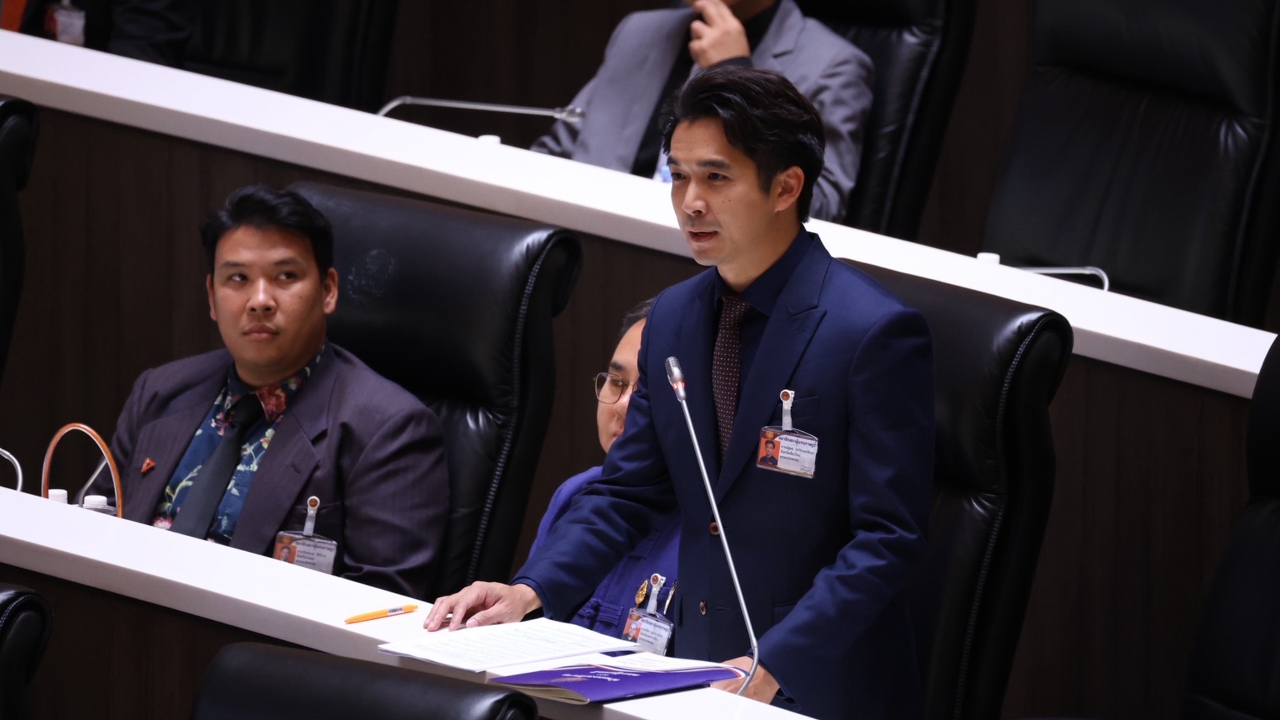
Natthapon Towijakchaikul, an MP from the People’s Party, criticized Deputy Prime Minister Anutin's tourism policy, saying it resembles old government ideas with insufficient budget allocation to local areas and misdirected spending. He emphasized the need to focus on developing regions rather than heavily investing in events that have had limited success.
On 9 April 2026, at the House of Representatives meeting room, 2nd floor, Parliament Building, during the first joint parliamentary session of the year to consider urgent matters, the cabinet presented its policy statement under Section 162 of the Constitution of the Kingdom of Thailand. Natthapon Towijakchaikul, MP for Chiang Mai district 3 from the People’s Party, debated that in the past 2-3 years, foreign tourists have decreased due to reduced appeal and lack of new attractions. Tourists lack motivation to return, while neighboring countries have better tourism performance. Data shows over 70% of tourism revenue is concentrated in just five main provinces, with the remaining 30% spread thinly among over 70 other provinces, some losing revenue share to foreign capital.
In some areas, tourist numbers are high but the cities’ capacity to support them is limited, preventing many provinces from developing tourism. Government responses have been slow, with weak control over nominee investments and delayed infrastructure development. Most budgets have been spent on event organization, investing billions in soft power initiatives, yet yielding tangible success in only a few cases.
Natthapon said the government's first policy to develop Thailand as a 365-day travel destination is fundamentally sound in aiming to spread tourism more evenly. However, the method—intended to create memorable experiences, ensure safety, and build on strengths such as health tourism, arts, culture, and traditional lifestyles combined with Thai products like tropical fruits, cuisine, spas, and GI-certified goods to add value throughout the supply chain—needs improvement.
Many areas already possess these qualities, yet they have not become true 365-day destinations. For example, Chiang Mai, his home, has health tourism, arts, culture, and food, established for a long time. The reason it cannot operate year-round is the PM2.5 dust problem. Thus, merely increasing tourism products is insufficient; obstacles discouraging visitors must be identified and addressed alongside product development for the policy to succeed.
The second policy concerns implementing compulsory travel insurance for tourists, which he supports. Recently, he saw news that a minister planned to propose a 300-baht 'footprint fee' for foreign tourists to the cabinet. The relevant law states that such fees can fund insurance for tourists. He urged clear answers from the responsible ministers on how travel insurance will be implemented, as this significantly impacts tourism.
The third policy addresses controlling nominee investments and reviewing the Free Visa scheme. Over nearly three years, these measures have not increased tourist numbers but have instead allowed gray and black nominee businesses to grow in tourist cities. The solution is to amend the Foreign Business Act to define “nominee” clearly, impose harsher penalties for such acts, and enforce these laws strictly to effectively tackle the problem.
The fourth policy involves physical development for tourism. While the official statement is not incorrect that physical development is necessary, the wording used seems to recycle old policies that should have been completed long ago. Local budgets remain insufficient, and tourism funds are not allocated effectively.
Natthapon added that if budgets were genuinely decentralized to local areas with careful attention to tourism funds focusing more on physical development than event organization—while preventing corruption, kickbacks, and domination by a few powerful groups diverting funds to their provinces—local tourism could thrive without waiting for new laws.
He said that what can be done immediately in the 2027 budget is to reform the overall budget system to enable greater decentralization and to reform tourism budget usage. Otherwise, newly generated revenues will continue to be spent inefficiently, failing to meet objectives.
The fifth policy area concerns financial measures. He wishes to see targeted relief measures specifically for the tourism sector. Operators have repeatedly called for support before relief measures were implemented. With current crises like war and rising oil prices impacting the sector, the government must provide targeted assistance to tour operators, bus, van, and taxi drivers who have already been affected by fuel costs.
Targeted financial relief for tourism operators is urgently needed. Even with initiatives like “Thai Tourism Half-Half,” many Thai people cannot afford to pay half the cost to travel. He believes relief measures aimed directly at tourism operators would better address their burdens and provide more effective support.
Regarding tourism-related laws in the policy statement, two laws are relevant: the Digital Platform Act and the Hotel Act. He understands the Council of State has drafted a Digital Economy Bill, which was pushed to cabinet under the previous government but reportedly blocked by large platform investors. Since the current government pledges to pursue this, he hopes it will remain firm and not allow interference.
The final policy is new to this government: merging the Ministry of Tourism and the Ministry of Culture. However, this merger raises several issues. The government has said no studies have yet been done and that it will take at least six months. He proposes establishing a special parliamentary committee during this session to study the matter collaboratively, as they might find better alternatives than merging the two ministries.
Natthapon concluded by reminding this government that all ministries related to tourism, according to the policy statement, are now under the jurisdiction of the Bhumjaithai Party. If they still cannot improve tourism this time, then all the extensive policies written will result only in negative outcomes.