

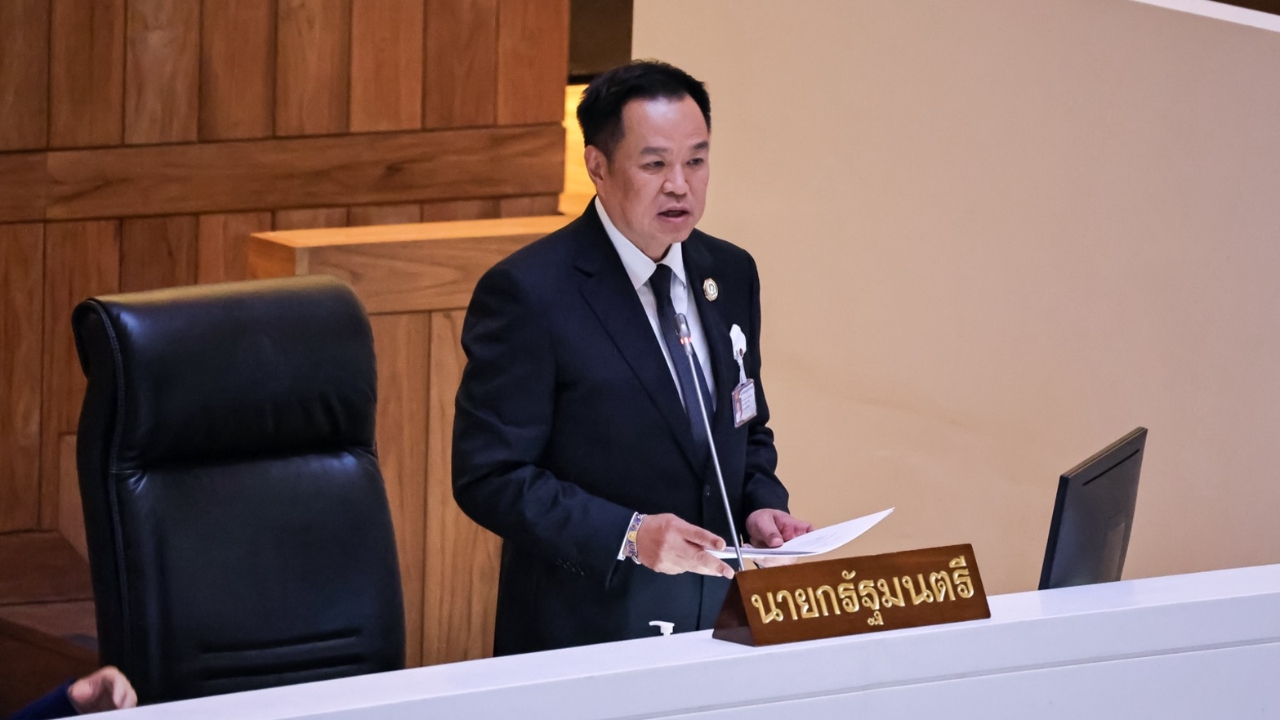
Watch live as the government delivers its final policy statement to Parliament. The opposition harshly attacks the government for failing to resolve the energy crisis and shifting the burden onto the people.
On 10 April 2026, the first joint session of Parliament (the first ordinary session of the year) was held to discuss urgent matters. The Cabinet presented its policy statement to Parliament under Section 162 of the Constitution of the Kingdom of Thailand, continuing on the final day. The session began at 08:00 and was scheduled to adjourn at 23:00.
During the first day of the policy statement on 9 April, Prime Minister and Minister of Interior Anutin Charnvirakul outlined the government's policies based on five pillars: 1. Economy, 2. Foreign affairs and security, 3. Society, 4. Disaster and environmental management, and 5. Public administration and legal reform.
Meanwhile, Deputy Prime Minister and Finance Minister Ake-niti Nitithanprapas explained that the energy issue is a global crisis. The Middle East war’s end is uncertain, potentially affecting other goods. Preparations are needed for inflation and global economic downturns. He admitted there would be no cheap oil prices for the next one to two years, as oil production infrastructure has been destroyed.
The opposition launched a fierce attack on the government's policies, especially regarding energy and the oil crisis response. Notably, Abhisit Vejjajiva, party-list MP and leader of the Democrat Party, severely criticized the Bhumjaithai government's policies as forgetting the people and campaign promises, offering no hope, and accused the government of shifting oil cost burdens onto the public.
Additionally, Isariya Paireepairit, party-list MP of the Prachachon Party, mocked the Anutin government for mentioning aid to vulnerable groups in just one line of the policy statement. He questioned whether the government felt ashamed compared to Hun Manet’s government, which reduced oil taxes to zero percent and distributed money to labor groups, managing the oil crisis better than Thailand.