

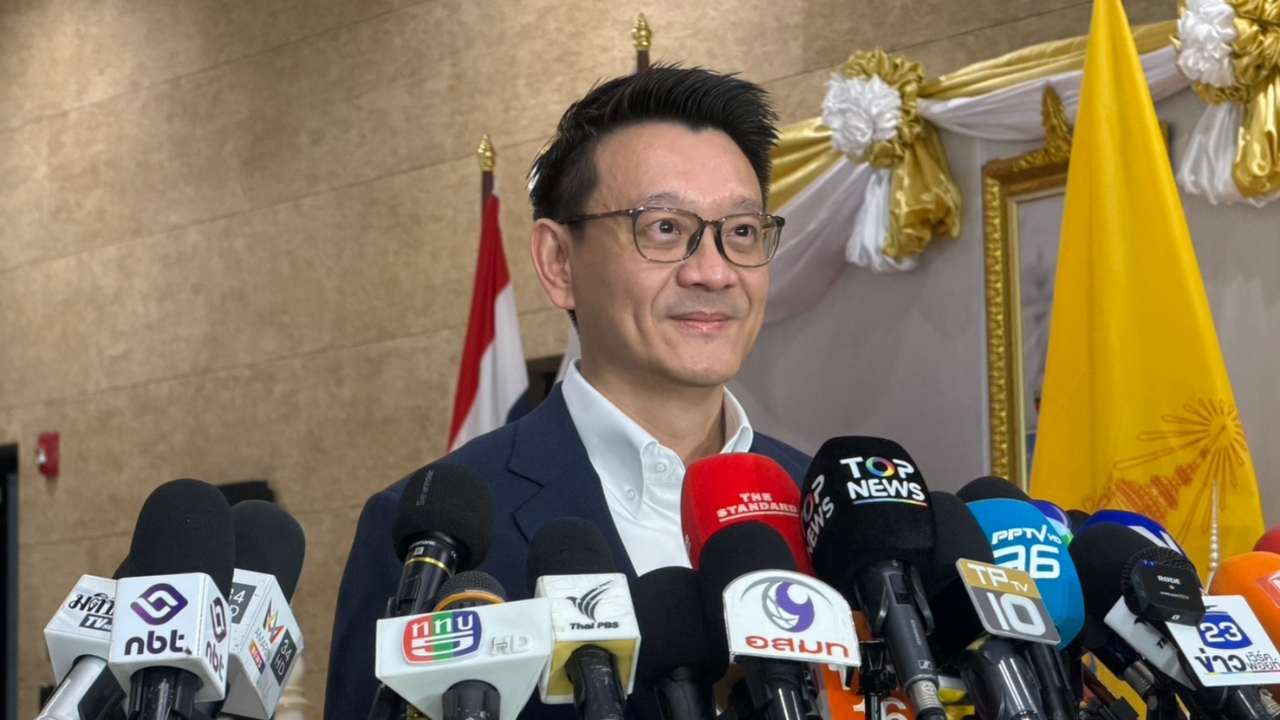
Veerayut expressed disappointment with Deputy Prime Minister Ekniti’s explanation of the oil crisis, saying it was the same as two weeks ago. He worried that Deputy Prime Minister Supajee received information from officials not present on the front lines. He urged the Prime Minister to stop trailing behind the crisis and to expedite solutions for rising prices, fearing masked individuals hoarding fertilizer.
At 08:40 on 10 Apr 2026 GMT+7 at the Parliament building, Veerayut Kanchuchat, party-list MP and deputy leader of the People's Party, spoke on how the party would respond if the government issued an Act or decree to borrow funds that might violate the constitution. He said he wanted to summarize after yesterday’s government clarifications from Deputy Prime Minister and Finance Minister Ekniti Nitithanprapas, especially on the budget transfer Act, and Deputy Prime Minister and Commerce Minister Supajee Suthamphan on agricultural and commerce products.
Regarding budget transfers, he confirmed that if the government intends to proceed, it should be done transparently through a budget transfer Act, which has been done before and can be approved by Parliament. In 2020, the process took only one week in Parliament and did not cause delays. Therefore, for transparency and to show citizens where funds are allocated, it should go through Parliament.
However, if the government opts for a loan decree, it must be clear, because budget transfers can cover only about 50 billion baht. It is uncertain whether this would delay disbursements in the current fiscal year, as many officials hesitate whether to spend or return funds to the government. He requested clear answers from Ekniti on the approach. If a loan decree is used, then a budget transfer Act becomes unnecessary.
Regarding the government’s clarifications, Veerayut said he was disappointed with Ekniti’s explanation, which was similar to what was said two weeks ago. He saw no real movement or serious actions on relief measures for various groups yet. They might have to wait until Saturday or tomorrow again, but he emphasized that people’s hardships are daily, especially fishermen who cannot go out, affecting seafood supplies that are already scarce. He urged starting relief immediately, as they have demanded for weeks.
On the government’s promise to help vulnerable groups first, Veerayut agreed with both broad and targeted aid but said the government has yet to specify which groups are considered vulnerable. He believed all Thai people are currently vulnerable amid uncertainty. Thus, the government must clearly state who will be helped and how much.
If the government issues a loan decree, Veerayut said the People's Party would have mechanisms to file a lawsuit. He reiterated that budget transfers should be done via an Act with parliamentary transparency. Borrowing is a state power, similar to during the COVID-19 pandemic, but they would seek clarity on its use. The COVID response left the country battered with higher household and public debt but no strong recovery. If another large loan of about 500 billion baht is taken, it must be justified and used for future development—such as serious skills training or supporting employment, which is already declining.
Veerayut also commented on Supajee’s explanations on various issues, expressing concern about information accuracy. For example, Supajee claimed coconut prices had risen to 7 baht, but when checked with the Office of Agricultural Economics, Ministry of Agriculture and Cooperatives, the price was still only 3 baht. He advised Supajee that relying solely on officials is insufficient; frontline data must be considered to manage correctly.
Regarding coconut processing centers, Veerayut sought clarification on what system would assist coconut merchants—whether central or community centers, or another system. He urged Supajee to follow up on frontline issues, as official figures might not match realities faced by merchants. On fertilizer, many have reported shortages. He asked the government to investigate whether fertilizer hoarding by masked individuals, similar to the oil hoarding issue, is occurring. Fertilizer prices lack transparency regarding price caps, and frontline reports indicate significant shortages, especially of essential formulas.
When asked about Supajee’s response to PM2.5 dust pollution, telling people not to go to Chiang Mai for 365 days, Veerayut said this might reflect a tourism-focused perspective. The dust issue they have consistently raised concerns residents, especially in the north, so it should not be viewed solely from a tourism standpoint but from the daily lives of people living there.
Asked if it is time for the Prime Minister to provide clarifications, Veerayut said the government, especially the PM, has been trailing behind the people too much. In a crisis, the government should lead by anticipating what will happen and preparing accordingly—leading the public by one step and businesses by one or two steps. While some actions were correct, such as the PM acknowledging the severity and need for adjustment, these came about five weeks late, as with the oil hoarding issue, which was about four weeks late. He urged the PM to take the lead in announcing the crisis perspective and preparations for the next two months. He understood that the Songkran measures had only recently been accelerated.
Regarding possible post-Songkran government measures such as lockdowns or pump closures that might affect daily life, Veerayut said the oil issue must be clearly separated between hoarding or other causes. For example, the PM recently said oil consumption dropped to about 40 million liters; this should first raise suspicion about the system and whether hoarded oil was released. He called for data verification to avoid policy planning based on inaccurate information. The hoarding issue is certainly not settled at 57 million liters. Also, over ten thousand vehicles have disappeared from GPS tracking; GPS should be installed on both boats and vehicles for real-time monitoring. This should have been done six weeks ago to ensure accurate oil data planning after Songkran.
On the People's Party appointing individuals to monitor government ministries, similar to a shadow cabinet, Veerayut said they are definitely following issues closely. Given the crisis, while the government has a war room, they also have a war room tracking each issue.
. (No translation provided) []
Regarding the National Anti-Corruption Commission filing a petition about 44 MPs with the Supreme Court's Criminal Division for Political Office Holders, and the party’s schedule for its general meeting, Worayut said the party’s general meeting is regularly scheduled for April, this year at the end of the month. He said they will reassess party restructuring depending on developments. When asked about rumors of him becoming the next party leader, Worayut said he would address that later.