

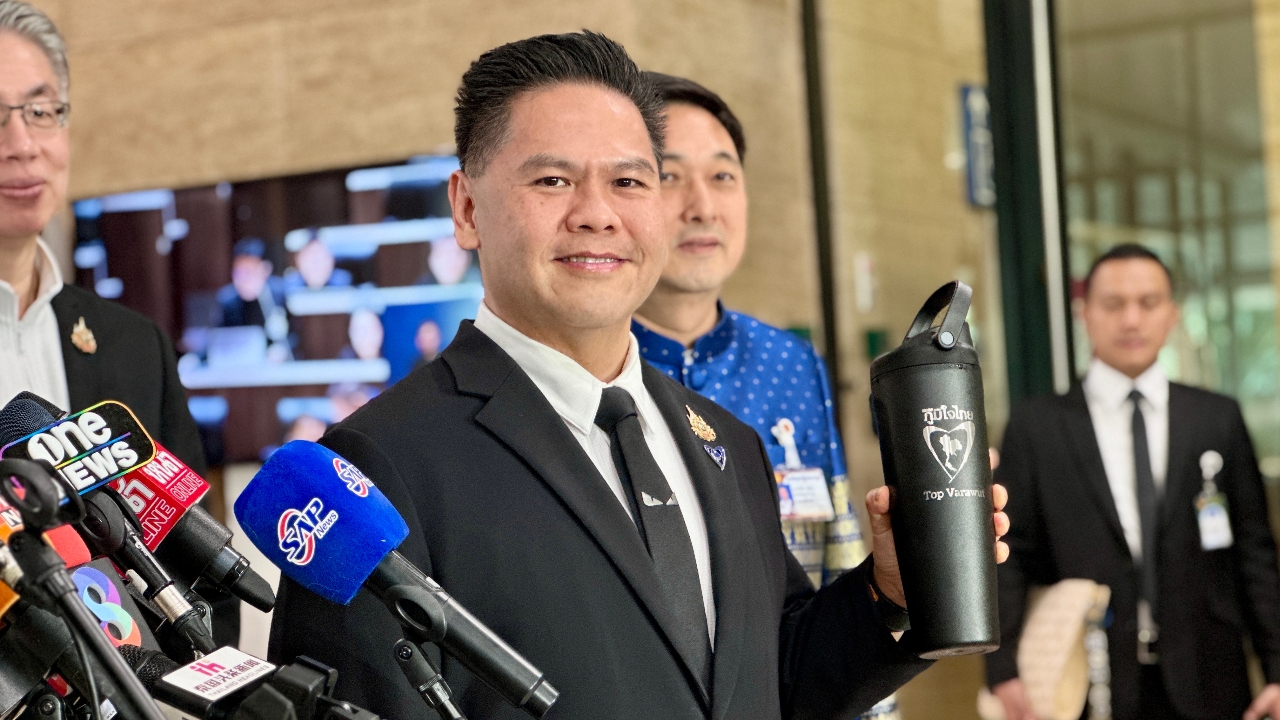
Warawut, Minister of Industry, acknowledges the surge in plastic pellet prices due to the Middle East impact, stresses that quantity and price controls are not yet implemented, and promotes campaigns to reduce plastic use and increase recycling rates before showcasing a portable water flask as an alternative.
At 10:25 a.m. on 10 April 2026 at the Parliament Building, Mr. Warawut Silpa-archa, Minister of Industry, addressed concerns from various sectors including industry, entrepreneurs, and consumers regarding the plastic pellet situation. He expressed gratitude to Ms. Supachai Sutthammanus, Deputy Prime Minister and Minister of Commerce, who invited the Ministry of Industry to discuss the matter. Currently, an inter-ministerial task force is being established, involving the Ministry of Commerce, Ministry of Industry, Ministry of Interior, Ministry of Natural Resources and Environment, and Ministry of Public Health, including agencies such as the Food and Drug Administration (FDA) and Pollution Control Department. The Ministry of Industry’s Standards Office (TISI) is also involved. This task force will investigate sources, stock levels of plastic pellets available in Thailand, and their prices. He emphasized that this is not a control measure on quantity or price but a review of upstream and midstream conditions in Thailand, including sales volumes, sources, and price comparisons with the global market.

Mr. Warawut stated that the Ministry of Industry is concerned about the public and industrial entrepreneurs, noting that the current situation in the Middle East affects Thailand’s plastic supply, causing prices to rise. Plastic pellets, bags, and various products are becoming scarcer and more expensive, ultimately placing a burden on the public.
He added that the Ministry of Industry recognizes the need for alternatives, such as substitute materials. Mr. Warawut demonstrated a black water flask he carries, noting it may be less convenient than before. However, as plastic pellets become scarcer and pricier, and transportation costs potentially increase the price of plastic and bottled water, he encouraged everyone to switch to using water flasks to reduce costs and burdens and to use other containers to lessen plastic consumption.
Mr. Warawut further stated that Thailand generates 2.7 million tons of plastic waste annually, but only 25% is recycled. Therefore, it is essential to separate waste properly, recycle, and clean it correctly to increase the recycling rate from 25% to 30–35%. This would help reduce the cost burden of imported and manufactured plastic pellets. Since plastic pellets originate from the petrochemical industry based on oil, reducing reliance on imported pellets and using domestic resources can help lessen the public’s burden.

Regarding substitute materials for plastic pellets, Mr. Warawut explained that the pellets discussed are newly produced raw materials. If not using new raw materials, recycled materials derived from Thailand’s 2.7 million tons of plastic waste, which is under-recycled, could be utilized. Reusing these materials would reduce the industry's need for new plastic pellets.
On whether more recycling plants are needed, Mr. Warawut said increasing recycling involves several factors, such as proper waste separation and cleaning before disposal. Although this may be a novel concept for Thais, many countries require plastic waste to be washed before disposal to reduce industry costs. When entrepreneurs receive cleaned and sorted waste, they need not clean or sort it further.
Mr. Warawut also noted that the Ministry of Industry plans to deliver policy directives to civil servants on the morning of 20 April, but since the Prime Minister is scheduled to present the fiscal year 2027 budget framework, he, as Minister of Industry, will instead deliver the policy directives on the morning of 22 April.