

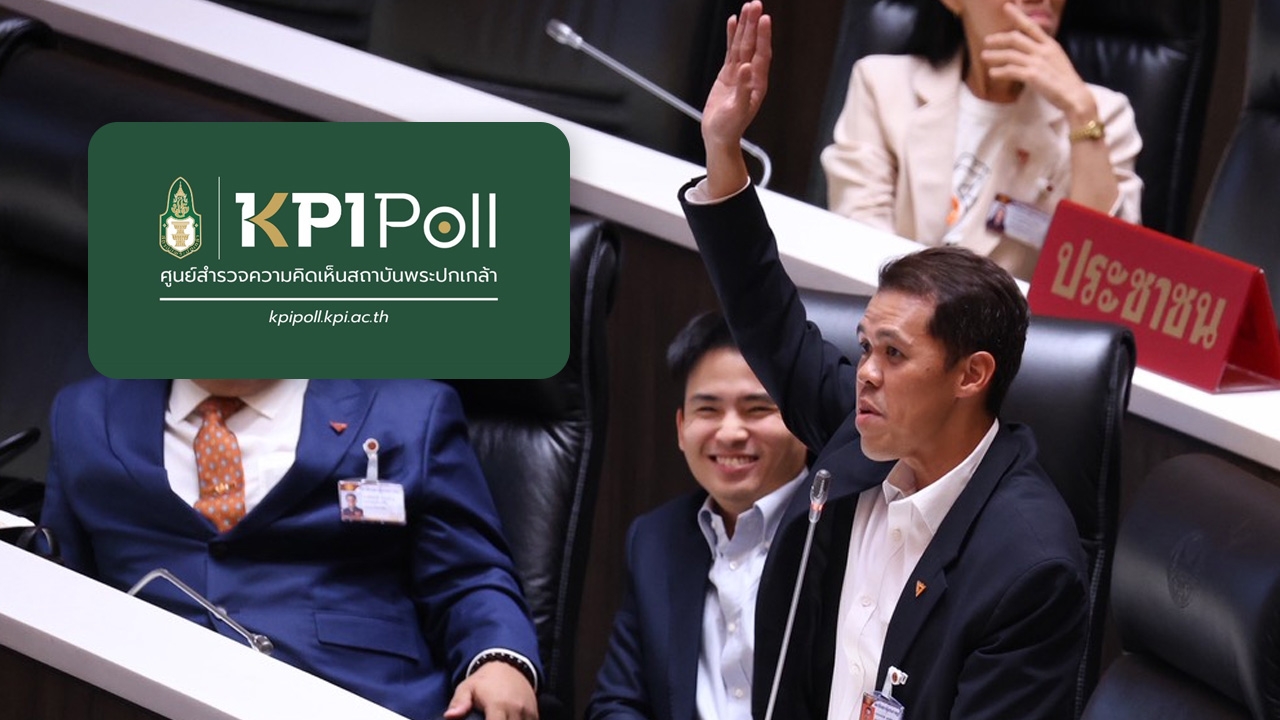
The “KPI Poll” shows that Thai people want an opposition with maturity and a government that can effectively manage challenges. They hope the opposition will act constructively by cooperating with the government on issues crucial to the nation, while still maintaining its oversight role.
On 10 April 2026, the King Prajadhipok’s Institute released a survey titled “The Role of the Opposition and Approaches to Mitigate Economic Impact Amidst the War Crisis That the Public Wants to See.” Associate Professor Dr. Issara Sereewatthanawut, Secretary-General of the King Prajadhipok’s Institute and Director of the KPI Poll Center, emphasized the key policy of KPI Poll as an academic survey designed to reflect political realities with neutrality, truthfulness, and usefulness. It upholds academic standards and accuracy, not aiming to influence politics but to listen to the political voice of the people.
The survey was conducted from 27 to 30 March 2026 among 2,000 respondents aged 18 and over, distributed across regions nationwide. The key findings are summarized as follows.
1. In the current crisis caused by war, what role do you think the opposition should play the most? (Survey conducted by Line Today)
• 43.3% want to see the opposition cooperate with the government on matters essential to the country while simultaneously conducting oversight.
• Next, 22.4% want the opposition to rigorously monitor the government to prevent misuse of power, 19.1% want clear alternative policy proposals rather than just criticizing the government, 12.5% want a temporary reduction in political conflict to help the country get through the crisis, and 2.7% are unsure.
/
➡ Nearly half of the public does not want the opposition to stop scrutinizing the government but desires an opposition with “political maturity” that is responsible during the national crisis. They expect the opposition to act constructively to help the country move forward while maintaining its role in government oversight.
2. All sectors agree on wanting a balanced opposition that does not intensify the crisis with conflict, with the South and Northeast leading.
• All regions tend to agree on wanting the opposition to “cooperate with the government on necessary national matters while also conducting oversight.” The South leads with 49.1%, closely followed by the Northeast at 44.4%.
➡ The shared expectation of the opposition during crisis is that the public wants a responsible opposition that does not create a "crisis on top of a crisis" through political conflict. Although the South and Northeast have different political support bases, they share the highest agreement on this point. This reflects that when survival is at stake, political ideology may be secondary to the desire for all parties to come together and genuinely solve livelihood problems.
Clear energy plan needed
3. Support for government measures to ease living and travel costs during Songkran leads—regional expectations vary; overall desire is for a “clear energy plan and swift cost-of-living relief.”
• 76.1% somewhat agree or strongly agree that the government should implement temporary measures during Songkran (such as stabilizing energy prices, increasing travel options, and reducing travel expenses). Meanwhile, 17.4% somewhat or strongly disagree, and 6.5% are unsure.
• The factor that most increases public confidence in the government’s handling of the economic crisis from the Middle East war is having a clear energy response plan (27.0%), followed by effective cost-of-living relief measures (23.0%), a credible and decisive economic team (17.1%), straightforward and continuous communication (16.8%), and 16.1% unsure or unable to answer.
• Breaking down top factors by region: The Northeast (34.2%) places highest confidence in a clear energy plan, while the North (28.5%) and South (27.1%) prioritize effective cost-of-living relief. Bangkok (28.8%) values straightforward and continuous communication most, whereas the Central (29.8%) and Eastern (25.6%) regions report uncertainty.
➡ Over three-quarters of the public place great importance on immediate measures that reduce living and travel expenses, especially during Songkran, when burdens increase. This reflects clear concern about cost-of-living impacts. Confidence in the government during crisis depends on demonstrating concrete management ability through clear plans and effective relief. Regional results show that while all areas share economic concerns, the specific priorities expected from the government differ by location.

/
This survey reflects that in times of crisis, the public does not want politics that deepen conflict but desires both a mature opposition and a government that can manage effectively. The opposition should act constructively by cooperating with the government on essential national matters while maintaining oversight. At the same time, the public seeks confidence in the government at both strategic and operational levels. Therefore, the government should urgently implement immediate measures to reduce living costs effectively, present a clear energy response plan, and communicate openly with society. Confidence during crisis arises only when the public sees both genuine intent and concrete administrative capability.