

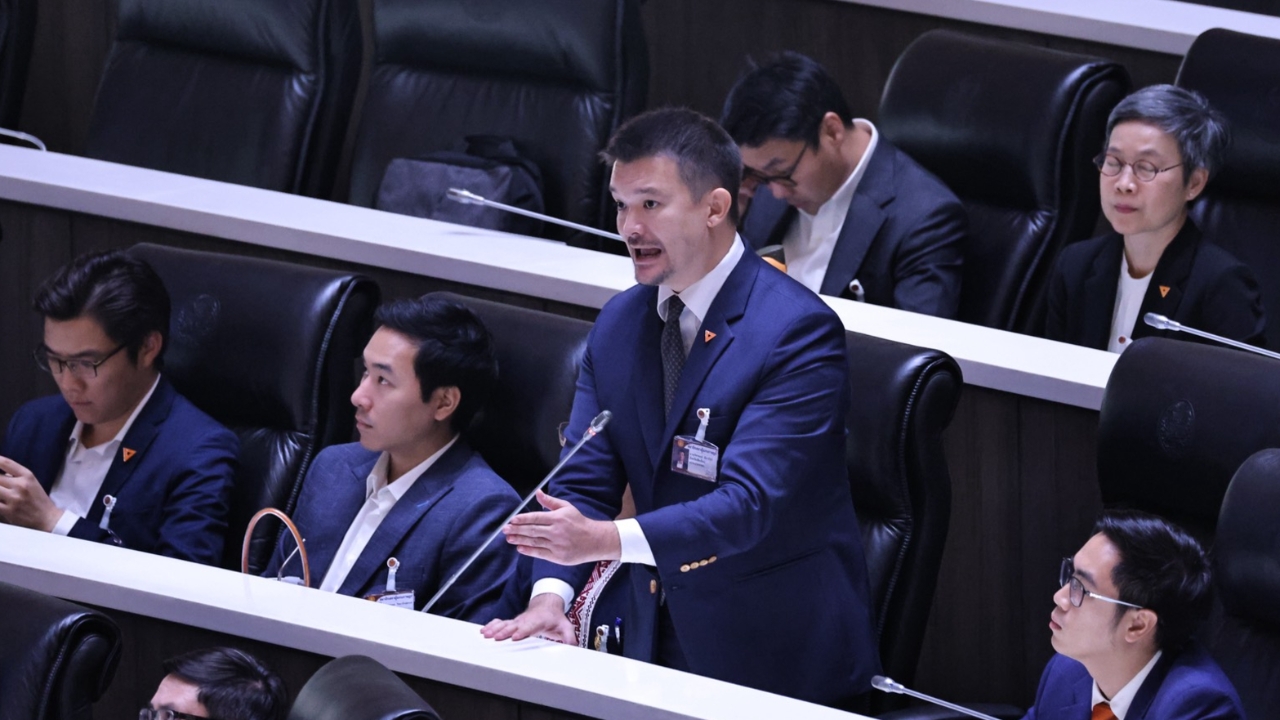
Pattharapong, Chiang Mai MP from the Prachachon Party, criticized the government for incompetence in managing disasters, PM2.5 toxic dust, and forest fires. He highlighted the failure further by pointing to the appointment of Suchart Chomklin to solve these problems and expressed disappointment that the Clean Air Act draft has been obstructed.
On 10 April 2026 at the Parliament, Mr. Pattharapong Leelaphat, Member of Parliament for Chiang Mai's 8th district from the Prachachon Party, spoke during the joint parliamentary session on the Cabinet's policy statement to Parliament under Section 162 of the Constitution of the Kingdom of Thailand.
Mr. Pattharapong stated that Thailand is currently facing four major threats: economic, social, environmental, and security challenges. However, one threat missing from the government's policy statement is the threat posed by the government's own incompetence.
He recalled that in September 2025, during the policy statement debate of Mr. Anutin, he clearly warned that pollution problems, especially PM2.5 toxic dust and cross-border water pollution, must be properly addressed within four months to minimize impact on people from late 2025 to mid-2026. Otherwise, Anutin's government would itself become a source of pollution. Today, the results show that under Anutin's leadership, the government has indeed become pollution itself. Now, Anutin has assigned Suchart Chomklin to oversee pollution control and environmental protection. Regarding the severe PM2.5 dust in the North recently, he outlined what he had advised Suchart before the crisis occurred.
First, the 2026 budget from the previous government was insufficient to tackle PM2.5, especially forest fires, with almost no allocation. He had urged the government to provide additional central funds to agencies, remove restrictions on local specifications, and complete the work by October. Suchart failed to act. When the severe problem emerged, he claimed to the media just days ago that this year's forest fires were unmanageable due to no central budget at all. This is the responsibility of the minister.
Mr. Pattharapong said that Northern residents are now enduring severe dust levels with no tax-funded budget from the government to help address the root cause of the forest fire dust.
Second, he advised Suchart to revise the pollution control area declarations so provinces could promptly prepare requests for central funding. He proposed expanding the pollution control zones from 4 to 9 provinces in the North, but Suchart ignored and took no action on this. Today, the 9 provinces he mentioned have PM2.5 levels meeting disaster criteria and have been declared disaster zones since 28 March.
The pollution control area declarations were incomplete, and the conditions in the 4 declared provinces have not improved due to government neglect. For example, Chiang Mai province, after the declaration, followed the plan and requested a 310 million baht budget before the dissolution of Parliament, but Suchart did not approve a single baht. When all mechanisms failed, leaving only disaster declarations, Suchart stated that disaster declarations would harm tourism, even though in reality, Mr. Pattharapong questioned the Tourism Minister whether tourism would not be affected if PM2.5 levels reached 500 without a disaster declaration.
Suchart also claimed that forest fires did not spread throughout the province and that declaring fire disaster zones at the subdistrict level was sufficient. However, the current issue is PM2.5 disasters affecting the entire North. The Ministry of Natural Resources and Environment itself set criteria for disaster declaration, stating that if dust levels exceed 125 micrograms per cubic meter for five consecutive days, it qualifies as a severe disaster zone. Why, then, does Suchart continue to make such claims?
Mr. Pattharapong said Suchart's chronic problem is denial of reality, as shown by ministry reports claiming Chiang Mai's dust this year is 45% better than last year, despite residents suffering nosebleeds from the dust. The government urgently needs to rethink its approach to PM2.5. Last night, Deputy Prime Minister Supachai said he did not expect the North to have tourists 365 days a year. The problem affects not only tourism but also Northern residents who cannot afford to move away from the dust. People live there all year round. If the government stood with its people, it would not make such statements.
Third, he had told Suchart to increase compensation for forest fire fighters, which remains only 240 baht per day. This issue has been raised since the Pheu Thai government but has never been addressed. Moreover, localities lack budgets and authority, causing a lack of field command. In the past 7 days, four forest fire fighters protecting the air have died. He expressed condolences and support to the families of the deceased in Chiang Mai, Phrae, and Udon Thani provinces.
Fourth, he had previously detailed cross-border pollution management, which includes not only PM2.5 dust but also water pollution from mining in neighboring countries. This covers mechanisms, international cooperation, and supply chain inspections of Thai business groups importing related goods to Thailand. Since then, he asked what progress had been made.
For example, the simplest matter: the ban on importing animal feed corn that is burned. Yet importers can self-certify using a system designed by large corporations that are themselves importers, without supply chain verification. To date, it is unknown where the imported corn is grown or whether it is genuinely unburned. The corn is sold through multiple intermediaries concentrated in certain companies. The Ministry of Commerce claimed this is a transition period and would tighten controls once the Clean Air Act is enforced. Yet the government has not advanced this legislation.
Furthermore, imports of minerals causing water pollution are unchecked, leading to rice contamination with arsenic, fish contaminated with mercury, lettuce containing cadmium and lead, and pumpkins and Thai eggplants with cadmium levels ten times above safe standards. Arsenic levels in people's bodies now exceed safety limits. We face polluted air, rivers flowing through homes, and contaminated food from inside and outside the country with no government action.
Lastly, regarding the Clean Air Act draft, political parties affirmed it must proceed, but after the election, the situation reversed. No government representatives dare to confirm support, and the draft is obstructed with arguments that charging polluters fees would raise industrial costs and hurt competitiveness. This contradicts the government's policy statement because the 'polluter pays' principle is internationally accepted, endorsed by the OECD. While the government aims to join the OECD by 2028, its actions contradict this. He asked the Prime Minister or Deputy Prime Minister responsible for the law to stop evading questions and clearly state whether the government will proceed with the Clean Air Act within 60 days or let it fail.
Mr. Pattharapong added that Thailand needs leaders who design policies to solve problems, not leaders afraid to address root causes or to make crucial decisions during crises. They do not want to see incapable individuals appointed as ministers.
He concluded that from the policy statement and Anutin's actions so far, it is clear the government does not lack power but lacks the courage to make decisions for the people's lives. The government consistently avoids problems by shifting decision-making burdens to others. In every crisis, they have never seen Anutin Charnvirakul decisively command as a leader to lead the country out of crisis even once.