

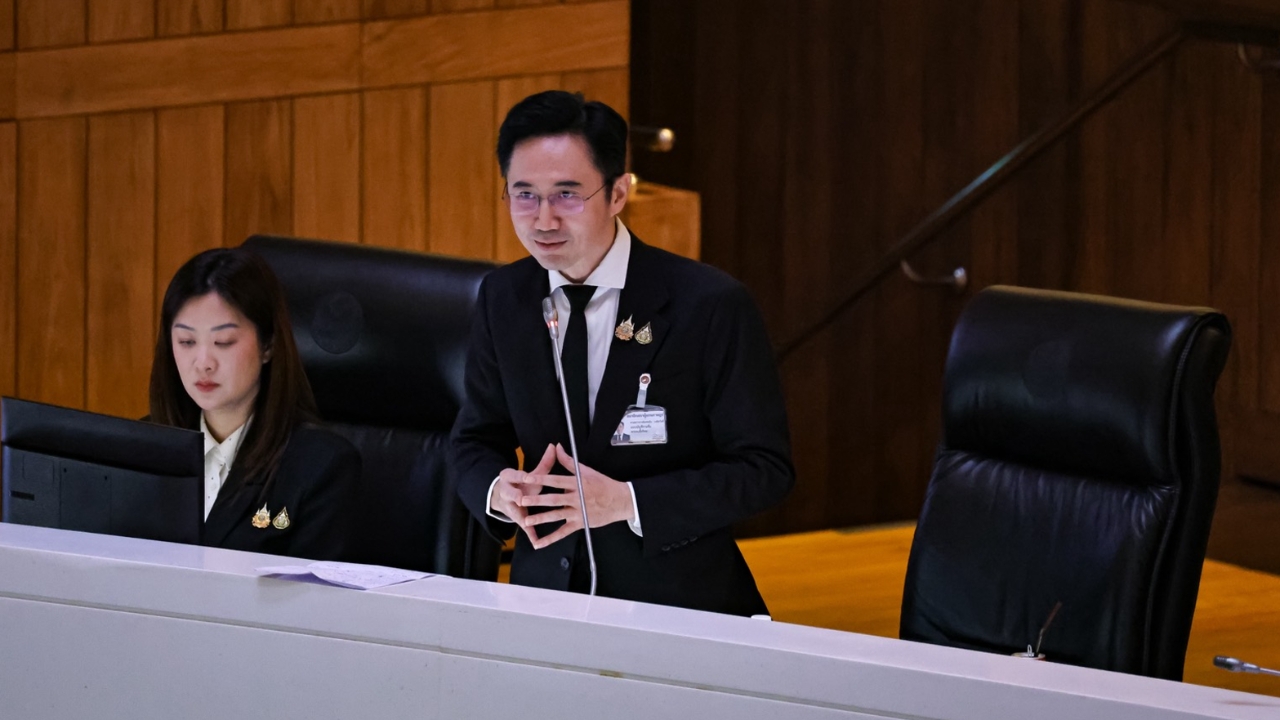
Yotsanan spoke to parliament for the first time, pledging to perform his duties to the best of his ability to develop Thailand's human capital, address inequalities in T-CAS, champion cybersecurity, build weapon sovereignty, and highlighted that all crises require timely assistance through science and technology.
On 9 Apr 2026 GMT+7, during the first joint session of parliament on urgent matters, the cabinet presented its policy statement to parliament under Section 162 of the Constitution of the Kingdom of Thailand. Sopon Sarum, the Speaker of Parliament, presided over the meeting.
Yotsanan Wongsawat, Minister of Higher Education, Science, Research and Innovation, explained that in times of crisis, it is essential to use science and technology to provide timely assistance. This process is already underway, and it is expected that current capabilities and limitations will become clear. Areas that are lacking or ineffective will be acknowledged and improved.
Regarding policies to elevate science, technology, and innovation for a high-value economy, it is necessary to link these with foreign policy, society, environment, disaster management, and public services. Fully developing science and technology will serve as a backbone to propel the country forward.
As for Thailand's innovation prospects, innovation arises from in-depth research and existing private sector assets. Thus, converting research into innovation requires connecting technology from upstream to downstream. This can be supported by budgets from the Ministry of Higher Education, Science, Research and Innovation, co-financed by the private sector and investors. Intellectual property-wise, the private sector will purchase research-based intellectual property, so it is essential to promote opportunities for researchers to earn income fairly, encouraging collaboration between thinkers and practitioners.
Regarding innovation leading to the economy, priority must be given to grassroots people while preserving technological sovereignty. The health economy will be emphasized, aiming for Thailand to become number one. Productivity of existing economic engines such as agriculture, industry, and services must be increased. High-value agriculture and services like Thai herbal products, food security, and future foods will be prioritized, along with upgrading medical device industries and using cell and gene therapies for incurable diseases such as thalassemia, Parkinson's, and cancer.
On security policy, the goal is to achieve sovereignty in weaponry and military equipment. The Ministry of Higher Education, Science, Research and Innovation will collaborate with the Ministry of Defense to ensure public safety. Cybersecurity must be linked with quantum communication technology, a new area requiring attention. Additionally, Open Data must be successfully implemented to advance digital government, promote Green Energy Technology, Net Zero Technology, and use technology for disaster prevention.
Yotsanan added that universities will be transformed in all dimensions, accepting everyone from early education through the elderly for upskilling and reskilling. Alumni can also return to study. Efforts will focus on reducing inequality and improving the quality of the T-CAS system.
“I will perform this role to the best of my ability to develop Thailand’s human capital, using science and technology as the hope for the Thai people.”