

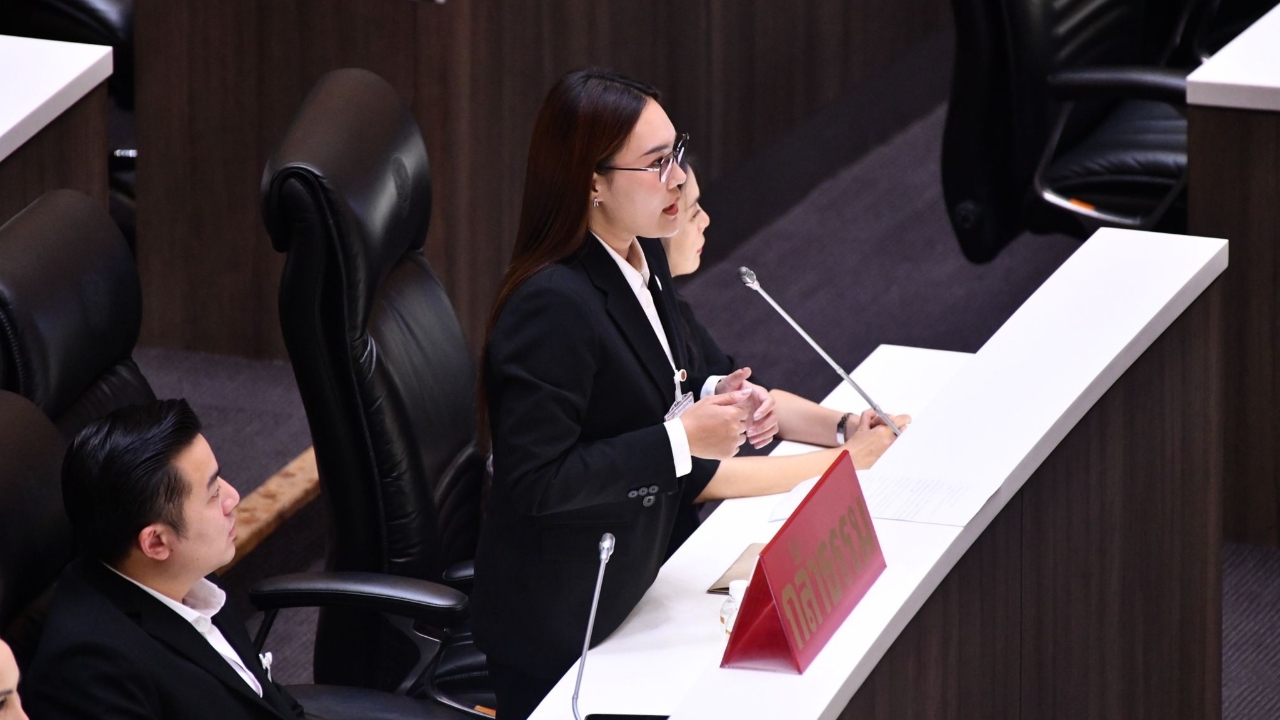
Suphanan, Chiang Mai MP from the Kla Tham Party, pointed out that mountain communities lack access to electricity, roads, and internet. While government policies are good, they have yet to reach marginalized populations. She urged urgent expansion of basic infrastructure, upgrading highways, and care for the elderly to address these issues. Tags: [infrastructure, rural development, government policy, Chiang Mai, electricity access, road safety, elderly care]
At 14:00 on 10 April 2026, during a parliamentary session reviewing the government's policy statement, Ms. Suphanan Panyathip, Chiang Mai Constituency 6 MP from the Kla Tham Party, discussed the challenges faced by residents in remote areas—especially in Phrao, Chiang Dao, Wiang Haeng districts and parts of Chai Prakan district—who still lack comprehensive access to electricity, water, roads, and communication signals. While many government policies are positive if implemented effectively, many citizens remain without access to basic services mandated by the constitution, particularly electricity, which is essential for daily life and learning.Tags: [parliament, government policy, rural access, Chiang Mai, basic utilities, constitutional rights]
Ms. Suphanan stated that policies such as free education, guaranteed employment, and learning anytime, anywhere will be difficult to realize if many villages still lack electricity or rely solely on insufficient solar power. Additionally, the absence of reliable telephone and internet signals hinders children in remote areas from effective online learning. She also questioned the health insurance policy allowing treatment anywhere, noting that while the idea is good, the reality in mountainous and remote rural areas remains challenging due to damaged and unsafe roads, affecting travel for residents and emergency patient transfers.Tags: [education policy, rural internet access, health insurance, transportation challenges, emergency care]
Ms. Suphanan cited Phrao District, nearly 100 kilometers from Chiang Mai city, where in 2024 the district hospital's ambulance was involved in two accidents on the Chiang Mai-Phrao road, resulting in deaths among patients and medical staff. She also highlighted Highway 107, the main route for Chiang Dao, Chai Prakan, Fang, and Mae Ai districts, which has many hazardous spots. In an emergency in January 2026, Mae Ai Hospital coordinated with the Sky Doctor team from Maharaj Nakorn Chiang Mai Hospital to airlift a patient, reducing travel time from 4–5 hours to just 45 minutes for timely treatment. Furthermore, Highway 1322, connecting Wiang Haeng and Chiang Dao, is currently deteriorated with multiple damaged sections. She called on the government to expedite infrastructure development to ensure residents can access medical care effectively.Tags: [road safety, ambulance accidents, emergency medical services, infrastructure development, Chiang Mai districts]
Regarding the policy to enhance healthcare services using medical AI, Ms. Suphanan acknowledged its importance for the future but stressed that the government must not overlook the limitations of remote areas, including the elderly, children, and vulnerable groups who still lack the necessary equipment, technology, and supporting infrastructure.Tags: [healthcare technology, medical AI, rural healthcare, vulnerable populations, infrastructure gaps]
On policies for caring for the elderly and vulnerable groups, Ms. Suphanan proposed that the government allocate budgets to train family members alongside establishing volunteer nurses in villages to provide continuous care for the elderly and patients, since families remain the primary caregivers after official working hours. Regarding the idea of setting up drug rehabilitation centers in every district, she suggested implementing screening systems for users prior to treatment to assess condition severity and treatment suitability. She also recommended enhancing security measures, such as assigning administrative officers or police to provide 24-hour supervision, ensuring community safety.Tags: [elderly care, community nursing, family training, drug rehabilitation, security measures]
“I hope the government will develop infrastructure in all areas so that citizens can equally access utilities, public services, and benefits, making the policies announced truly effective for everyone,” Ms. Suphanan concluded.Tags: [government development, infrastructure equality, public services, policy effectiveness]