

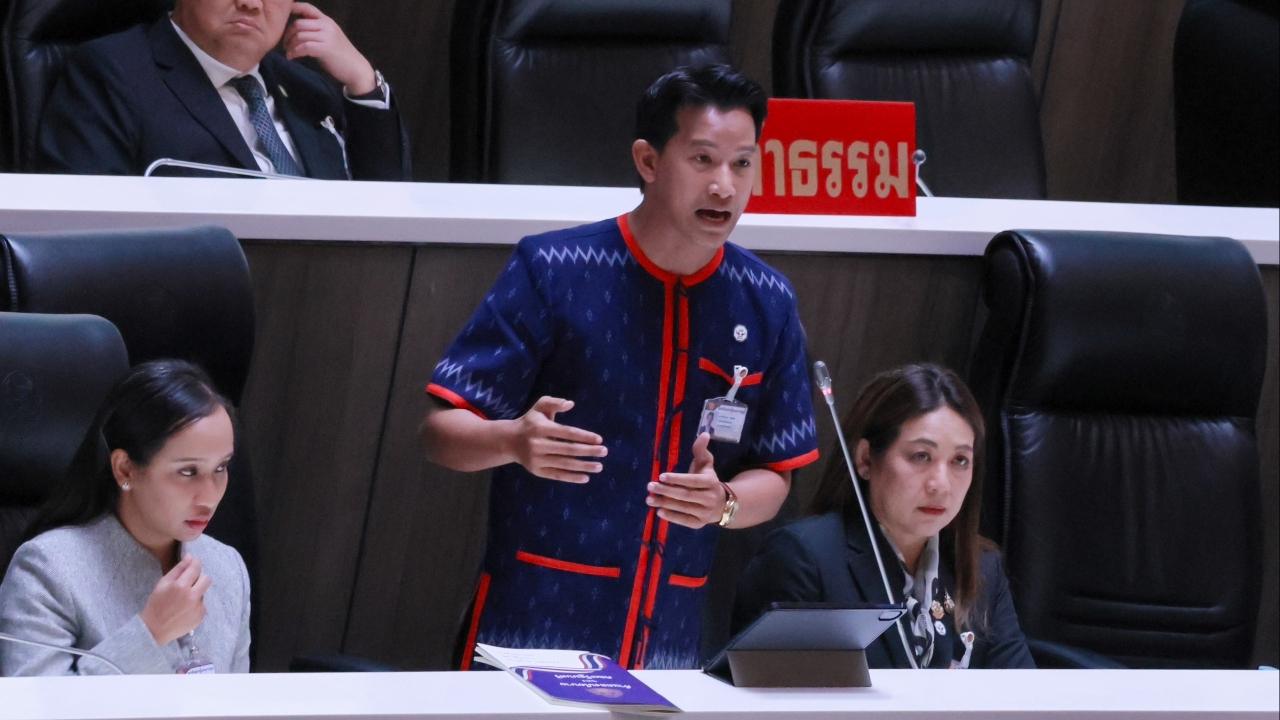
Siraphop urges the government to follow Thammanat's example by using the 'Kwan Phayao Model' as a solution to revive Nong Han Lake, criticizing the government's agricultural policies as "superficial but failing to address root problems."
At 20:00 on 10 Apr 2026 GMT+7, during a parliamentary session to consider the government's policy statement, Siraphop Somphon, Member of Parliament for Sakon Nakhon from the Kla Party, fiercely criticized the government's agricultural policies, stating he felt "disappointed." He explained that the government's proposals were full of grand terms such as AI, big data, smart farming, and global market integration but failed to address the fundamental problems that farmers face in their daily lives.
Siraphop said that many small-scale farmers still lack farmland, water sources, and capital to sustain their livelihoods, while being trapped in debt. Yet, the government continues to apply the same old debt relief policies—debt suspension, extension, and liquidity injection—that are only short-term measures, not sustainable debt solutions.
"The key question is not whether the government can act, but whether it dares to act, because solving the real problems requires addressing structural issues and confronting powerful vested interests," he said. Siraphop added.
He pointed out that the real production costs for farmers—including seeds, chemical fertilizers, and fuel—are heavy burdens, yet the government focuses more on selling prices than on farmers’ actual living costs. He criticized the government's blanket assistance policies as "one-size-fits-all." This approach represents a failure in policy design because farmers in different areas face completely different conditions.
Siraphop highlighted the problems in Sakon Nakhon province as a reflection of structural failure, especially around Nong Han Lake, where many locals still lack land titles despite having settled and farmed there for generations. The royal decree designating the forbidden zone around Nong Han, enacted in 1941, had a five-year framework to resolve the issue, but after 85 years, the problem remains unresolved, turning original landowners into perceived state trespassers.
"People have waited for land titles until they've died and been reborn twice. This problem is not unique to Sakon Nakhon but occurs nationwide. The government must be sincere and not let people wait for hope for decades more," he said. Siraphop stated.
He also addressed the problem of weeds covering over 77,000 rai in Nong Han, noting that the state spends tens to hundreds of millions of baht annually on removal but fails to create added value. He proposed lifting urban planning restrictions to promote fertilizer factories using these weeds, which would reduce farmers’ costs in the area.
Siraphop called on the government to advance the “Cheewathamwet Nakhon” project to develop Nong Han Noi as a health tourism center in upper northeastern Thailand. Although the project received an initial budget of 50 million baht, it has been frozen due to political changes.
Furthermore, Siraphop proposed that the government adopt the 'Kwan Phayao Model' to solve the Nong Han problem. He said that if the government does not know where to start, it should consult Lieutenant Colonel Thammanat Prompao, who successfully promoted Kwan Phayao's development, generating income and stimulating the local economy.
"Thailand does not just need a government that talks and acts, but a government that acts without mistakes, because those who bear the consequences are not the government but the people," Siraphop concluded.