

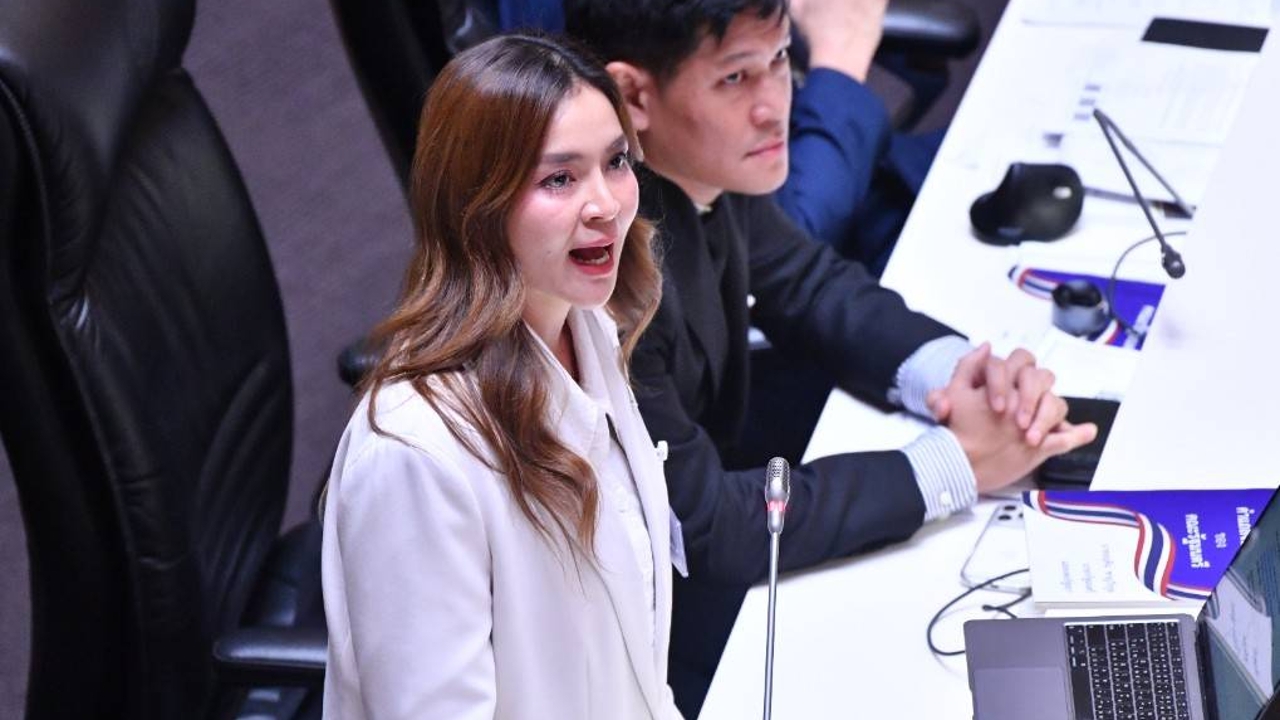
Panida called on Anutin to draft a new constitution, condemning the government’s disregard of the 21.6 million referendum votes. She declared that the People’s Party does not place its hopes on the government and is already moving forward to submit a section-by-section constitutional amendment bill to Parliament, and she urged action without delay.
On 10 April 2026, Ms. Panida Mongkolsawat, Member of Parliament for Samut Prakan’s 1st district from the People’s Party, spoke during the joint parliamentary session on the Cabinet’s policy statement. She said that after the polls closed on 8 February 2026, the referendum results clearly showed that over 21 million citizens voted in favor, sending a strong message to all of us here—both MPs and Senators—that enough is enough with the 2017 constitution and its old rules. This 21.6 million vote count is twice the People’s Party’s party-list votes and importantly, exceeds the “yes” votes by 5 million. Therefore, there is certainly support from voters who chose coalition parties. This is not just a partisan issue; the mission to open the door to drafting a new constitution is a crucial national agenda and the responsibility of all of us.
But why is this issue not significant enough to be mentioned even once in the government’s policy statement? Or that Prime Minister Anutin Charnvirakul does nothing about it? This proves that Anutin and his circle directly benefit from the 2017 constitution.
No government elected by the people has ever held such power over all institutions before. Those who determine the country’s direction mostly come from the same political network—the Cabinet, MPs, especially Senators who have the power to select institutions that oversee state authority, such as the Constitutional Court and independent agencies. All of these have become a uniform group. Those benefiting from this constitution also include the Election Commission (EC), which manages elections in ways contrary to public expectations without fear of public scrutiny, because the 2017 constitution does not grant the people the power to remove EC commissioners or other independent agency members. Ms. Panida also said,
Furthermore, the State Audit Commission (SAC), which has absolute authority to audit every baht of public funds across all government organizations, has never taken responsibility over the collapsed SAC building incident. Under this constitution, which allows independent agencies to oversee each other, those responsible cannot be held accountable. The nine Constitutional Court judges can decide the fate of political parties by ordering their dissolution and disqualifying elected politicians, wielding a judicial sword of ethics that has removed two prime ministers. At the same time, it legitimizes the power succession of the military junta and its political affiliates, serving as a potent tool for those holding a “second license” to decide who deserves to be politicians or ministers under this regime.
Most importantly, those who benefit from the current constitution are the government itself, because the constitution states that the state will provide public services to varying degrees, with citizens only as recipients of rights rather than full claimants. Citizens thus lack full rights to demand. These groups tend to act against principles, ignore public opinion, and speak without regard for the people. Is this the true face of those who fully benefit from this constitution? This is why Anutin refuses to listen to the people’s voice expressed through the 8 February referendum.
The People’s Party MP added that she does not place all her hopes on the government. The party is not idle. At present, Mr. Parit Wacharasindhu has already submitted a section-by-section amendment bill concerning the origin, powers, and removal of independent agencies to Parliament. Given recent election management by the EC that has seen transparency index scores fall to the bottom worldwide, which even Anutin cannot accept, the responsible independent agencies remain detached. She hopes members who have expressed support for section-by-section amendments will join in voting to approve their proposals.
The key question today is: what will be done about the Thai constitution? Will the previously jointly considered draft be revived within 60 days to set up a new committee, or will the Cabinet propose a new draft to be considered alongside the Pheu Thai Party’s draft? What will the procedure be? She challenges the government to stand up and confirm, after coming this far, what the new constitution’s content will be.