

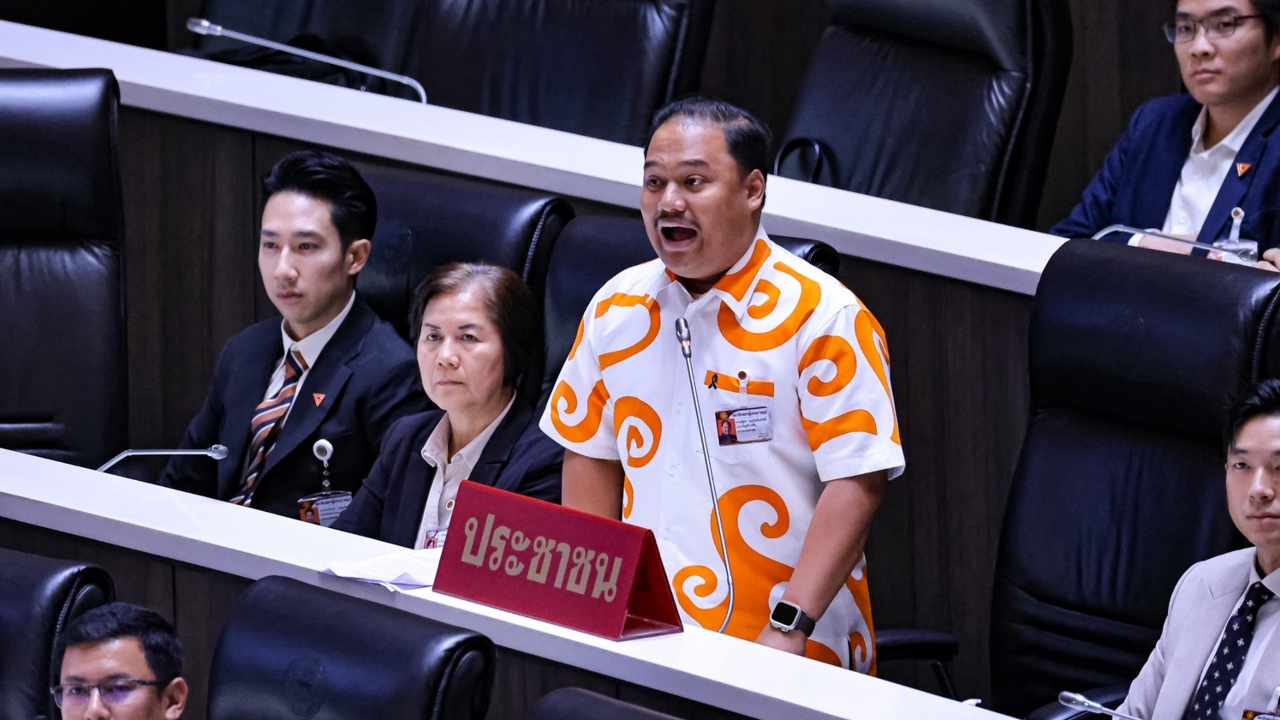
Nattacha criticized the Bhumjaithai Party, asking whether it will abandon the 21 million votes demanding constitutional reform. She mocked the appointment of the Minister of Transport to oversee energy affairs, comparing it to sending a starving tiger to guard a meat chopping block. She accused the government of fixing prices to benefit profiteers, while sweet-talking voters during campaigns. Now that the government has started, the people have had enough and cannot endure any more bad luck with this prime minister.
On 10 Apr 2026 GMT+7, at the Parliament Building during the first joint parliamentary session for urgent matters and the cabinet's policy statement, Nattacha Boonchaiinsawat, a party-list MP from the Prachachon Party, rose to debate. She said that after listening to five policy statements, if one closed their eyes, this time seemed well done with a hopeful future. Listening with eyes closed was pleasant and felt promising, but opening them to see the same prime minister ruined credibility. It raised doubts whether the good-sounding words could become reality. She recalled that if working required a four-month internship, she had supported that last term. But this time, it was like an intern who gave up halfway after two months, doing nothing. The assigned tasks per the MOA were not done. Even the simplest task—controlling votes in both houses—was not achieved. She thought the prime minister should be highly skilled at this, but ultimately failed.
Nattacha continued that perhaps the prime minister thought these issues were only what the Prachachon Party wanted, not necessarily what the public desired. But today, the people's voice is loud and clear nationwide—21,621,638 votes—demanding a new constitution, calling for change and reform. This is not just opposition voices but from all parties and Thai citizens. Yet the prime minister hears only the faint whispers from some in Buriram and leads the country according to his own will. How can the nation move forward when at the start of work there is not a single word about realizing the demands of over 21 million people? She asked for a chance to speak a little and for a better start to work before the night ended.
Nattacha added that the prime minister's character appeared untrustworthy. Among the policy statements was one aiming to increase food security and make Thailand the world's pantry, known for diverse food security. But did the prime minister know that people aware of this policy were alarmed? Today, the black-chinned tilapia is devastating rivers and canals, wiping out native fish species. How would the prime minister lead a policy to make Thailand the world's pantry when local waters are being eaten away by this destructive pest?
Nattacha further said that the promise to create volunteer nurses sounded good but questioned its political feasibility. Political analysts noted that past efforts used volunteer networks to facilitate political missions. She did not disparage this, but if the intent was to truly care for people's well-being, the prime minister should look at existing professional nurses under the Ministry of Social Development, which are already insufficient. Instead, the government is renaming and elevating the program within its own ministry with new policies that seemed politically motivated. Such management appeared to exploit crises and people's suffering to enrich insiders. The prime minister and those around him have a talent for turning crises—like people starving—to opportunities for their allies to get rich. During the COVID-19 crisis, when he was Minister of Public Health, mismanagement of masks and vaccines led to a tragic disaster. Now, the high oil prices have become another trigger blocking progress.
Nattacha stated that the prime minister’s management style damages public trust and confidence in the country's top leader. She pointed out that when shootings occurred in the east, the next day Thailand and Asia were thrown into chaos, yet the prime minister had done nothing—indicating a crisis. Upon starting work, she was shocked to learn that while there is an energy minister, the prime minister appointed the transport minister to oversee energy. How would the public feel? It is like sending a hungry tiger to guard the meat cutting block—an extremely dangerous situation. Much was spent during the election, and the hungry tiger drooled as it took charge. How can the public trust that this will resolve the crisis? Furthermore, appointing an oil expert to manage the problem, then immediately imposing price caps, was ineffective. Soon, prices were held artificially, allowing profiteers to hoard supplies and exploit the public. Then prices were deregulated, benefiting the profiteers most. The public asked if basic goods' prices could be controlled first. The prime minister and commerce minister declared prices must be held steady, but in reality, food prices soared with only reactive management.
Nattacha said the prime minister today cannot control oil prices or food prices. The only two things he controls are the sternness of his facial expressions and his unwillingness to answer citizens' questions. After three days of silence, his hearing appears impaired. The public loudly points out that there are hoarders of oil, but he stubbornly denies it. If the justice minister were present, she would commend his straightforward work, as he revealed 57 million liters of hoarded oil were found. The prime minister admitted he knew this a day earlier but did not disclose it. So when he said there was no hoarding previously, what does that mean? Or is his management style to lie to the public today about what was said yesterday?
Nattacha asked how the country can move forward when the nation's leader lacks credibility and trust. The public questions how this management style has bogged down Thailand from day one. Another habit is blaming others: in the southern floods, the prime minister, as Minister of Interior responsible for the Department of Disaster Prevention and Mitigation, delegated responsibility to the Minister of Agriculture, who was not even in the south but had to fly from Phayao and wander around for some time. How can progress be made under such circumstances?
Nattacha said that the oil crisis was also mismanaged by blaming the wrong people. These issues explain why the first day of work was so poor. She offered three recommendations to the prime minister: urgently adjust his character to align with public needs; quickly restore credibility by reshuffling the cabinet to remove those undermining trust and clearly demonstrate who has knowledge and ability; and then begin working efficiently rather than making empty promises on campaign stages to "say and do."
She concluded, “Today, you say you 'say and do,' but once in power, you say and break everything. During the election, many MPs heard the public say that the sweet campaign phrases must be included in the policy statement to become real. Enough, enough—we are already too rich. The people were happy, hoping to share in that wealth. But at the start of the new government, the people say enough, enough—we have suffered terribly already with a prime minister like this.”