

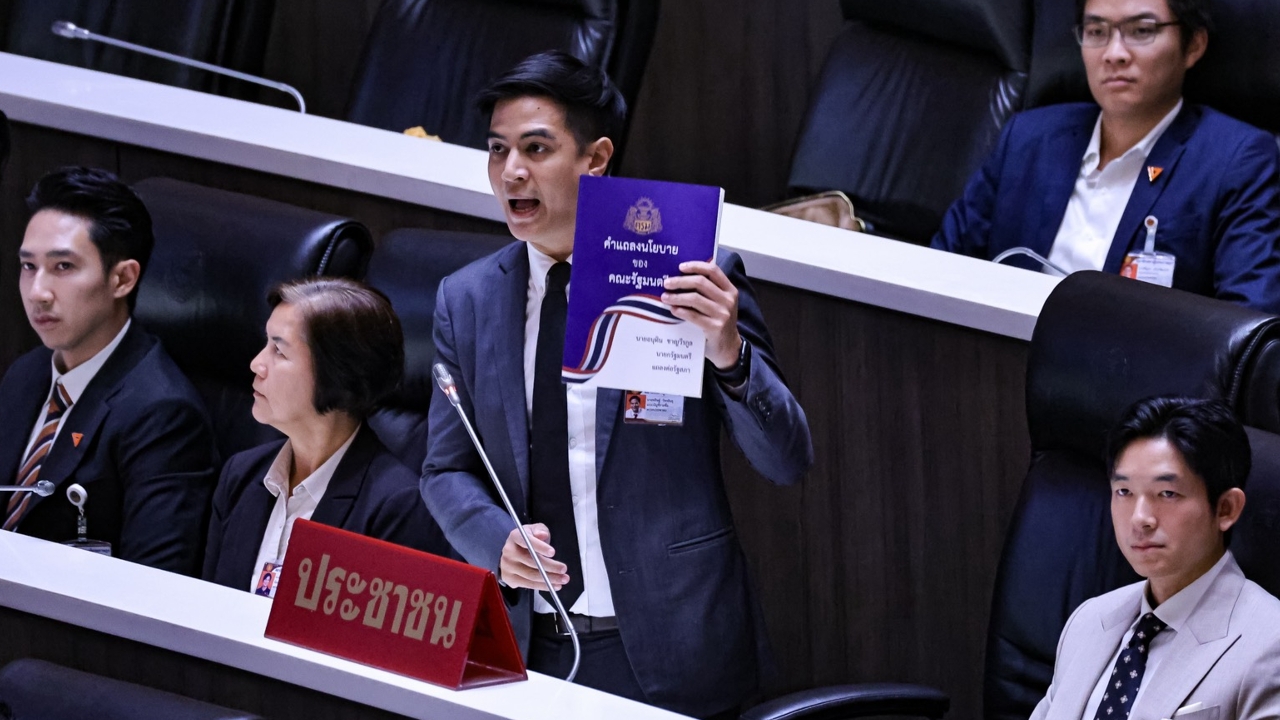
Pita pointed out that the government's policies reflect the image of a "contractor government" facing potential blacklisting due to contract breaches, delayed deliveries, reduced specifications, task shifting, and corruption allegations. The government tries to project an image of "talk and act" but does not specify what it will do.
On 10 April 2026, during a joint parliamentary session to hear the government's policy statement, Pita Wongsinsin, a party-list MP from the People’s Party, summarized the government's policies from his party’s perspective. He noted that amid global crises threatening Thai lives, people expect the new government to solve problems from day one. This should not be difficult since the government is not entirely new, retaining the same prime minister and core team, with only some coalition partners changed.
Assessing past performance, especially crisis management during the caretaker period and policy explanations over the past two days, this government has not appeared professional to the public. Instead, it resembles a contractor government about to be blacklisted. According to procurement law criteria, there are at least five behaviors matching what this government is doing to the people, including:
1) Breaching contracts. During the prime minister selection, much effort was made to maintain the image that Bhumjaithai Party "talks and acts" by not specifying what policies or plans would be implemented, only boasting patriotic claims. The party submitted only eight policy points to the Election Commission (EC). Yet, even with limited promises, the Bhumjaithai government appears to have breached its promises from day one.
For example, the electricity tariff reduction promised to the EC was 3 baht per unit for the first 200 units for every household nationwide. However, the Energy Minister later admitted the policy would apply only to about half the households using less than 200 units. Worse, this change was not even written in the policy statement.
Regarding the constitution, before the election, the cabinet decided to ask the public nationwide whether they wanted a new constitution. Although over 20 million people responded affirmatively, their voices seemed insufficient to be included even as a single line in the 19-page policy statement.
Regarding appointing professional ministers, Bhumjaithai stated in documents to the EC that this meant ministers with relevant knowledge and experience. The prime minister might argue this was not broken since only three names were submitted to the EC and all were appointed as deputy prime ministers. However, the public would not object if more qualified ministers were appointed. What citizens want is a cap on refinery and oil prices, not a limit on the number of knowledgeable ministers.

2) Delays, missed deadlines, and neglecting crises causing damage. The policy statement mentioned three times that the world is highly uncertain. Whether this is an excuse for breaching some policies remains to be seen. This excuse is only valid if the prime minister responds swiftly to crises, but in reality, he often lets the country suffer without prompt action.
In the energy crisis, the government often lags behind problems. When fuel stocks started running low at gas stations, the prime minister waited weeks before ordering oil traders to report daily stock levels. When citizens demanded investigation of oil hoarders, the prime minister denied it and accused citizens of hoarding. When asked about implementing windfall tax measures, the government claimed it was still studying, although the Finance Ministry completed studies in 2022.
What is most unforgivable is that when problems affect citizens, the prime minister is slow and lethargic, but when issues affect himself, he acts swiftly. For example, the decision to raise diesel prices by 6 baht in one night on Wednesday, 25 March 2026, was reportedly to protect himself from parliamentary scrutiny. The government seemingly planned carefully to wait until parliament adjourned before announcing the price hike, preventing lawmakers from questioning the next day, as the parliamentary chair did not schedule a meeting, despite weekly Thursday sessions.
Meanwhile, the government made no plans to protect citizens suffering from higher fuel prices. The relief plan for vulnerable groups, announced only hours before the price hike, has yet to deliver any funds to the public two weeks later. Yesterday, the deputy prime minister presented the plan again in parliament, stating a special cabinet meeting would approve measures tomorrow. The question is why the caretaker cabinet, which had constitutional authority, did not act earlier. Claims that approval from the EC was needed are unconvincing, as the EC would have no reason to reject.
Additionally, the government ignored foreseeable crises, such as the PM2.5 pollution in the North, known to peak from March to May. The government took no preparatory actions, leading to a worsening situation. Masks and dust nets were not provided, and budgets for firefighting equipment and welfare remained insufficient, as in previous years.
3) Reducing project specifications. Although the prime minister often tags policies with “Plus,” many actually warrant an asterisk. Numerous policies hide details that fall short of targets or social expectations advertised.
For instance, agriculture policy: the minister claimed coconut prices ranged from 7-10 baht per fruit, but ministry websites reported only 3-5 baht. The planned central coconut collection points were scaled down to community-level hubs. Fertilizer supply timelines kept changing. Although the deputy prime minister insisted fertilizers were price-controlled without increases, farmers nationwide reported higher prices and shortages.
Regarding disaster management, during the campaign, the DE Minister promised a disaster insurance fund paying 1,000 baht insurance premiums per household nationwide and compensating 100,000 baht per affected household. However, the current policy statement lacks figures, raising doubts whether compensation will reach the promised amounts.
4) Shifting tasks, acting like middlemen passing work on, avoiding responsibility, possibly just waiting for kickbacks. Border crises are handed to the military; dust problems to provincial governors; flooding in Hat Yai to newly formed committees almost daily. It remains to be seen which minister the prime minister will assign to answer live parliamentary questions next week.
A highly dangerous issue is the prime minister planning to transfer all human capital development tasks to coalition partners, risking having a third consecutive Minister of Education from outside the leading party. While sharing ministries is normal, human capital development is a vital national agenda requiring the prime minister’s direct leadership.
Regardless of coalition partners’ efforts on education reform, if the prime minister disagrees or lacks commitment, the future of children will not improve. Although the current education minister promises truly free education and agrees to revise budget formulas beyond per-student calculations, success depends on the prime minister and budget office. Without their support, small schools will continue fundraising, and parents will still need loans before school terms.
The prime minister might claim a strategic group or cluster management approach. However, this excuse is weak as clusters have been reshuffled to solve political rather than national issues. For example, the Ministry of Agriculture and Cooperatives, which should be under the deputy prime minister overseeing production, trade, and administration, was moved under the deputy prime minister for social and welfare clusters simply because the agriculture minister is from the same party as the latter.
5) Corruption allegations. The prime minister's strong statement expressing shame over the country's lowest transparency scores in over ten years is welcomed. His policy statements on tackling corruption, such as opening state data for analysis, pushing for a Super Licence or Omnibus Law, are promising. However, these words lose credibility if the prime minister continues actions opening doors to or risking involvement in corruption.
One corruption form forbidden for contractors is having conflicts of interest with companies overseeing construction, as this violates conflict-of-interest rules. However, the prime minister appointed Deputy Prime Minister Pipat Ratchakitprakarn as Energy Crisis Center director, despite knowing Pipat holds oil business shares across the supply chain and may be a creditor linked to oil hoarding networks in Ang Thong province and possibly elsewhere. Despite objections, the prime minister persisted, only later agreeing not to reappoint Pipat when the Energy Crisis Center dissolved under the caretaker cabinet.
Another corruption type involves contractors winning bids dishonestly through bribes or collusion. Although this government has strong parliamentary support, it faces the most legitimacy questions about its power base. No senators share the prime minister’s party, but 134 are implicated in investigations by the DSI and EC into senator vote-rigging cases. A recent resolution found grounds and recommended the EC file charges in court.
Regarding MPs, although all were elected in the same election, the vote was riddled with irregularities. For example, in Suphanburi's 2nd district, vote counts in some polling stations doubled after recounts, favoring Bhumjaithai. This election was the first to use barcodes enabling vote traceability. Also, Ministry of Interior officials involved in managing the election in that area were heavily reassigned just months before the vote under Interior Minister Anutin.
If the prime minister wants the public to believe these "Plus coincidences" are genuine coincidences, he should affirm 1) support for parliament to form a special committee with all parties to investigate election issues transparently, dispelling doubts and preventing allegations that any MP or party gained seats through fraud; and 2) willingness to allow the EC to prosecute himself and allies based on investigation findings regarding senator vote-rigging, proving no ministers unlawfully seized power.
Pita concluded by expressing hope that these five behaviors are temporary and the government will improve and prove him wrong. The opposition will act as a vigilant shadow, monitoring and scrutinizing every government move for the people's benefit. Since contractors can be blacklisted, if the government breaches contracts, delays work, lowers specifications, shifts tasks, or engages in corruption, this parliament must also blacklist the government.
