

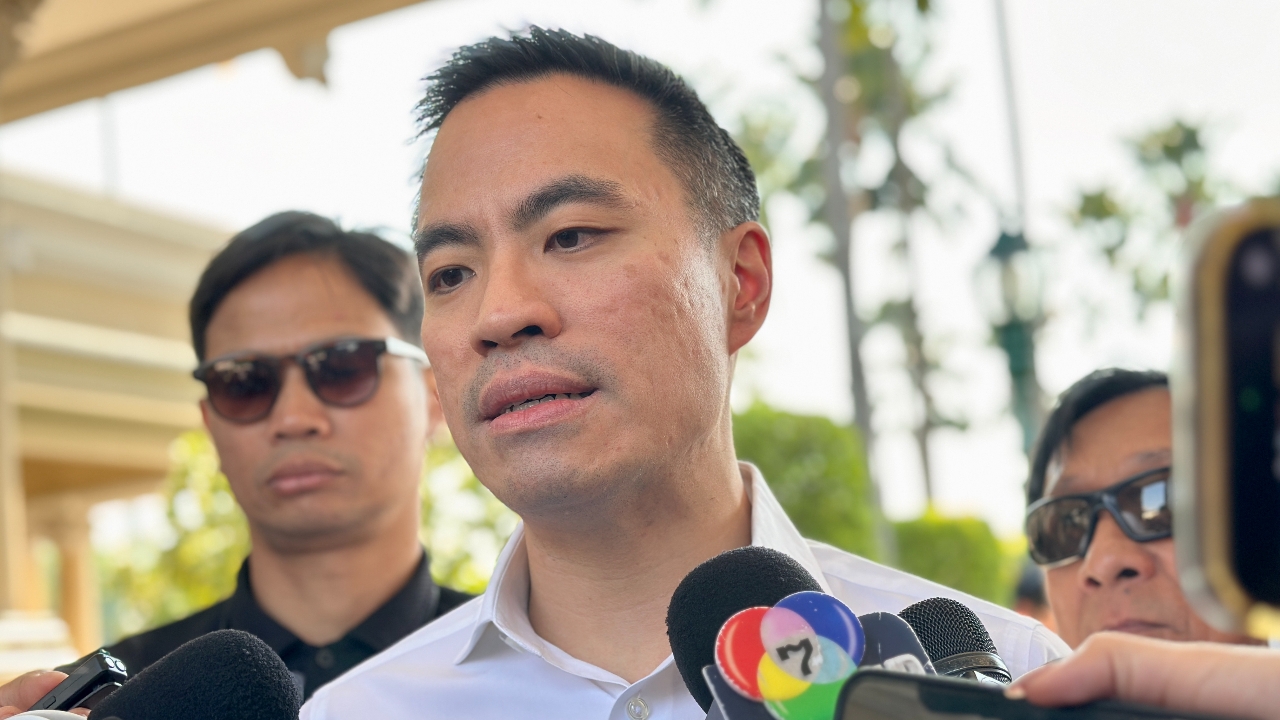
"Eknat" confirms there will be sufficient oil for Songkran, stating that although it is a holiday, the Energy Minister will not stop working. He is preparing enough oil and monitoring global market prices. He believes that if the oil fund can manage liquidity, there is no need to issue an emergency loan guarantee decree for the fund.
At 09:45 on 11 April 2026 at the Government House, Mr. Eknat Phonphan, Minister of Energy, spoke about the current status of the oil fuel fund. He said it has improved significantly, from a maximum daily loss of 2.5 billion baht to about 400-500 million baht per day, a level that can be managed.
When asked if oil prices will fall further, Mr. Eknat said he has mentioned several times that adjustments will be made appropriately according to the situation. Currently, the conflict in the Middle East shows some positive developments with ongoing negotiations, though the results remain uncertain. The latest crude oil prices have dropped slightly. As for refined products like diesel in the Singapore market, prices have fallen from 300 to 200 US dollars over the past 4-5 days, which is expected to allow some reduction in pump prices.
Regarding the Songkran festival from 10 to 16 April, he was asked if oil prices might decrease. Mr. Eknat replied that although it is a holiday, he is not resting. He has two main tasks: to ensure there is enough oil during Songkran and to secure as much crude oil reserve as possible nationwide to prepare for any escalation.
His second task is to monitor global oil prices and the ongoing uncertainties in the Middle East to assess how oil prices might evolve. The oil fund can fulfill the role of evaluating the situation because if global prices rise or fall, adjustments in prices are inevitable.
When asked about how much new oil supply has arrived, Mr. Eknat said that April shipments are arriving as scheduled. For May, he can guarantee that crude oil supply will be sufficient for the whole month. June orders and contracts are already being made, with daily monitoring of details. He noted that certainty is uncertainty because if the situation escalates, even if crude oil has been ordered or is on ships, it is unclear whether others might outbid with war premiums, so continuous monitoring is necessary.
Regarding sourcing additional oil beyond Russia and Africa, Mr. Eknat said they do not purchase from those areas originally. Oil is sourced from various countries depending on suitability—not just quality, but also factors like oil heaviness, lightness, sweetness, acidity, and sulfur content—ensuring compatibility with Thailand's refining processes. They look globally and, if necessary, use the Ministry of Foreign Affairs' channels to purchase oil state-to-state. Currently, they can order crude oil as scheduled.
When asked if he has spoken with the Ministry of Finance about not guaranteeing loans for the oil fund, Mr. Eknat replied that it depends on the oil fund’s financial status. Before the crisis, the fund was positive, but during the crisis, it went nearly 60 billion baht negative, with daily losses of 2.5 billion baht at the worst. Now, the position has improved to daily losses of hundreds of millions. If the fund can secure loans and manage liquidity independently, there may be no need for an emergency decree granting the Ministry of Finance authority to guarantee the oil fund’s loans, though preparations remain in case it becomes necessary.
Asked whether oil refineries will be called in again to discuss refining fees, Mr. Eknat said preparations are underway. Various mechanisms to support oil prices have been prepared, not just through the fund but also encouraging refineries to reduce factory gate prices as a form of responsibility and to ease price burdens. This will be reviewed periodically because refining fees fluctuate with conditions. Actual figures must be examined; in March, refining fees were estimated at about 2 baht per liter, reflecting a price discount benchmarked from Singapore.