

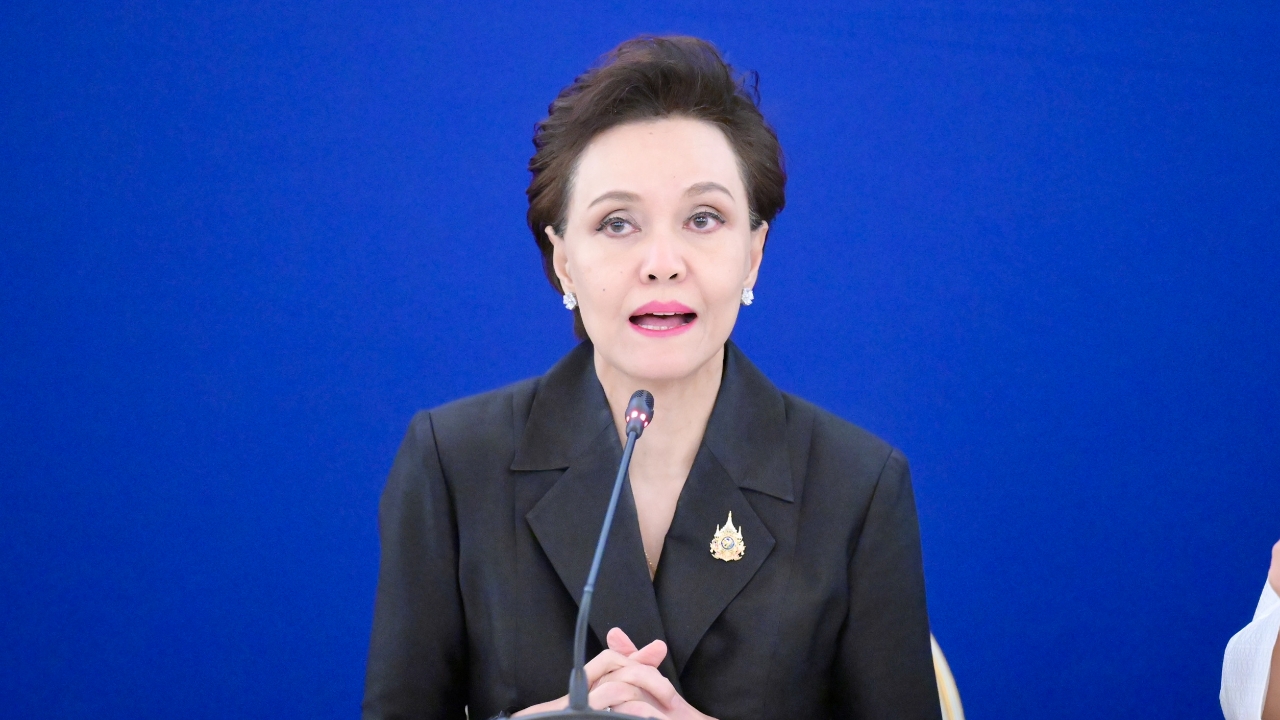
Deputy Prime Minister Suphajee announced Cabinet approval of a cost-of-living reduction package that brings SMEs onto online platforms, issues 500,000 discount coupons, and introduces the Green Flag Plus fertilizer program to manage the fertilizer system and assist farmers.
On 11 April 2026 at Santimaitri Building, Government House, Mrs. Suphajee Suthamphan, Deputy Prime Minister and Minister of Commerce, spoke after the Cabinet meeting No. 1/2026 alongside Mr. Akniti Nitithanprapas, Deputy Prime Minister and Minister of Finance, and Mr. Siripong Angkasungkiat, Deputy Minister of Transport.
Mrs. Suphajee said this builds upon her earlier parliamentary announcements and related policies aimed at reducing the public's cost of living, while also managing agricultural sector costs.
In the short term, the Ministry of Commerce has been operating since 1 April, cooperating with at least 300 small and large enterprises and retail wholesalers nationwide to distribute “Thai Help Thai” essential consumer goods as affordable options, with discounts up to 58% across more than 3,000 items, already distributed throughout all 77 provinces.
For the next phase, the Cabinet approved a budget to expand this effort to SMEs nationwide, integrating small producers into the system. Products that meet quality standards and are ready for sale can immediately connect to nationwide retail networks. Products needing improvement will receive support from the Ministry of Industry for TISI standards and the Ministry of Public Health for FDA approval, to elevate products for nationwide sales. This ongoing effort will continue throughout the year, alongside maintaining affordable products and generating income for small businesses.
Additionally, the Cabinet approved a budget to support online product sales. The Ministry of Commerce partners with at least five platforms: Thailand Postmart, Nexgen, Shopee, TikTok, and LINE, which will not charge commission fees (GP). The Ministry will subsidize shipping costs and issue 500,000 discount coupons valued at 100 baht each for buyers.
SMEs that are actual producers, meet standards, and are ready to sell online will be selected—2,000 in total—to join these platforms. Sellers will pay no fees, buyers will incur no shipping costs, and will receive discount coupons to encourage trial of SME products and boost income for producers. The goal is to expand to at least 10,000 SMEs both online and offline in the future.
Marketing promotion will also involve collaborations with influencers and key opinion leaders (KOLs) to build brands, raise awareness, and increase SME product sales.
To assist vulnerable populations and remote areas, there will be over 500 Thong Fah project points nationwide, plus distribution of consumer goods and educational items such as school uniforms and supplies, in partnership with the Ministry of Education. Sales points will be set up at over 1,000 educational institutions to help ease parents' expenses for the May school term start.
There will also be over 1,000 markets nationwide, including using gas stations as points to sell affordable agricultural products and community goods, facilitating direct contact between buyers and sellers.
For some agricultural products facing potential price drops, a “market-leading purchase” measure will be implemented in cooperation with the Ministries of Agriculture and Cooperatives, Defense, Justice, and Energy, buying from farmers at market-leading prices and distributing to agencies such as correctional facilities and the military, as well as for nationwide sales, avoiding budget burdens from stockpiling.
In remote, hard-to-reach areas, the “Mobile Thong Fah” project will operate alongside acceptance of “Poompuang” mobile vendors, currently numbering over 2,000 vehicles and expanding to 5,000. Support includes fuel subsidies and registration for product distribution.
For long-term fertilizer measures, the “Half-Subsidized Fertilizer” project is underway, integrating efforts with the Ministry of Finance, Bank for Agriculture and Agricultural Cooperatives (BAAC), and agricultural cooperatives. The Department of Agriculture and Department of Land Development provide “fertilizer formula” data suited to local soil conditions. The Ministry of Commerce coordinates with suppliers to procure fertilizer components, delivering them to cooperatives for sale to farmers. Participating farmers can access BAAC loans at half the usual interest rate. This approach analyzes fertilizer needs by area due to soil differences and reduces reliance on imported raw materials.
Discussions are also ongoing with the Ministry of Higher Education, Science, Research and Innovation to enhance research accuracy.
However, there remain constraints with urea fertilizer, which depends on imports. At least five cargo ships are currently stalled in the Strait of Hormuz, causing supply changes from a previous forecast of sufficiency until August to only until April. Mr. Sihasak Puangketkaew, Deputy Prime Minister and Minister of Foreign Affairs, is monitoring the release of these vessels.
Meanwhile, producers and fertilizer associations have sought alternative import sources, such as Malaysia and Brunei, extending supply from April to May.
The Ministry of Agriculture and Cooperatives, led by its minister, is preparing to negotiate additional raw material sources and works with fertilizer associations to adjust fertilizer formulas to ensure adequate supply and avoid shortages.
However, regional tensions have increased urea fertilizer raw material costs. While the Ministry of Commerce has urged producers to maintain price caps and conducted inspections at over 1,000 locations—finding 48 violations currently under legal action—the public is encouraged to report offenses to provincial offices, central authorities, or hotline 1569 for further investigation.
Price caps may only be feasible temporarily. Therefore, the Ministry of Commerce launched the “Green Flag Plus Fertilizer” project to mitigate rising cost impacts by increasing subsidies from 200 baht to 300 baht per sack for five sacks, plus an additional 50 baht for agricultural chemicals, totaling 1,550 baht per household.
Farmers holding official agricultural registration books (“green books”) and soil cards will receive increased benefits covering six sacks and a 250-baht organic fertilizer coupon, with maximum benefits of 2,100 baht per household.
Furthermore, fertilizer producers have agreed to reduce factory gate prices by 50 baht per sack, targeting 10 million sacks. This will be implemented through agricultural institutions nationwide to help ease farmers’ cost burdens, encouraging all sectors under the “Thai Help Thai” initiative to collaborate in guiding the country through the crisis.


