

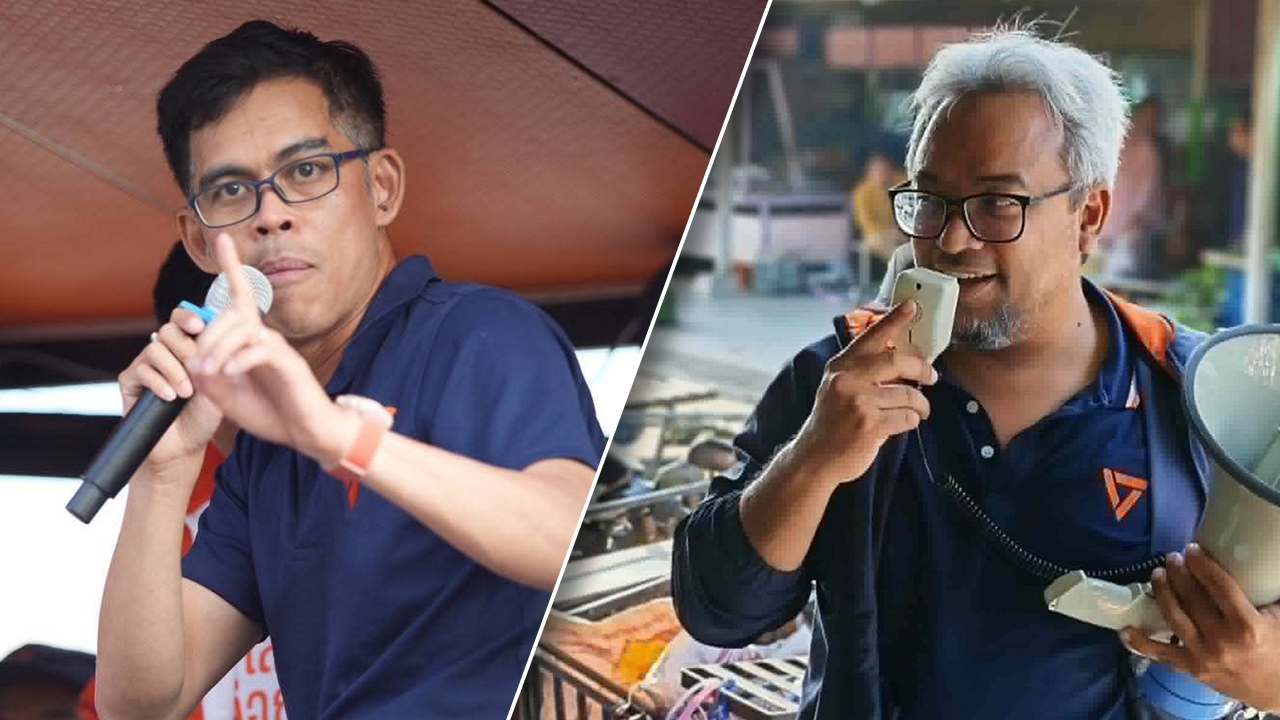
Ramadon and Kittipong, People's Party MPs, rebut the 4th Army Region Commander regarding the assassination attempt on MP Kamolsak, saying it endangers public safety. The commander’s comment, "If it were me, I wouldn't let them get away," intensifies local fear. They demand the Prime Minister review his performance.
On 14 April 2026, Mr. Ramadon Panjor, party-list MP, and Lieutenant Kittipong Piyawanno, party-list MP of the People's Party, disagreed with the 4th Army Region Commander's remarks during a press interview about the assassination attempt on Mr. Kamolsak Liwamo, Narathiwat District 5 MP from the Prachachart Party. When asked if security forces were involved, the commander ended the interview by saying, "Speaking personally, if it were me, I wouldn't let them get away. If I did it."
Mr. Ramadon said this was the first press briefing by the 4th Army Region Commander, who also serves as director of the Internal Security Operations Command (ISOC) Region 4 Forward Command, regarding the shooting of MP Kamolsak Liwamo from the Prachachart Party on 20 March. He noted that facts link several current and former ISOC and military personnel to the case, including the use of an ISOC vehicle in the attack. During the briefing, the commander chose to answer a reporter’s question off-mic, stating, "Speaking personally, if it were me, I wouldn't let them get away. If I did it." Taken in context, this seemed to deny military involvement in the assassination, which could be understood frankly.
This statement effectively nullified the significance of the entire briefing. While there has been considerable progress in the investigation of the MP Kamolsak shooting, public interest centered on hearing the ISOC leader’s initial comments. Therefore, tone, manner, and body language were crucial. The deliberate choice to speak this key phrase off-mic was highly significant, possibly revealing the leader's true stance more clearly than the official on-mic statements.
Mr. Ramadon questioned whether this mindset, advocating use of force that "wouldn't let them get away," is an appropriate method to address the Southern Border Provinces’ issues. He asked whether this approach is endorsed by the commander's superiors, including the Army Chief of Staff, who was reassigned from the Thai-Cambodian border to lead the southern forces last October, and whether the Prime Minister Anutin approves this thinking and method.
The commander’s off-mic remark in the briefing on the assassination investigation reflects a profound misunderstanding of public sentiment. Mr. Ramadon urged the Prime Minister and Army Chief of Staff, as ISOC director and deputy director respectively, to urgently reconsider the role and conduct of the 4th Army Region Commander. More frightening than the off-mic challenge is the question of whether ISOC Region 4 Forward Command, under this commander, has already conducted operations where "no one was let to get away." How many such cases exist? Will this personal approach become official policy?
Meanwhile, MP Kittipong Piyawanno of the People's Party stated, "The phrase ‘If it were me, I wouldn't let them get away’ carries very significant implications for public confidence when uttered by a high-ranking security official responsible for the area’s security."
The implication of Major General Narathip’s communication may have been to assert that ISOC was not behind the assassination, because if ISOC had ordered it, MP Kamolsak would not have survived the incident.
Speaking in this tone not only fails to clear ISOC from public suspicion given the existing evidence, such as the vehicle involved and suspects linked to ISOC disclosed in initial reports, but also increases public doubt toward both Major General Narathip and ISOC. His words may be interpreted as inconsistent with respect for law and justice or even as implying ISOC might act beyond legal boundaries under the pretext of security.
As a state security agency, ISOC’s operations, especially the use of force by officials, must strictly comply with the rule of law and be accountable. The presumption of innocence and legal obligations apply equally to state officials and citizens. Therefore, communication by senior commanders must not suggest that the state can exercise power outside legal frameworks.
The assassination attempt on a Member of Parliament deeply undermines public safety and confidence in the state. When such remarks come from the highest official responsible for local security, the impact on public sentiment is even more profound.
What society now expects from ISOC is cooperation with justice agencies to swiftly bring perpetrators to legal accountability regardless of their position or connections within ISOC. This will demonstrate equality before the law and alleviate public concern about impunity historically associated with the military, from unrest in the three southern provinces to various political protests.
Looking beyond this case, it is unavoidable to question whether such attitudes have contributed to the prolonged 22-year insurgency despite substantial state resources. These attitudes starkly contrast with ISOC’s oft-cited principles of "understanding, reaching out, and development" that are supposed to guide its work.
This situation reflects not only an isolated problem but also the broader limitations of current conflict resolution methods. Structural review is necessary, including enhancing independent oversight mechanisms separate from military command, such as civilian-inclusive fact-finding committees, continuous public case updates, and adjusting procedures to increase civilian participation and reduce economic disparities alongside security efforts. This would ensure conflict resolution is based on rule of law, transparency, and genuine public trust.