

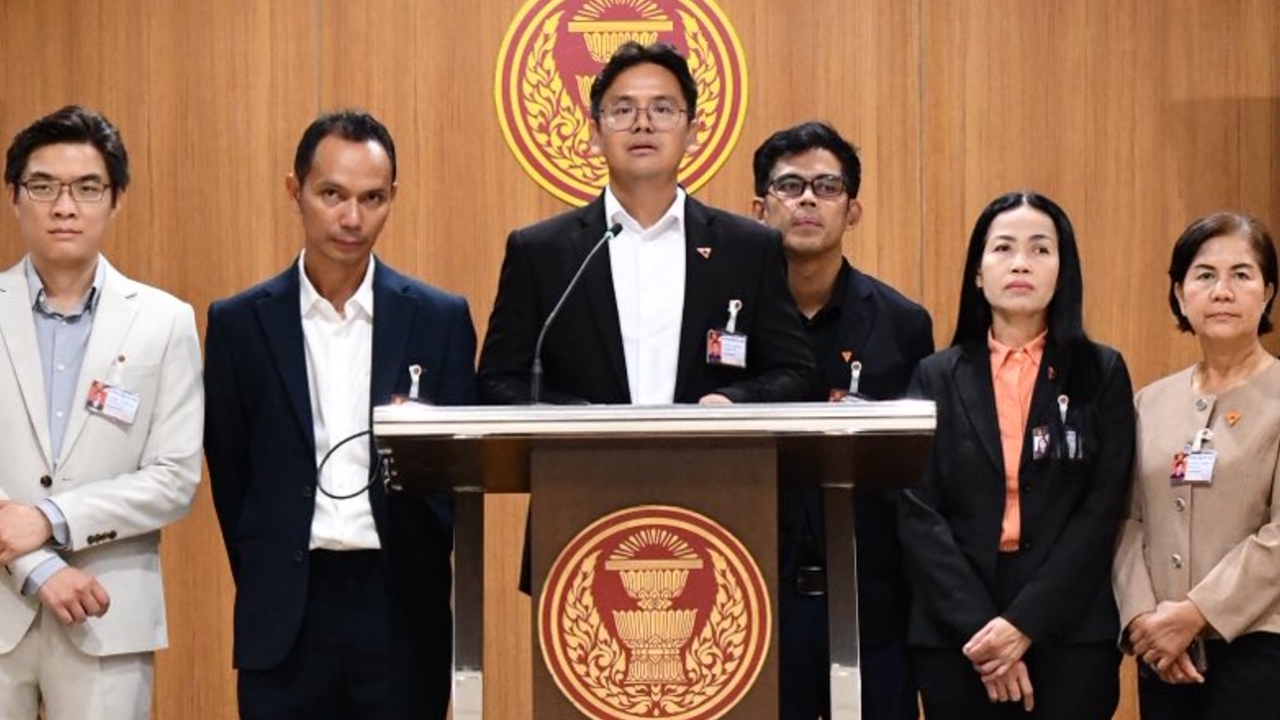
Ekkarat urges the Prime Minister to prove he acts on his words by promptly investigating the 4th Army Commander’s interview about the shooting of MP Kamolsak, in which the commander said, “If it were me, I wouldn’t let them get away.” Meanwhile, Chetwan suggests it is time to reform ISOC, pointing out that the 4th Army Commander's comments are causing public fear.
On 14 April 2026, Ekkarat Udomamnuay, an MP from Bangkok representing the People’s Party, posted on Facebook that the Prime Minister had declared to Parliament his commitment to uphold the rule of law, enforce laws fairly, and administer the government based on good governance for the benefit of the people. Regarding Lieutenant General Narathip Poynok, the 4th Army Commander, Ekkarat said this was an important step to uphold the rule of law and build public trust in the southern provinces. This incident occurred when the commander was briefing the media on progress in the assassination case of MP Kamolsak Leewamo, a Narathiwat MP from the People’s Party. The problematic remark came when Lt. Gen. Narathip spoke off the record: “I’m speaking personally: if it were me, I wouldn’t let them get away. If I did it.”
This statement reflects a mindset inconsistent with respect for the law. Although the 4th Army Commander insisted that the military was not involved, evidence in the case shows links to ISOC officers and that ISOC vehicles were used in the incident. Under the slogan of “saying and doing” like the Prime Minister, this is even more concerning. But certainly, thinking or speaking like this means a military man must be held accountable for his words.
“I call on Prime Minister Anutin, as Director of ISOC, to set up an investigative committee. I also urge the Minister of Defence to instruct the Department of Legal Affairs to investigate to dispel doubts that the military, through ISOC, may be exercising power outside the law under the guise of national security. Such words severely undermine public confidence. There should be a prompt review of Commander Narathip’s role. This attitude may be a reason why unrest has persisted so long and contradicts the military’s usual motto of 'understand, reach out, develop.' Whatever the outcome—removal or disciplinary action—the commander must be accountable for his words. The public is watching to see if the Prime Minister will truly act.”
Chetwan suggests it is time to reform ISOC, noting that the 4th Army Commander's words are causing public fear.
Meanwhile, Chetwan Tueprakorn, an MP from Pathum Thani representing the People’s Party, also posted on Facebook: “’Not letting them get away’—is this the kind of language used by someone the public authorizes to carry arms?” He said he truly did not expect the phrase “If it were me, I wouldn’t let them get away. If I did it,” from the 4th Army Commander as Director of ISOC Region 4. Whether spoken personally or publicly, it gives a very bad impression. It erodes public trust in state agencies entrusted with arms to protect security and safety. It also raises serious fears that if such actions are taken in the name of that agency, unarmed civilians like us would stand no chance.
The 4th Army Commander, as ISOC Region 4 Director, is making the public fearful. He is enabling an agency perceived to interfere in all aspects of community affairs—from the smallest to the largest—to easily control the people.
I think it is time to reconsider the military’s expanded role in society through organizations like ISOC, which involve the military in matters that government agencies are already responsible for. These are not military duties, which should focus on defending sovereignty and protecting the country.
What are ISOC’s military missions? If such camouflage is meant to bring the military closer to the people, the question is: does this constitute an expansion of military roles? If other agencies already have those responsibilities, and ISOC also undertakes those projects, who listens to whom?
The issue of reforming ISOC—including its roles, missions, budget, and personnel—has been discussed for a long time. Yet perhaps now society is asking whether ISOC is still necessary at all.