

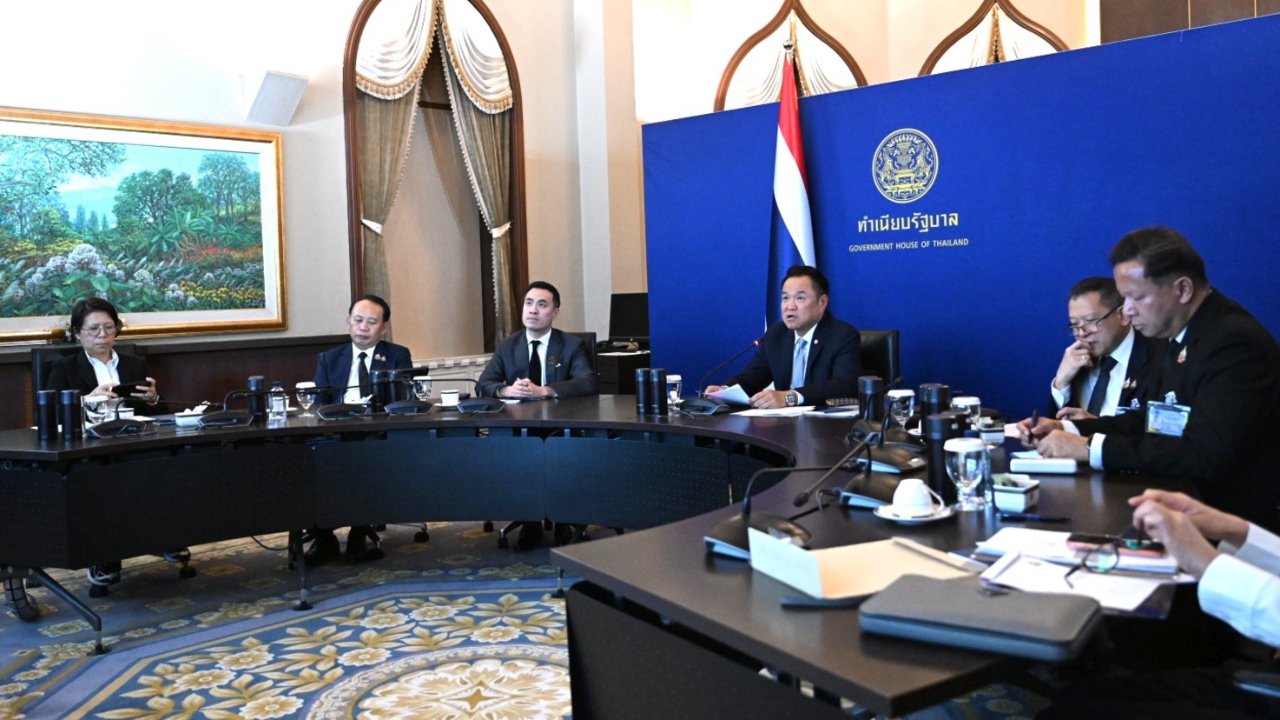
Prime Minister Anutin participated in the AZEC Plus meeting online, emphasizing regional energy cooperation and advancing the transition to clean energy and Net Zero emissions.
At 1:00 p.m. on 15 April 2026, at the Dome Room, 2nd floor, Thai Khu Fah Building, Government House, Prime Minister and Minister of Interior Anutin Charnvirakul attended the Asia Zero Emission Community (AZEC) Plus Online Summit via remote conference, upon invitation from Japanese Prime Minister Sanae Takaichi, the meeting chair.

AZEC is a forum initiated by Japan in 2022 to address energy security. This year’s meeting included leaders from AZEC member countries such as the Philippines, Malaysia, Singapore, Vietnam, Timor-Leste, Bangladesh, and Thailand, along with ministerial representatives from South Korea, Australia, Brunei, India, Sri Lanka, and international organizations including the International Energy Agency (IEA) and the Asian Development Bank (ADB).

On this occasion, the Japanese Prime Minister announced a new initiative to support AZEC member countries by providing low-interest loans for crude oil, refined oil, and essential goods procurement, along with financial support measures. She also proposed upgrading cooperation to "AZEC 2.0" to enhance long-term energy resiliency among member states.
Ratchada Thanadirek, spokeswoman for the Prime Minister’s Office, revealed that during the meeting, the Prime Minister emphasized the importance of regional cooperation amid global energy volatility and ongoing impacts from the Middle East situation, highlighting that international connectivity is essential and maritime security is crucial for global energy and food security.

The Prime Minister stated that although many countries have similar response measures, their capacities and limitations vary, making international cooperation vital. ASEAN has discussed this at the foreign minister level and will continue at the ASEAN leaders’ forum to strengthen cooperation with Japan to maintain supply chain stability and enhance resilience at critical points.
In the short term, the Prime Minister stressed the need to maintain energy market stability and utilize cooperative mechanisms to mitigate impacts. Meanwhile, Thailand has implemented close fuel management measures domestically to prevent rapid increases in energy costs, along with targeted assistance programs for specific population groups.

The government prioritizes public welfare by ensuring sufficient energy supply to the population at reasonable prices, while also reducing the cost of living burdens caused by global energy price fluctuations.
In the long term, the Prime Minister views this crisis as an opportunity to accelerate the energy transition. Thailand continues to promote clean energy, such as increasing biofuel shares, expanding solar energy, and strengthening the renewable energy supply chain regionally, aiming to achieve Net Zero greenhouse gas emissions.
Thailand welcomes Japan’s leadership role and supports both short-term measures and the development direction of AZEC 2.0. The Prime Minister reaffirmed Thailand’s readiness to collaborate with Japan and ASEAN members to address the crisis and build sustainable energy security for the future.