

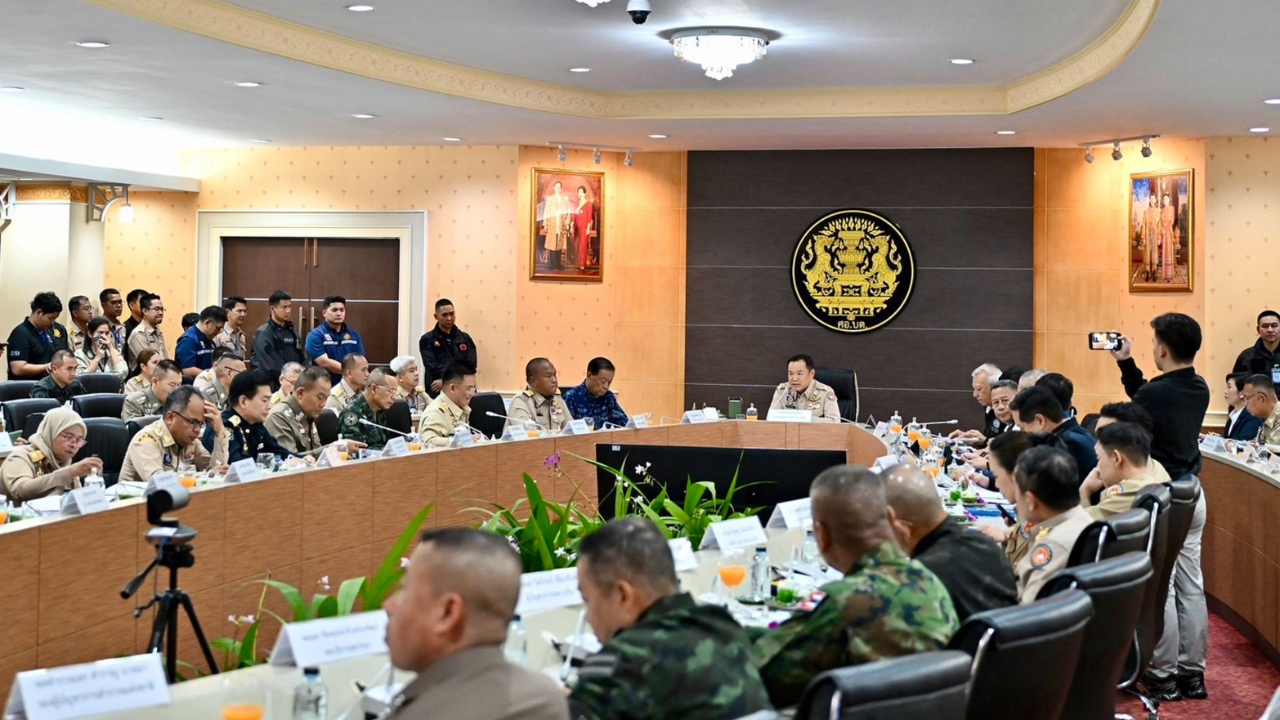
The Prime Minister, accompanied by Wannor and Kriangkrai, set policy directives for the Southern Border Provinces Administration Center based on the principles of understanding, accessibility, and development, declaring firmly that the situation cannot be left as it is. He emphasized clearly that the purpose is to assist in the work, not to nitpick or find fault.
At 10:10 a.m. on 17 April 2026, Anutin Charnvirakul, Prime Minister and Minister of Interior, along with his delegation, arrived at the Southern Border Provinces Administration Center (SBPAC) in Mueang District, Yala Province, to hold a joint meeting with local government agencies. Present were Piyasiri Watthanawaranukul, Secretary-General of SBPAC; Lieutenant General Narathip Poinok, Commander of the Fourth Army Area; Police Lieutenant General Piyawat Chalermsri, Commander of the 9th Provincial Police Region; governors of the five southern border provinces; Wannor Mahata, Chairman of the Prime Minister's Advisory Board; General Kriangkrai Srivarak, Deputy President of the Senate and former Commander of the Fourth Army Area; General Chaiphruek Duangpraphet, Army Chief of Staff; Admiral Phairoj Fuangchan, Commander of the Navy; and General Ukrit Boontanon, Supreme Commander, who also participated in the meeting.


The Prime Minister stated that they came to SBPAC with the intention to meet officials serving in the southern border provinces to affirm that he, the Cabinet, and senior officials in security agencies all place great importance on resolving issues and developing the southern border provinces. In the government’s policy statement, addressing these problems is a key priority presented to Parliament. This administration is fully committed to governing. He expressed honor in having Wannor Mahata, a former chairman, serve as the Prime Minister's advisor. Given his seniority and appropriateness, he believes the current situation is a good opportunity to have an experienced and respected figure with expertise in the area to support the government’s efforts.


The Prime Minister said that solving problems in the southern border provinces is based on the principles of “understand, access, and develop,” inspired by the late King Rama IX’s approach. They believe this approach will quickly restore lasting peace to the border area. These three simple words carry deep meaning: "understand" means studying information thoroughly to grasp the problems, the area, and the way of life of local people; "access" means seriously engaging on the ground, meeting residents to learn their needs and issues, building mutual understanding and trust; and "develop" means addressing problems and creating sustainable progress using methods appropriate to the local community context. Ultimately, everyone must work together to develop this region to achieve peace, economic prosperity, and improved quality of life for its people. With cooperation, trust, and confidence from the public, the set goals can be achieved quickly.


The Prime Minister explained that he came to update the situation because it changes rapidly, with new factors and problems emerging, requiring constant reassessment. He emphasized the need to adjust the frontline defenses accordingly. He instructed officials from the Ministry of Interior, as the administrative authority, to work in a timely, modern, and world-aware manner. The current southern situation must align with global realities, as worldwide issues affect the five provinces under SBPAC jurisdiction: Satun, Songkhla, Pattani, Yala, and Narathiwat. Therefore, they must stay current, modern, and responsive at all times. He urged units under the Prime Minister's Office to adopt these principles as their working guidelines to help SBPAC achieve its goals.

The Prime Minister said that beyond security concerns, the meeting aimed to reaffirm support for SBPAC as the main agency responsible for improving all aspects of residents’ quality of life. He is ready to listen to any needs for Cabinet and government support to advance SBPAC’s objectives. He also assured security agencies dedicated to guarding the borders and maintaining peace that everyone is willing and committed to working together. He expects the discussions today to produce actionable plans benefiting both the people and the country. He noted that no previous Prime Minister had held a meeting with SBPAC at this level, and he expressed his pleasure in joining the effort to solve problems in this region.

“We have esteemed and influential figures present, such as Wannor, who adds strength. I believe we cannot allow the situation to continue as it is. We have the Deputy President of the Senate, a former Fourth Army Commander who knows the area well. We are here to work together—not to find faults or nitpick, but to focus forward. We must help local residents understand our intentions and build their confidence and trust in us,” the Prime Minister said.
The Prime Minister noted that all field missions aim to turn the southern border provinces into an opportunity for Thailand and for all groups, including Thai Muslims and Thai Buddhists. They seek to develop the region’s capacity to bring prosperity to the country and raise the local economy so residents can have stable incomes and improved family quality of life.
The Prime Minister referred to a recent article reflecting perspectives on Thai Muslims, noting that in daily life—whether government officials, employees, cashiers, security staff, or service workers—there are good relationships, smiles, and trust among people. However, the same individuals are perceived differently when they are in the southern border provinces, as if they belong to a different group. He stressed the need to remove prejudices about the environment rather than about people. Sometimes the area is seen as lacking peace, and residents are collectively associated with unrest, which is not accurate.
He emphasized that problem-solving must focus directly on root causes without generalizing the population. He believes that everyone in the area desires peace, and the key to achieving peace is justice. Historical studies show that the main demand of local people is fairness. Although there have been occasional expressions beyond ideological boundaries, if the government can build understanding and demonstrate sincerity in addressing issues, the situation will improve toward a positive direction.