

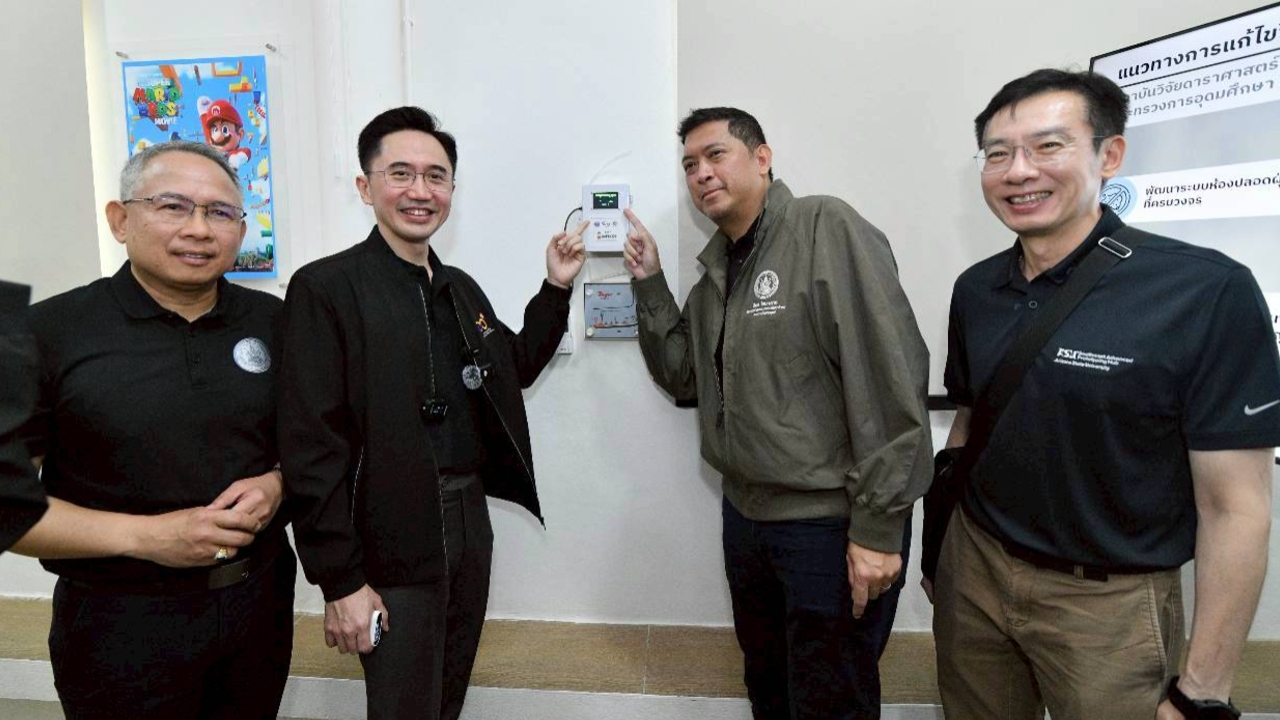
Yotsanan visited Chiang Mai to launch dust-free rooms aimed at helping vulnerable groups combat the PM2.5 crisis, with plans to expand to 83 locations across 8 northern provinces. Nikorn stated that the Ministry of Social Development and Human Security is working with the Ministry of Higher Education, Science, Research and Innovation to use innovation to create safe environments.
At 11:00 a.m. on 18 Apr 2026 GMT+7, at the Wiang Ping Children's Home in Mae Rim District, Chiang Mai, Mr. Yotsanan Wongsawat, Deputy Prime Minister and Minister of Higher Education, Science, Research and Innovation, together with Mr. Nikorn Somklang, Minister of Social Development and Human Security, led senior executives, local administrators, the Chiang Mai Provincial Administrative Organization president, and Pheu Thai Party candidates for Chiang Mai MPs to inaugurate and activate a comprehensive dust-free room. This innovation, developed by Thai researchers at Chiang Mai University, aims to assist vulnerable groups in northern Thailand to cope with the PM2.5 crisis concretely, at a cost of only 3,600 baht per room. Mr. Yotsanan personally used a portable dust monitor to measure outdoor air quality, finding dust levels soaring to 150-180 micrograms per cubic meter, a critical level directly affecting public health.


Mr. Yotsanan said the situation cannot wait and requires immediate action using practical technology. The government is advancing two parallel approaches: short-term, by deploying Thai-developed technology to solve problems affordably for Thai people; the comprehensive dust-free room, a Chiang Mai University research product, comprises three main components: a positive pressure system, a DIY air purifier, and an IoT dust sensor. These work together to supply fresh air and remove dust inside the room and can be installed to supplement existing buildings immediately. In the long term, the government will utilize deep tech to trace the true sources of dust problems and develop a real-time wildfire detection system, aiming for practical use within one year to reduce dust at its source. The first phase will expand the dust-free rooms to 83 sites in 8 northern provinces to protect vulnerable groups including children, the elderly, and patients, with plans to eventually scale nationwide soon to systematically improve Thai people's quality of life from air pollution.


Afterward, Mr. Yotsanan and his team traveled to the National Astronomical Research Institute of Thailand (NARIT) in Mae Rim to hold an integrated meeting on solutions and operations to mitigate particulate matter pollution in the northern region. During the meeting, Mr. Yotsanan stated that Thailand, especially Chiang Mai, has long had the capability to produce innovations to solve dust problems independently, commonly referred to as“Made in Chiang Mai.”He added that such innovations should be officially supported as infrastructure for sustainable solutions, emphasizing the integration of science and technology with local operations, such as positive pressure rooms and affordable DIY dust nets, to allow easy access for the general public and vulnerable groups. Additionally, vocational schools and universities like Rajamangala and Rajabhat should be engaged as central partners to promptly assist communities.


Mr. Nikorn remarked that addressing PM2.5 pollution is an urgent policy of the Ministry of Social Development and Human Security, focusing on protecting vulnerable groups including young children, the elderly, and people with disabilities by expanding dust-free rooms in care facilities nationwide, especially in 8 northern provinces with urgent needs (Quick Win) totaling 83 locations. The ministry will coordinate with the Ministry of Higher Education, Science, Research and Innovation to apply innovation in creating safe spaces, deploy Rapid Response Units to remote areas, and plans to extend coverage to over 2.3 million vulnerable individuals in 17 northern provinces to prevent health issues and sustainably enhance quality of life.