

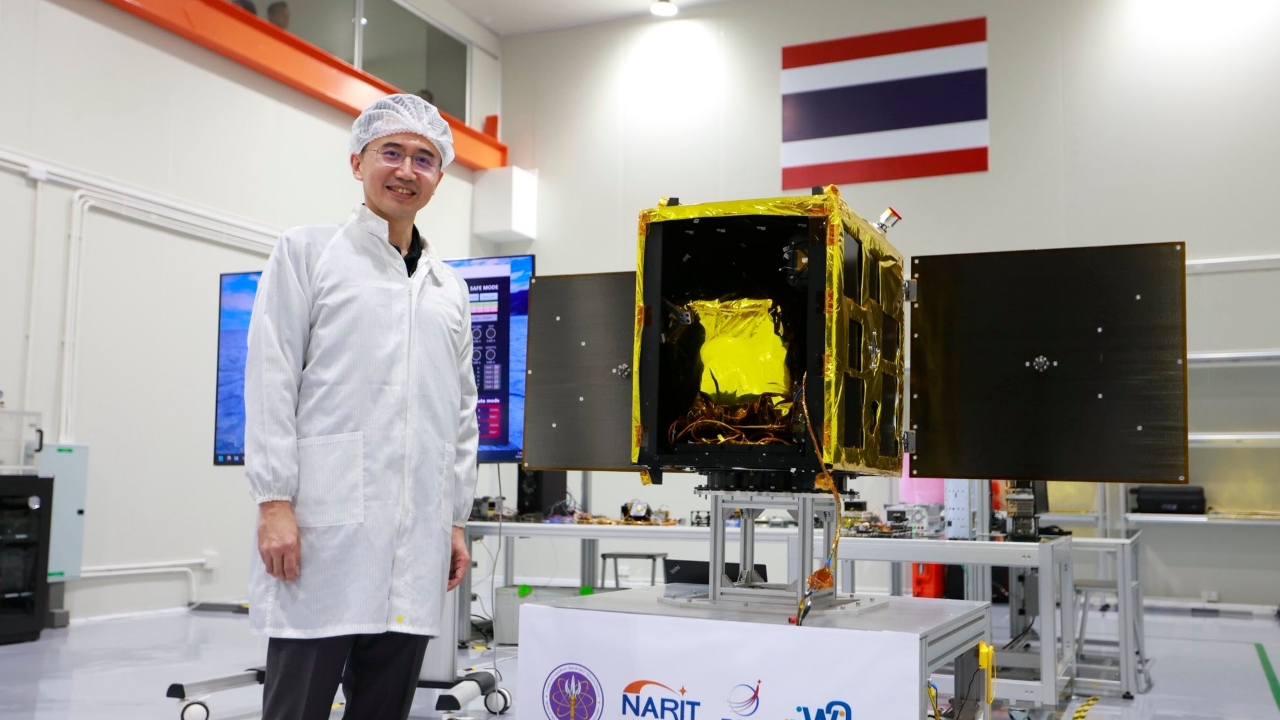
Yotsanan monitors the progress of the Thai-made satellite TSC-1, soon to launch into space. He points out this is a significant step in becoming a Deep Tech developer and declares it a source of pride that Thailand can achieve this on par with anyone.
At 11:06 a.m. on 19 Apr 2026 GMT+7 Mr. Yotsanan Wongsawat, Deputy Prime Minister and Minister of Higher Education, Science, Research and Innovation, posted photos and messages viaFacebookstating that the Thai-made satellite is close to launching into space, marking an important milestone in Deep Tech development. Yesterday (18 Apr), at the National Astronomical Research Institute of Thailand (Public Organization), or NARIT, in Mae Rim District, Chiang Mai Province, he went to follow the progress of the TSC-1, a Thai research satellite. What he saw was the impressive potential of Thai engineers, which fills us with pride and hope.
. The core of TSC-1 is that we built 60% of it ourselves—from the high-resolution imaging camera, attitude control software, to the ground station—all designed and assembled almost entirely by Thais. The toughest tests have been passed. He visited the laboratory where extreme conditions were tested, including the low-pressure environment of space (Thermal Vacuum), radiation resistance, and severe vibrations. The test results confirmed that our Engineering Model passed. The technology we developed is stable and ready for actual operation. The next goal is the Flight Model, the real spacecraft that will be launched into space in 2027.

“This is a landmark indicating that Thailand is moving beyond being a technology consumer to becoming a full-fledged Deep Tech developer. Building a satellite is not just about obtaining space data but creating an ecosystem for the space economy, which requires a highly skilled workforce. Most importantly, it inspires the younger generation to see that space is not so far away for Thais.”
At NARIT, the public can visit and learn in a comprehensive environment, with modern astronomy exhibitions, a sharp planetarium, and an observatory open for public telescope viewing of planets. The atmosphere is excellent. Anyone visiting Chiang Mai is encouraged to bring children here for inspiration. Additionally, there is a learning space for the visually impaired to experience the wonders of space through 3D printed models simulating the moon’s surface and other celestial bodies, allowing tactile exploration and imagination. Astronomy here is not just for viewing but designed for equal access for all Thais.
Mr. Yotsanan also stated at the end, “We are building a high-income country by transforming the economic structure through science and innovation, and this is another concrete example showing that we can achieve this on par with anyone.”

