

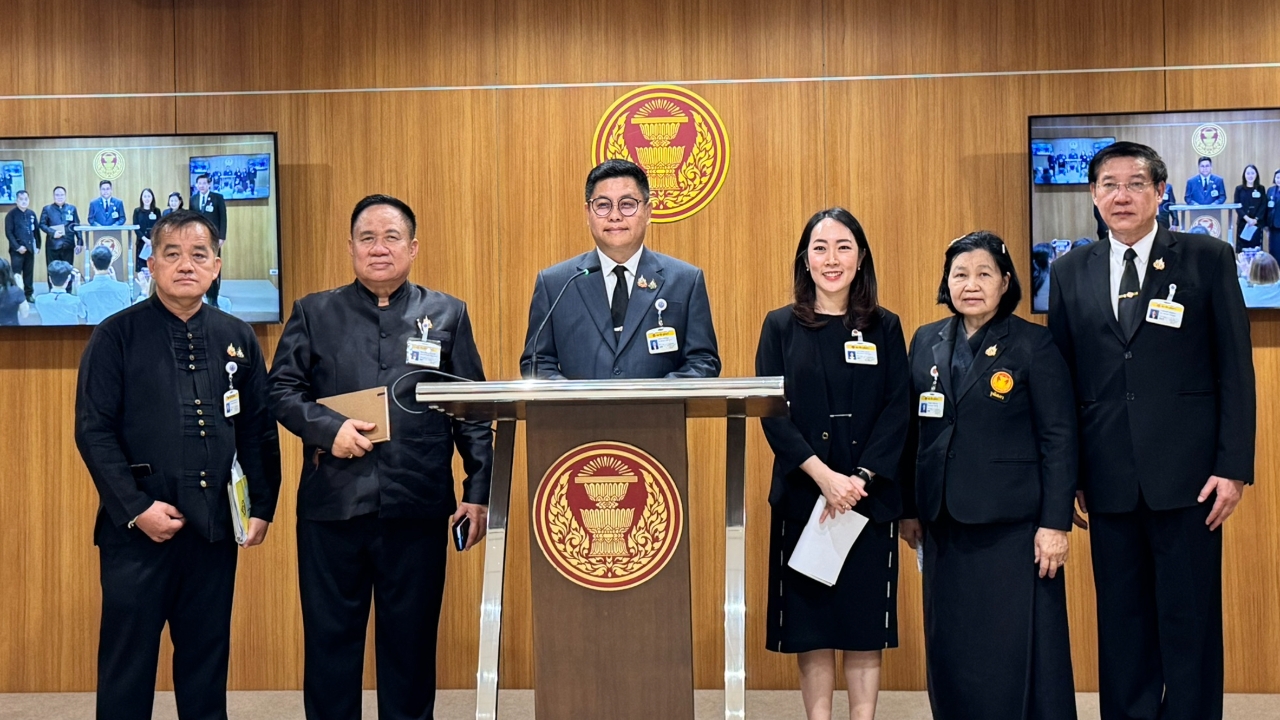
Northern senators call on the government to resolve the PM2.5 crisis, pointing out that nearly one billion baht in funding remains ineffective. They urge the Prime Minister to bring the Clean Air Act back to parliament before its dismissal on 13 May. They see forest burning as not the sole cause and recommend structural-level solutions instead.
On 20 April 2026, Northern members of the Senate gathered to urge the government to tackle the PM2.5 dust problem. Mr. Mangkon Sricharoenkul, senator from Nan Province, said that after field visits, it is clear that current efforts remain insufficiently effective despite nearly one billion baht spent. He reported receiving direct feedback from the field about the issues encountered.
1. The coordination among agencies involved, including the Ministry of Interior, volunteers, national parks, and military units.
2. Insufficient budget coverage, leading to a call for increased overtime pay for understaffed officials.
3. Equipment issues, such as more than half of the air-blowing machines being broken, with no budget allocated for maintenance.
4. The high cost of fuel in the area, prompting a demand for electric air-blowing machines.
5. The announcement of forest closures has caused hardship for villagers; the government must provide solutions, such as compensation or alternative livelihoods during closures.
Ms. Maneerat Khemawong, senator from Chiang Rai Province, stated that Chiang Rai currently faces cross-border pollution issues, including toxic dust and contaminated water, severely affecting public health, the community economy, and local lifestyles. Many northern provinces have endured red or dark purple pollution alert levels for over two months. Statistics show that dust levels exceed standards for 3-4 months annually, with severity increasing each year. The main causes are not solely forest burning but also agriculture, industry, transportation, and cross-border pollution. She questioned whether the focus on forest burning alone is misplaced since the smoke originates beyond Thailand as well.
Addressing the PM2.5 problem must begin with tackling its root causes, which are structural. Temporary measures are insufficient; a comprehensive law is needed to systematically manage air pollution.
. . .Therefore, wecall uponthe Cabinet's policy, specifically item 18.4, to urgently push environmental legislation. We remind that the environmental bill package includes the Clean Air Act, which was dropped during the parliament dissolution. Hence, wecall uponthe Cabinet to re-submit this bill for consideration by 13 May before it lapses again. This bill will restorethefundamental right of the people to have sustainable clean air, as the public's breath cannot wait."
Meanwhile, Pol. Lt. Col. Sanga Songmahachai, senator from Lampang Province, stated he has been criticized about his team's efforts. He clarified that he and his team have continuously met with citizens and parliamentary committees to study and prevent the issue. He believes the budget is insufficient, so he mobilized nearly 20 households to help create firebreaks, successfully establishing 10kilometersof firebreaks. He has donated half his salary since becoming a senator to a foundation supporting villagers, emphasizing that he has been actively working and not idle.
Mr. Prayad Chatupornpitak, senator from Chiang Mai Province, said that current central government policies include a blanket ban on burning, but some forest communities still rely on shifting cultivation. Today, Prime Minister and Minister of Interior Anutin Charnvirakul will visit Chiang Mai and witness the hardships faced by residents. Upon returning, he should clearly state whether the Clean Air Act will be reconsidered.
However, he sees another major issue as government administration,specifically decentralization,and management to achieve sustainable solutions.
Senator Kanlaya Yaiprasarn from Lamphun Province highlighted Lamphun's forest fire control model, where community members prepare year-round with communication tools and CCTV to monitor continuously. She called for welfare and compensation for these villagers and volunteers.
"We still have hope for Thailand, but it cannot be through old management styles. It requires decentralization andunlockingbudget use, allowing local people to purchase necessary items effectively to solve problems. Preventing people from entering forests means only state officials enter, risking their lives fighting fires they cannot control. Allowing community participation means even those starting fires will be caught by locals."