

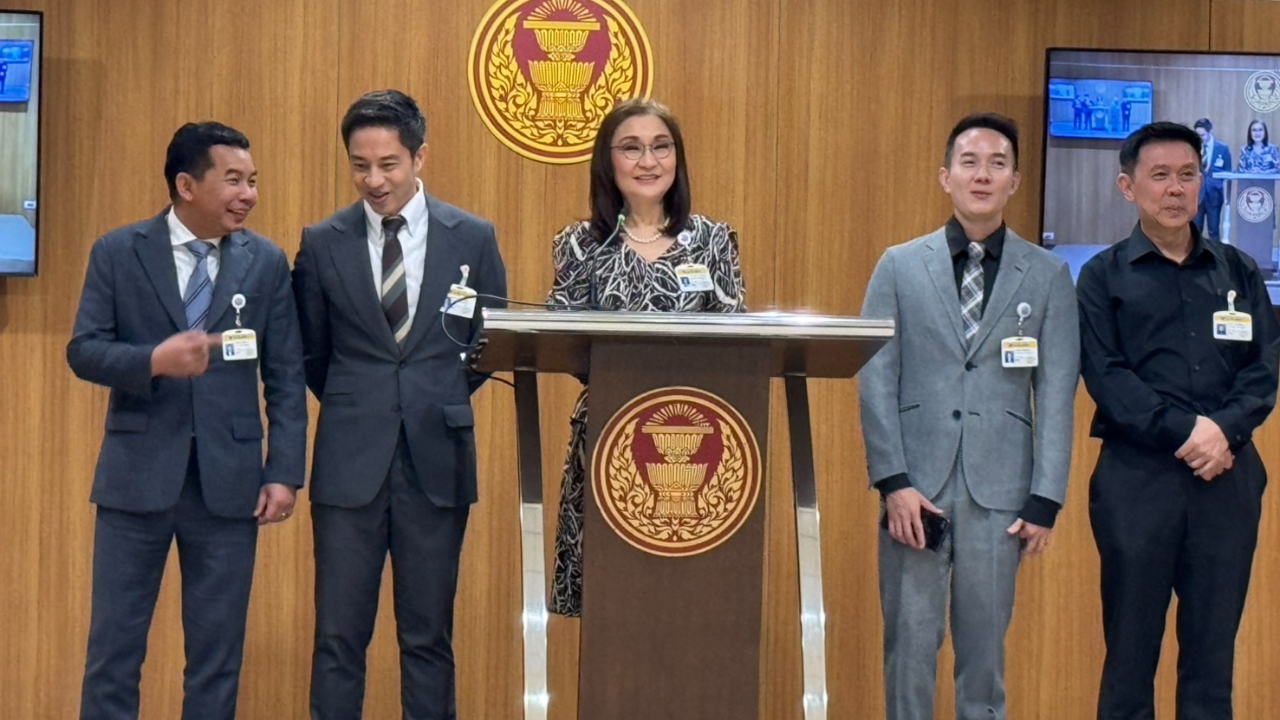
New senators oppose the government's land bridge project, emphasizing it is not a worthwhile investment. They accuse the government of concealing environmental and health impact information and plan to summon the Office of Transport and Traffic Policy and Planning (OTP) for clarification, highlighting the need to conduct a Strategic Environmental Assessment (SEA) and seek more input from local communities.
At 1:00 p.m. on 20 April 2026 at the Parliament, Ms. Nantana Nantavaropas, a senator, along with Mr. Noraset Prachayakorn, also a senator, and the new group of senators, held a press conference opposing the land bridge project. Ms. Nantana stated thatRegarding the case wherethe government plans to proceed with the land bridge project as a flagship initiative, expected to require a budget exceeding one trillion baht, making it the largest project ever undertaken by Thailand. The problem is that this project has never sought the opinions of the public, was not mentioned during election campaigns, does not appear in the government's policy statement to Parliament, has not been debated in Parliament, and lacks genuine public hearings or consultation. This project began during the administration of former Prime Minister Gen. Prayut Chan-o-cha, who declared the establishment of the Eastern Economic Corridor (EEC), as well as a Southern Economic Corridor (SEC)anda special border economic zone. Yet, after nearly 10 years, we have seen little progress or success in the EEC project, and no one can clearly distinguish the difference between the EECandthe Eastern Seaboard from 40 years ago.

Today, Prime Minister Anutin Charnvirakul's government intends to implement a hastily and superficially planned land bridge project that will build a connection between the Gulf of Thailand and the Andaman Sea via Chumphon and Ranong provinces. The plan is for cargo ships to dock on the Gulf side at Chumphon, unload goods onto rail or trucks, then transfer them onto ships on the Andaman side at Ranong. This land connection between the two seas is meant to shorten the shipping distance instead of using the Strait of Malacca by one to two days. The question is whether this cargo transfer can really save one to two days, or if it might take six to seven days because of the "unload onto land, reload onto ships, then unload again" process. Ultimately, it might become an abandoned port like Pak Bara Port in Satun province,whichnobody uses except for tourism.
“The reason our group of new senators opposes the land bridge project is that it was studied by the National Economic and Social Development Council (NESDC), which concluded that it is not cost-effective as an economic infrastructure investment due to high costs, low returns, insufficient cargo volume, and inconvenience. Currently, the Strait of Malacca in the Malaysian Peninsula sees only moderate cargo ship traffic, with 200-220 ships passing daily, averaging less than 10 ships per hour. However, the Office of Transport and Traffic Policy and Planning (OTP), under the Ministry of Transport, reported that the project is worthwhile and worth investing in, yet it refuses to disclose information about environmental and other impacts. Additionally, cargo ships have other routes, such as through the Indonesian straits,whichhavetwo or threealternative routes. Therefore, there is no reason why cargo shipswould choose to use a slower transport method like the land bridge project because the Strait of Malaccahas been in use for over 200 years and benefits from established banking systems, intermediaries, international law, ship maintenance, and transparent legal frameworks. The environmental impacts would affect forests, wetlands, coastal ecosystems, coastal fisheries, and other local livelihoods (Environmental Health Impact Assessment - EHIA)
in the affected areas, which would be lost permanently. Thailand is currently facing economic challenges with both deflation and inflation, and government debt has reached 70% of GDP, hitting the borrowing ceiling. Yet this government still seeks to borrow more, not necessarily to fund projects that benefit the people’s lives. The government should prioritize the people's interests over factional benefits. We oppose the land bridge project for all Thai citizens.”Meanwhile, Mr. Noraset, as chairman of the Senate Committee on Public Participation, Human Rights, Liberties, and Consumer Protection, said that the land bridge projecthas been widely criticized by academics regarding its economic viability. The Senate’s Political Development Committee has invited both the OTP

and the NESDCto clarify their economic feasibility reports. There is conflicting information: one report says it is cost-effective, another says it is not. The scientific basis is insufficient to push this project forward. The OTP’s report also shows procedural and content flaws, which the Political Development Committee is addressing with proposals to be submitted to Parliament during this session. There are also questions about public participation, especially regarding the Environmental and Health Impact Assessment (EHIA), which the OTP refuses to release to the public, even though it should be publicly accessible. This issue is on the agenda for the Senate Political Development Committee meeting tomorrow (21 April).“If the government insists on pushing this project forward, I believe Thailand needs a new economic engine and new development models because we cannot continue with the old economic framework. However, the land bridge project raises many questions about cost-effectiveness and its impact on local areas. I think it is too soon to proceed with such a large project. A more specific report is needed, including a Strategic Environmental Assessment (SEA), and greater public participation. We oppose the government's plan to proceed with this project.”