

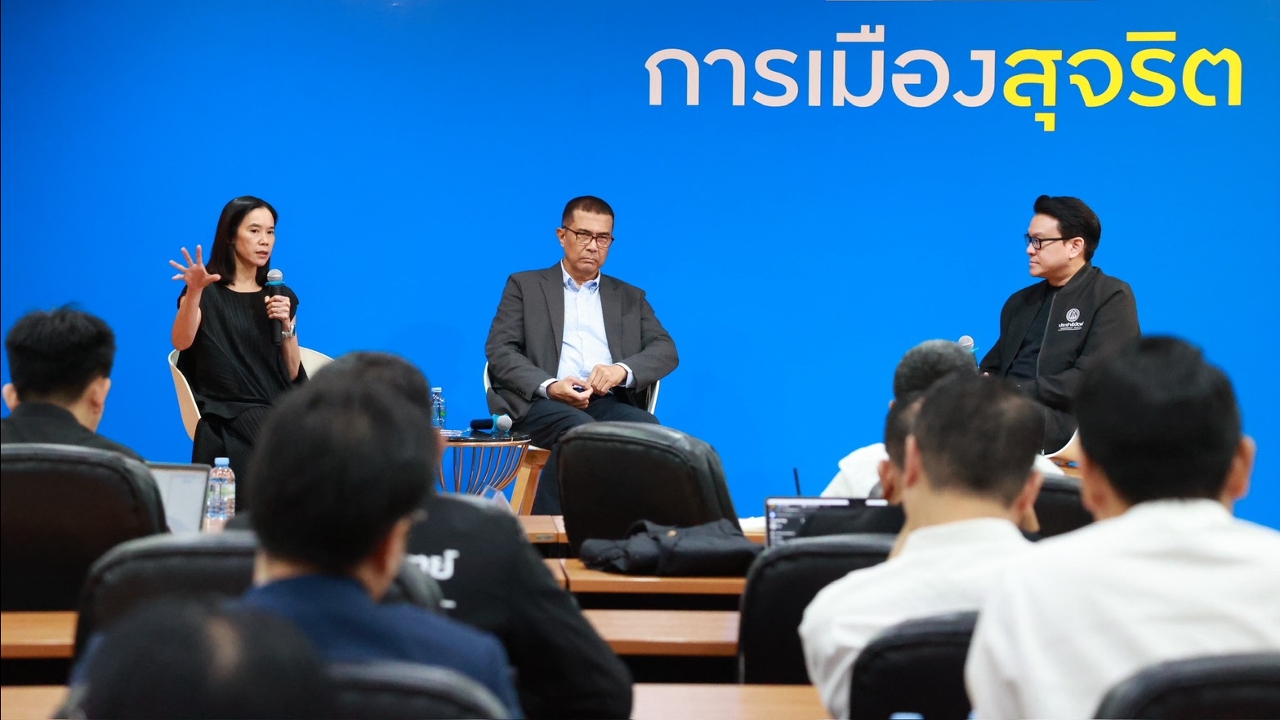
At the “Fah Mai Forum” discussion, water scholars proposed plans to cope with climate volatility, recommending managing Bangkok in six zones to move beyond being a "drainage city" toward becoming an "adaptive city." Tags: [climate change, Bangkok management, water management, urban planning]
On 20 Apr 2026 GMT+7, the Democrat Party held the “Fah Mai Forum”—a platform to discuss all issues Bangkok faces, questioning what the city cannot or does not do. The first problem addressed was Bangkok's flooding—from waterlogging to a sinking city—and how to solve it. Two Thai water management experts from Kasetsart University participated: Associate Professor Dr. Sitang Pilailah, a water management scholar and engineering faculty member, and Associate Professor Dr. Kobkiat Phongphut, architect of Thailand's water governance system and engineering faculty member. The event was moderated by Mr. Sakolthee Phatthiyakul, Deputy Leader of the Democrat Party overseeing Bangkok and party-list MP.Tags: [Democrat Party, Bangkok flooding, water experts, Kasetsart University]
Associate Professor Dr. Kobkiat Phongphut, architect of Thailand’s water governance system and engineering faculty member at Kasetsart University, said during the discussion that adapting to systemic and sustainable water management is essential to address climate uncertainty in Bangkok and the Chao Phraya River basin. Especially for Bangkok and the basin, tackling increasing climate volatility challenges requires adherence toTags: [water governance, climate adaptation, Bangkok, Chao Phraya River basin]
1. The context and threats from climate change include water uncertainty, as rainfall patterns have shifted, extreme weather events have become more frequent, and timing of water flow is unpredictable (e.g., water arriving early or late, or in large volumes). Traditional forecasting is ineffective. Unsteady water flow requires moving beyond engineering systems based onTags: [climate change impact, water uncertainty, extreme weather, hydrology] "steady flow"Tags: [hydrology, water flow] which is insufficient; instead, more complex analysis usingTags: [hydrology, water flow analysis] "unsteady flow"Tags: [unsteady flow, hydrology] is necessary. This may cause alternating droughts and flash floods in the same area. Resource degradation has reduced natural water retention areas, and ecosystem decline has led toTags: [drought, flash floods, ecosystem degradation, water retention] "water banking"Tags: [water banking, resource management] —where water demand exceeds available resources, directly impacting the economy, quality of life, and urban security.Tags: [water scarcity, urban impact, economy]
2. Transition from isolated infrastructure to systemic governance involves the limitations of previous concepts that focused primarily on infrastructure (e.g., digging canals, pumping water), which is insufficient without integrated data, decision-making, and collaborative operations across the system. Lessons from countries like the Netherlands ("Room for the River"), China ("Sponge City"), and Australia ("Water Sensitive Design") show shifts toward systemic water management. Therefore, it is necessary to move from viewing projects as "isolated" to seeing them as "interconnected systems" working together.Tags: [systemic governance, infrastructure, international examples, water management]
3. Water management in the Chao Phraya River basin: Bangkok is the confluence of three forces—upstream water flow, local rainfall, and high tides. The complexity of flow means that water in the lower Chao Phraya River does not move solely by gravity but requires precise timing management.Tags: [Chao Phraya basin, water management, tidal influence, hydrology]
Major projects lack coordinated rehearsalTags: [infrastructure projects, water management, coordination]
Associate Professor Dr. Kobkiat also expressed concern about large-scale infrastructure projects, such as the Bang Ban-Bang Sai drainage canal set to complete in two years. He stressed the need for serious joint rehearsal of water management under various scenarios before actual operation. He proposed reviewing the basin master plan, suggesting postponing several multi-hundred-billion-baht water projects (both old and new plans) for one to two years to carefully review and compare alternatives. This review should consider the entire Chao Phraya basin (upper and lower) comprehensively, under new contextual and design criteria.Tags: [water infrastructure, project review, basin master plan, Bangkok]
4. The concept of "Bangkok: An Adaptive City" includes current strengths and gaps. While Bangkok has improved infrastructure and operations, gaps remain in fragmented management, lack of integrated early warning and response systems, and reduced natural water retention areas. Thus, the city must move beyond a "drainage city" to become an "adaptive city" capable of handling both floods and droughts.Tags: [adaptive city, Bangkok, flood management, drought resilience]
Associate Professor Dr. Kobkiat suggested solutions including increasing green spaces, water retention areas, and natural systems to slow and absorb water, alongside a robust decision-making system to manage these zones. Bangkok should be divided into six zones based on risk (e.g., flooding, flash floods) and appropriate functions (e.g., retention, distribution, absorption, protection). Three zones requiring urgent action include:Tags: [urban planning, green infrastructure, flood zones, Bangkok]
1. Eastern Bangkok (Min Buri, Khlong Sam Wa, Lat Krabang) focusing on water retention and distribution.Tags: [Eastern Bangkok, water retention, water distribution]
2. Western Bangkok (Thawi Watthana, Bang Khae, Phasi Charoen) emphasizing water absorption (percolation).Tags: [Western Bangkok, water absorption, percolation]
3. Northern Bangkok (Khlong Prem Prachakorn, Rangsit) managing critical bottlenecks in water drainage.Tags: [Northern Bangkok, drainage, water bottleneck]
Additionally, Associate Professor Dr. Kobkiat presented a vision that Bangkok has the potential to become a model adaptive city for other monsoon-affected cities worldwide. The city must transition from a flood-problem solver to a hopeful, sustainable city. However, old formulas are obsolete because flood patterns and climate are no longer fixed. Bangkok faces "compound risks" from heavy rain, upstream water, tidal surges, and rising sea levels.Tags: [urban resilience, climate adaptation, Bangkok vision, sustainability]
The approach should shift from "spot fixes" to "system connectivity." The solution is to develop an "adaptive city." The traditional focus on "drainage" no longer works as it neglects "water retention." The ultimate goal is not just a "Sponge City" but a city that lives adaptively with water, using nature-based solutions.Tags: [adaptive city, water management, nature-based solutions, urban planning]
Challenges in Bangkok’s pipe systemTags: [infrastructure challenges, drainage system, Bangkok]
Associate Professor Dr. Sitang views structural and zoning challenges as significant despite available tools. Bangkok faces factors delaying water drainage, including: 1. Population density from new zoning plans, as the 4th revised Bangkok master plan permits denser development along mass transit lines, changing the city's water absorption capacity.Tags: [urban density, zoning, drainage challenges, Bangkok]
2. Uncontained water volume (massive wastewater), since an average person uses 200–250 liters daily, with 80% becoming wastewater. Bangkok has started intercepting wastewater before it enters canals (improving Khlong Saen Saeb’s water clarity) but still faces pipe system challenges.Tags: [wastewater management, water use, Bangkok]
3. Combined sewer system: Bangkok uses a single pipe for both rainwater and wastewater. These pipes are old and less than fully efficient, with over half their capacity occupied by wastewater. Thus, even 30 millimeters of rain can cause immediate flooding. Bangkok plans to separate stormwater and sewage pipes.Tags: [combined sewer system, infrastructure aging, flooding, Bangkok]

