

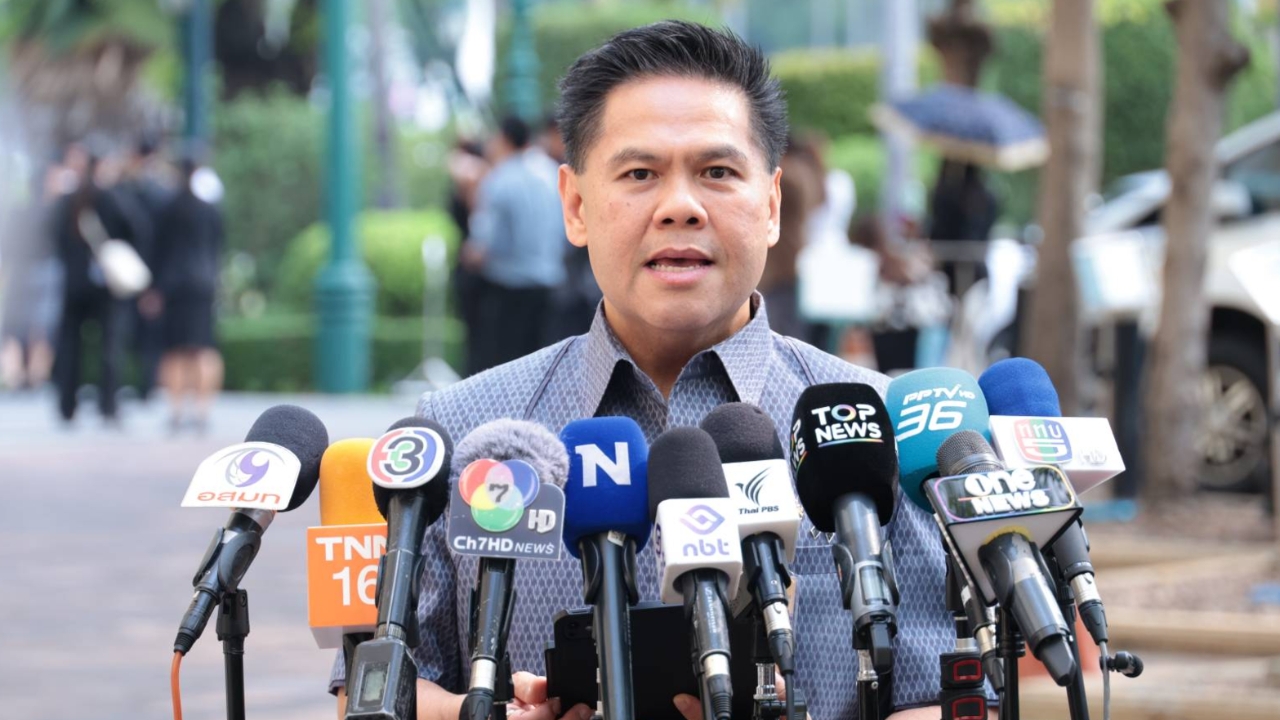
Warawut promotes 40 TISI standard products to save energy, plans to submit to the Cabinet for reviewing fresh sugarcane relief to help farmers, and orders strict factory safety measures to handle the hot season after frequent fires occurred.
At 09:20 on 21 April 2026 at the Government House, Warawut Silpa-archa, Minister of Industry, revealed that the Ministry of Industry focuses on promoting industrial growth alongside environmental conservation, especially efficient energy use. Recently, he assigned the Thai Industrial Standards Institute (TISI) to accelerate the promotion of TISI energy efficiency standards to guide manufacturers in producing quality goods and help reduce energy costs for the public.
Warawut said data from TISI showed there are currently 40 established energy efficiency standards, including 5 mandatory and 35 general standards. Most cover household electrical appliances such as air conditioners, refrigerators, washing machines, microwaves, rice cookers, and electric welders, as well as lighting equipment, building materials, electric vehicles (EVs), electric motorcycles, hybrid vehicles, and other products like window films and thermal insulation materials.
“The Ministry of Industry through TISI has also injected fee exemption measures to encourage manufacturers to develop energy-saving products. Currently, 119 manufacturers have been licensed with a total of 235 licenses issued. Another new measure is adding extra points in government procurement. TISI is discussing with the Comptroller General’s Department to push for energy-efficient TISI-certified products to be the 'first choice' in government purchasing under the Ministry of Finance regulations of 2017. This will help expand the energy-saving product market significantly.”
At the same time, the ministry is upgrading factories with the international ISO 50001 standard. TISI has set 15 energy management system standards such as TISI 50001 (ISO 50001) to help industrial factories manage energy efficiently within organizations. Currently, more than 70 agencies have received certification.
Plans to submit to Cabinet for review of fresh sugarcane relief to aid 4,600 more farmers.
Warawut also commented on measures to assist sugarcane farmers harvesting fresh, high-quality sugarcane to reduce PM 2.5 dust. The Ministry of Industry is preparing to propose a review of the Cabinet resolution from 17 June 2025 to expand assistance beyond the original approval for only 100% fresh, high-quality sugarcane with a total budget of 5.175 billion baht.
He said that payments to the first group of 126,000 farmers totaling 4.687 billion baht have been completed, leaving a balance of 487 million baht. Therefore, the ministry requests approval to pay an additional 4,667 contracts representing 6.91 million tons of sugarcane, divided as follows.
The first group consists of sugarcane farmers whose cane is not burned but contains impurities (no more than 5%). Excess impurities will be deducted, and only the clean portion paid. This group covers 1,053 contracts, 5.96 million tons of sugarcane, with aid totaling 411.10 million baht.
The second group includes farmers delivering 100% fresh sugarcane to ethanol factories, with 3,505 contracts. The aid budget for the ethanol group is 62.34 million baht for over 900,000 tons of sugarcane.
The third group is farmers delivering 100% fresh sugarcane to brown sugar factories with 109 contracts and a budget of 3.61 million baht. The total additional funds needed are estimated at 477.04 million baht, which remains within the originally approved Cabinet budget. The ministry will expedite the proposal to the Cabinet.
Orders the Department of Industrial Works to strictly enforce factory safety measures to prepare for the hot season.
Additionally, Warawut addressed the frequent factory fires during the hot season, stating that he instructed Prayos Klankrong, Director-General of the Department of Industrial Works (DIW), to enhance safety measures and proactive monitoring nationwide. Three main measures must be strictly implemented to reduce losses. Some have already been carried out, such as issuing warning letters to manufacturers and industry associations twice yearly, with the latest on 11 March.
A key proactive measure is for DIW to inspect high-risk areas, focusing on plastic, paper, paint, and tire factories. These factories must conduct intensive online training monthly and perform on-site safety drills within industrial zones, targeting at least 6,000 trainees annually.
“The final measure is a legal requirement under the 2009 Ministry of Industry announcement, mandating category 2 and 3 factories to install automatic fire detection and alarm systems at risk points and have sufficient 4.5 kg fire extinguishers for the area. Warehouses of 1,000 square meters or more or flammable material storage areas of 14 square meters or more must strictly install automatic sprinkler systems according to the law.”
Last week, fires occurred at an electronic parts factory in Rojana Industrial Estate 1, Phra Nakhon Si Ayutthaya, and at a glasses factory warehouse on Route 340, Bang Bua Thong District, Nonthaburi Province.