

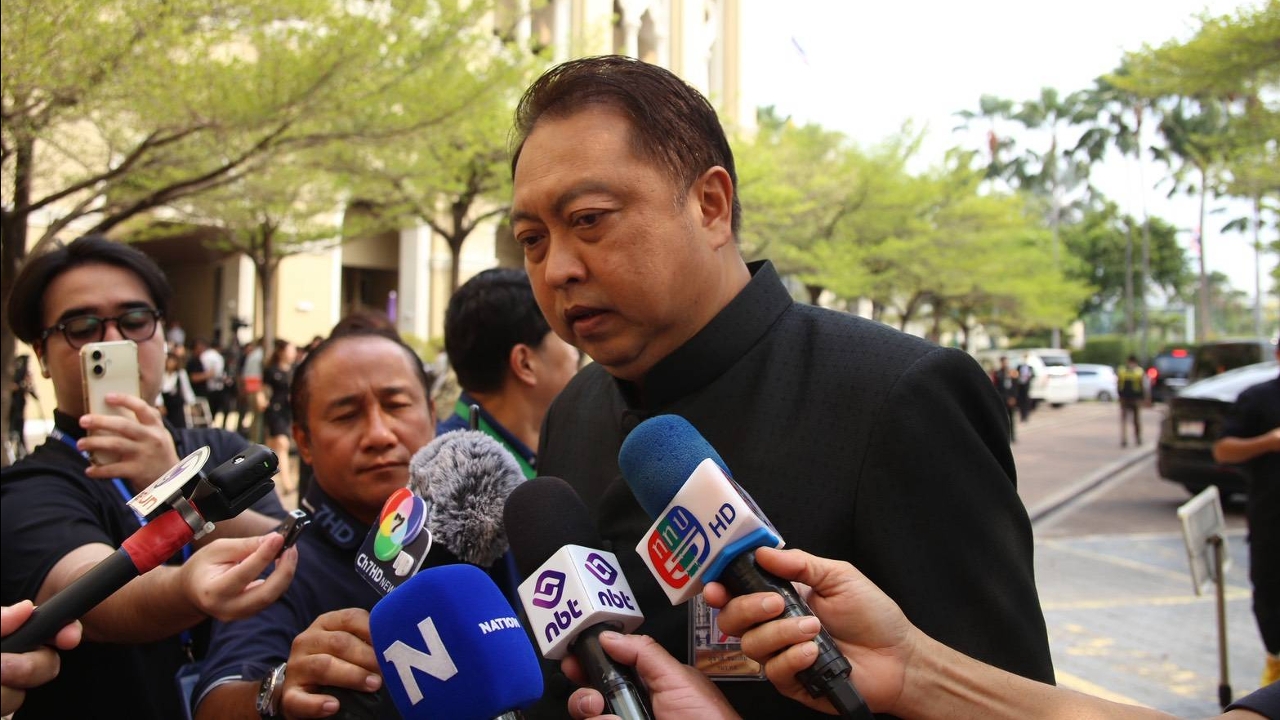
Suchart pointed out that people burning forests to forage are the root cause of PM2.5 pollution. He urged the public to be aware of the large-scale harm caused by pollution. He emphasized that the government supports the Clean Air Act and denied that it protects business interests. Regarding compensation, provincial governors already have established criteria.
On 21 April 2026 at the Government House, Suchart Chomklin, Minister of Natural Resources and Environment, spoke about the Prime Minister’s visit to Chiang Mai Province to address the PM2.5 issue. He reported that various agencies—including the Ministry of Defence, Royal Thai Police, Ministry of Natural Resources and Environment, Ministry of Agriculture and Cooperatives, and Department of Disaster Prevention and Mitigation—have deployed 6,000 to 7,000 personnel to fight fires in the area. He acknowledged that this year is very dry with delayed rainfall compared to previous years. The fires mainly result from people setting fires to forage for forest products, as natural fires have significantly decreased. Hotspots have been reduced substantially using helicopters to fight fires from mountaintops. Officials are exhausted and must also fight fires at night since daytime firefighting risks heatstroke. The budget used comes from park revenues in the southern region.
Suchart added that the Public Relations Department must communicate with provincial governors and the public. The Prime Minister has tasked agencies to address multiple issues, especially creating dust-free rooms for students, which relevant agencies must consider. The Ministry of Natural Resources will enforce laws seriously, particularly against forest burning. He therefore urged the public to understand that forest burning for foraging causes widespread pollution and must be avoided.
Regarding compensation measures for those affected in the area, Suchart said that provincial governors are responsible for setting the criteria. The Prime Minister’s visit aimed to encourage officials. Currently, the government is promoting the Chiang Dao model, involving surrounding communities to help protect the forest. They are also exploring ways to provide alternative income sources for people who forage in the forest.
Support for the Clean Air Act
When asked whether the Cabinet will review the pending Clean Air Act bill in Parliament, Suchart said the government already supports the law. Currently, the bill is under second reading in the Senate, where some conflicts are being examined. He clarified that the government is not defending business interests but must understand that investors are attracted to Thailand under the Board of Investment (BOI), which offers many incentives. Therefore, laws must not conflict with investment promotion laws. The Senate will decide, but the government welcomes the Clean Air Act while considering various aspects—such as how to define vulnerable groups working outdoors and the forms of compensation. Regarding fines, appropriateness must be considered. Legislation must balance multiple dimensions.