

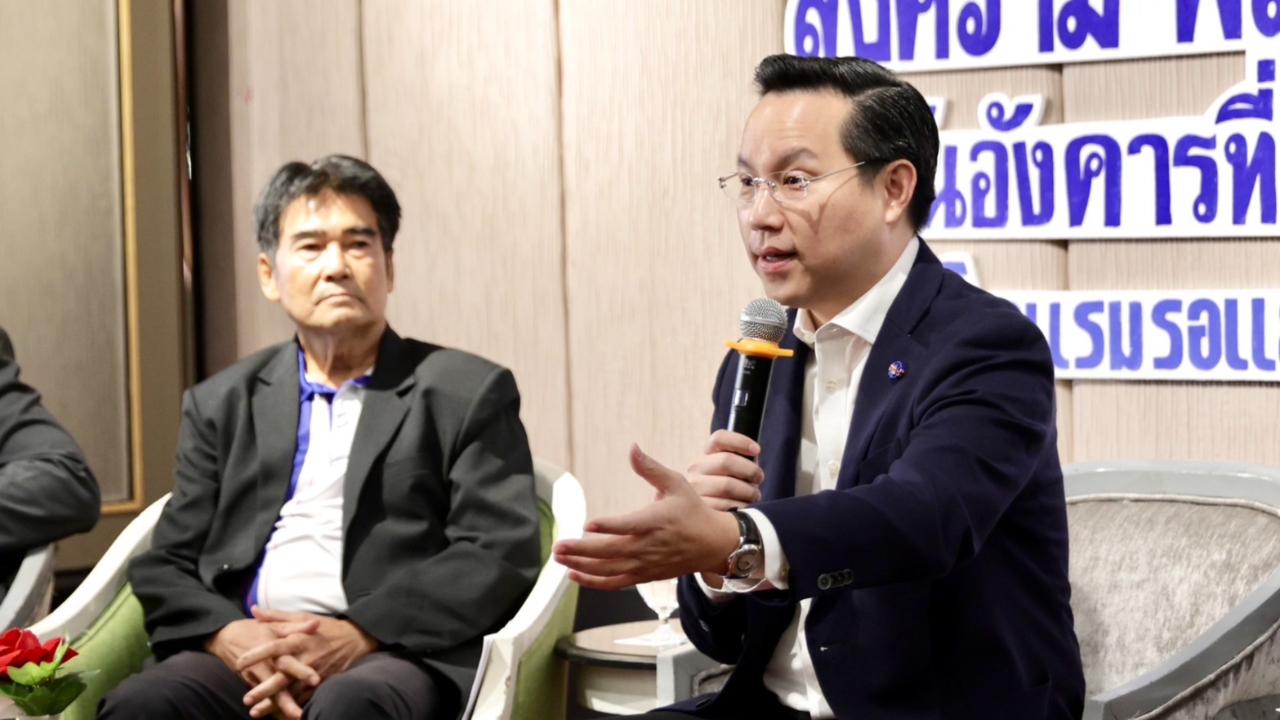
Attawit supports Thai workers in fighting high oil prices, exposing refinery profiteering mechanisms during the crisis. He urges the government to reform the entire system, repeal the 2000 law, and end subsidies of refinery profits through the oil fund.
On 21 April 2026, Mr. Attawit Suwanpakdee, party-list MP and deputy leader of the United Thai Nation Party, shared his vision at the academic seminar titled “War, Energy, and Thai Labor,” organized by the Thanong Pho-an Foundation at Racha Room, Rattanakosin Hotel, Ratchadamnoen Road, Phra Nakhon District, Bangkok.
Attawit spoke about Thailand’s energy development, noting that the country’s energy system has evolved since the early days when Thailand could produce its own oil. He cited the example of the "Three Soldiers" gas stations during wartime, where the military produced oil and sold surplus to the public at low prices, while high-quality oil was imported from foreign companies like Esso, Shell, and Caltex. In the past, oil prices varied and were not uniform as they are today.

Attawit noted that Thailand once faced an oil price crisis, especially during Prime Minister General Kriangsak Chomanand’s tenure, when diesel prices rose sharply and contributed to his removal from office. This was followed by the era of General Prem Tinsulanonda, when Thailand began restructuring its energy sector, transitioning to the fully state-operated Petroleum Authority of Thailand (PTT). At the same time, Thailand attracted foreign refineries to invest domestically to meet rising energy demand from economic growth, referencing oil prices based on the Singapore market, which was then appropriate but is now outdated due to changing contexts.
Attawit added that Thailand has its own energy sources, including oil and especially substantial natural gas reserves in the Gulf of Thailand, but these are insufficient for demand, requiring imports. There are also exploration limitations due to some areas being protected forest reserves and national parks.

Regarding the current situation, Attawit said Thailand imports crude oil mainly from the United Arab Emirates, Saudi Arabia, and the United States. Oil from the Middle East must pass through the Hormuz Strait, a critical transport route currently tense due to Iran’s closure of the strait since late February, disrupting oil shipments for over one and a half months with prospects of lasting nearly two months. As shipping from Hormuz to Thailand takes about two months, impacts from the closure will become apparent in May, potentially causing oil shortages. The public should closely monitor government signals, especially from the Ministry of Energy and Ministry of Foreign Affairs, on whether oil imports can be adequately managed.

On Thailand’s oil reserves, Attawit stated that by law, reserves are required only for 25 days and maintained by the private sector. Although total system stocks—including crude yet to be refined, oil in transit, and those in production—might appear to cover over 100 days, in reality, immediately usable volumes are limited.
“It has been over 50 days since the Hormuz Strait closure, representing half the shipping cycle. What must be closely watched is whether new oil shipments will arrive on time, as current data shows only one or two ships have arrived,” he said.
However, Attawit observed that despite prior assurances of no shortage, some areas have begun to experience oil shortages at gas stations, reflecting urgent structural problems in energy management that require prompt resolution.

Attawit addressed Thailand’s current oil price issues, stating they are not due to actual shortages as commonly believed but rather from hoarding and a price structure allowing some operators to earn excessive profits. The spot pricing system based on the Singapore market causes refined oil prices to rise sharply during crises or wars, even though most oil sold domestically is from older stock imported and transported one to two months earlier at lower costs. Yet sales are priced on current global market rates, generating substantial “windfall” profits. Operators cite increased costs such as war premiums for transportation and insurance, but these apply only to new transactions, not existing stock, creating accounting inconsistencies where taxes are paid based on real costs but sales use higher global market prices.
He further explained the profit mechanism: operators forecast rising oil prices and accumulate purchases in stepped increments, stockpiling in warehouses or tankers, then selling at peak prices. During wartime, refined oil prices rise faster than crude oil, increasing profit margins significantly. There are also management loopholes enabling speculation, such as delaying transportation times from one to two or three days when price increases are anticipated every two days, to sell at higher prices. This issue is under investigation by relevant authorities like the Department of Special Investigation (DSI).

To address these issues, Attawit proposed that Thailand consider imposing a windfall tax similar to the United Kingdom, using excess energy sector profits to aid the public. He also pointed out irregularities in Thailand’s oil pricing structure, citing the case when Energy Minister Akenat Phompand reduced refinery fees by 2 baht on his first day, lowering retail prices from 50 to 48 baht. While this gave the impression the government could control prices, refinery gate prices dropped by 13 baht—from 56 to 43 baht—reflecting global market conditions, yet retail prices fell only 2 baht. Marketing fees increased from 1.50 to 10.50 baht, despite gas stations earning only about 0.75 to 1 baht per liter, indicating most benefits went to refineries, not retailers.
Attawit also noted that while excise tax reductions have been proposed, without clear final price controls, profit margins may shift to refinery or marketing fees instead. Therefore, a key solution is adopting a Cost Plus system, setting prices based on actual costs plus reasonable profits, with price ceilings. This can be implemented under the 1999 Price Control Act, empowering the Central Price Committee to set prices. Fuel is already a controlled item but has not been seriously regulated.
He criticized the use of the oil fund, which is money from the public. At times, subsidies reach 15-18 baht per liter, whereas under normal conditions it should be about 2.80 baht. However, subsidies are based on Singapore market prices, effectively supporting refinery profits instead of stabilizing the system during losses.

Regarding Thailand’s refinery sector, Attawit said it is currently saturated with six refineries sufficient for domestic demand and exports, so no new refineries are needed. There are also legal and structural limitations, as the Ministry of Energy, established in 2002, still operates under the outdated 2000 oil law, while authority over final price setting rests with the Ministry of Commerce, resulting in inconsistent management.
He viewed current measures such as the 1973 Emergency Decree on Oil Shortage, which grants the Prime Minister power to address shortages, as merely temporary fixes rather than long-term structural solutions.
In closing, Attawit emphasized that energy sector reform requires political courage due to opposition from energy capital groups. He acknowledged that working in the Ministry of Energy is challenging and demands decisiveness to resolve structural problems over the long term.
Mr. Adisorn Pho-an, chairman of the Thanong Pho-an Foundation, said the seminar was held to commemorate Mr. Thanong Pho-an, a fighter for labor and the people. He highlighted global tensions, especially escalating Middle East conflicts likely to have broad impacts on livelihoods, particularly workers. He condemned opportunistic hoarding and abnormal oil price hikes that burden the public while enriching some groups massively, which should not happen during a national crisis.