

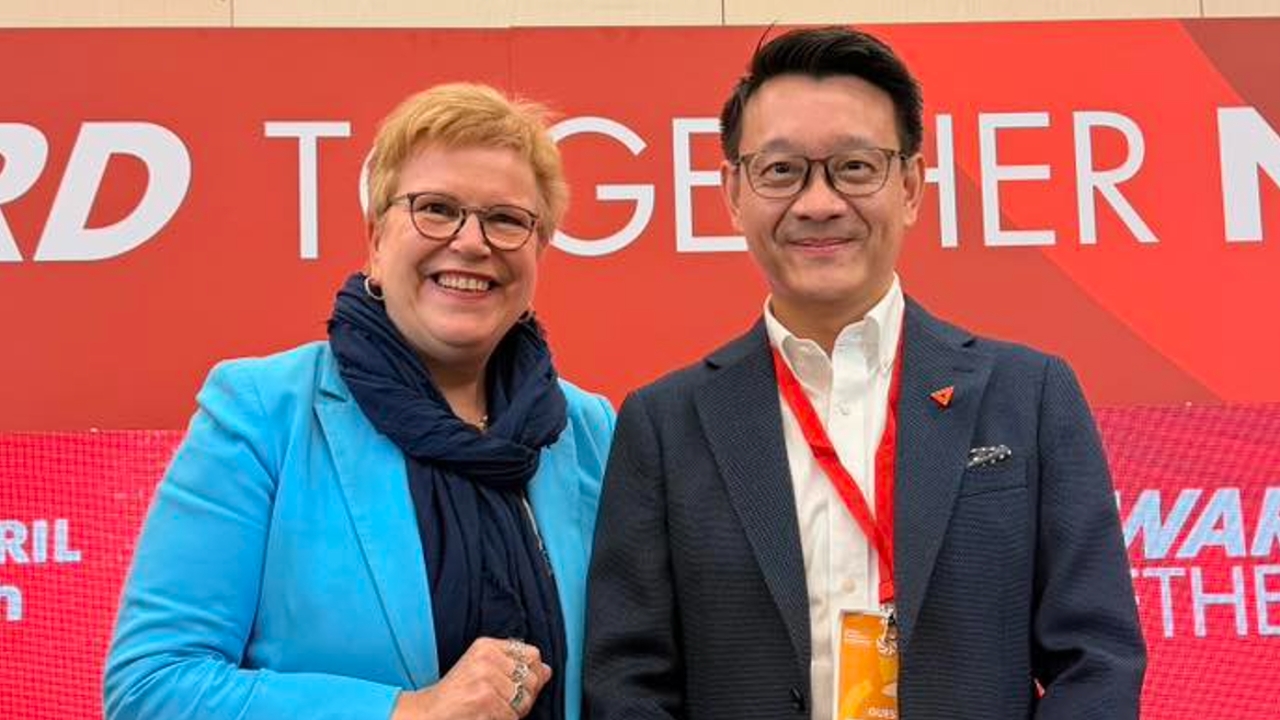
Veerayut led People's Party MPs to participate in the cooperation forum for progressive party leaders, emphasizing that "the state must lead investment" to build the country's competitive capabilities and highlighting the People's Party's economic goals.
On 21 April 2026, reporters reported that on 17–18 April, Veerayut Kanchuchat, Deputy Leader of the People's Party, along with Rakchanok Srinok, a party-list MP, and Phandil Nuamjeum, MP for Bangkok's 4th district, traveled to Barcelona, Spain, after being invited to attend the Global Progressive Mobilisation. This global forum is held for cooperation among leaders of progressive parties and social democracies worldwide.
Mr. Veerayut said the event was organized through collaboration among social democratic parties globally, led by Spain’s Prime Minister Pedro Sánchez and Brazil’s President Lula, to reaffirm that amid this turbulent global crisis, it is essential to jointly uphold rights, freedoms, fairness, and establish an orderly world. Otherwise, the already chaotic world could become even more unstable, as major powers seek to control the planet's limited resources, leaving no room for medium and small countries to negotiate.
“This oil crisis has shown us directly how a disorderly global order affects the livelihoods and lives of everyone. I had the opportunity to join an economic policy panel with Mariana Mazzucato, a progressive economist from UCL, who plays a key role in policy work with many developing countries.”
They agreed that national competitiveness is central to a country's development. However, developing countries will never sustainably become wealthy if they cling to outdated thinking—old formulas that suggest opening markets to foreign investment, lowering tariffs, reducing the state's role, and letting the market operate freely during economic downturns. Such illusions have never made any country sustainably rich; only foreign corporations and local monopolies have prospered. Lessons from East Asia and Europe show that the state must adopt the spirit and mindset of an Entrepreneurial State because, ultimately, the state collects and spends taxes and remains the most important investor in the country.

Mr. Veerayut added that state reform is not just about cutting personnel, budgets, or regulations. The state must take the lead in long-term investment projects that benefit the people, set market competition directions, and foster a society that "shares both burdens and benefits" in investing for the future. When the state bears risks on behalf of private sectors and citizens, some subprojects may fail, but if private companies succeed by building on pioneering research funded by the state, profits must be shared with society. The state should incentivize and enforce reinvestment of profits for the future, not merely distribute dividends to shareholders. Successful examples include Germany’s clean energy transition with state ownership of technology and state enterprises investing in critical missions that short-term profit-driven private companies avoid.
“Conversely, granting infrastructure concessions like electricity or energy to private companies under long-term contracts has created 'sleeping tigers' that do not stimulate investment in technology ownership, while the public bears electricity costs alone. A closer example is Vietnam, advancing Doi Moi 2.0 with major state reforms.” .
Mr. Veerayut said that today’s state reform focuses on livelihood policies because a more capable state can effectively and fairly use tax revenues to support the people during crises and invest wisely to lead us through crises toward a brighter future, seeing light at the end of the tunnel.

Mr. Veerayut also presented the People's Party’s economic goals: an economy owned by the people based on a firm foundation, fair competition, and future growth. These goals have yet to be achieved. International cooperation can help by strengthening state capacity, overseeing platform governance, and supporting technology and financial assistance for the transition, to realize a truly people-owned economy.