

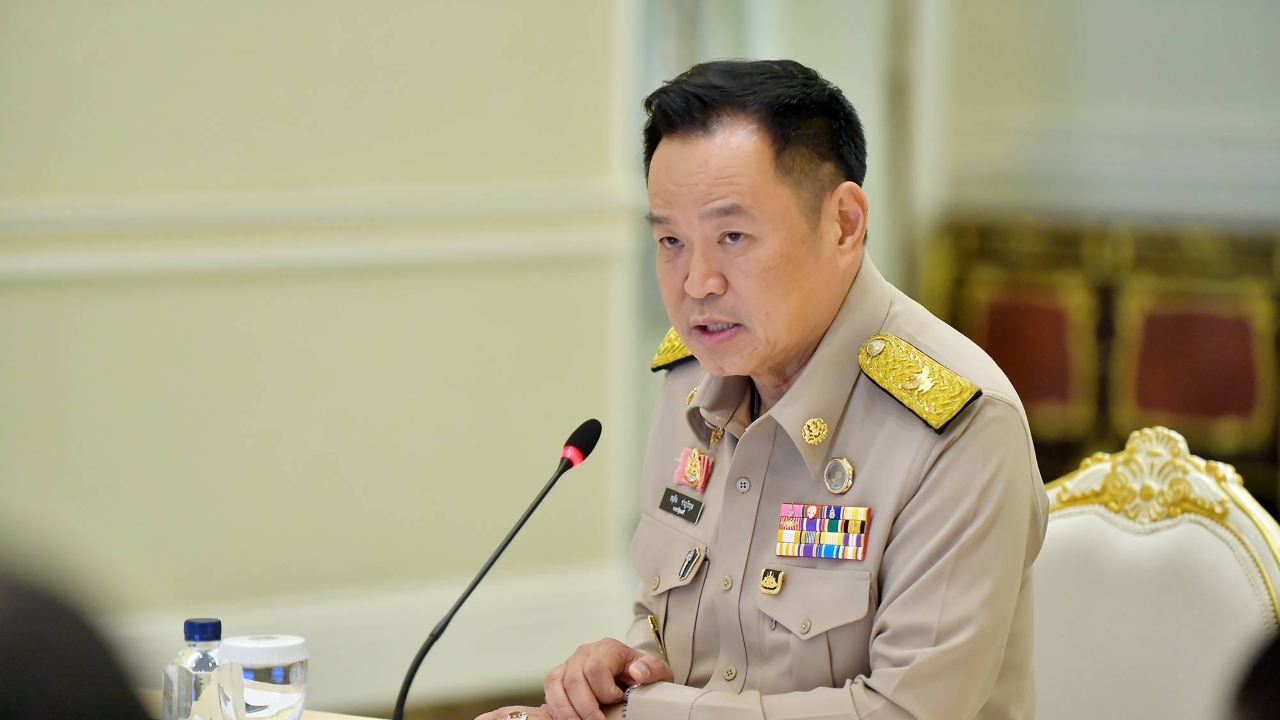
The Prime Minister met with four agencies to set the 2570 fiscal year budget framework, driving policies amid global volatility. Ekkaniti revealed plans to draw on pending budgets and push a budget transfer bill involving 69 billion baht, combining reserves of 95,000-125,000 million baht as financial ammunition to handle crises.
At 10:20 a.m. on 22 April 2026 at the Government House, Prime Minister and Minister of Interior Anutin Charnvirakul chaired a meeting to consider the expenditure budget framework for fiscal year 2570 among four agencies: the Budget Bureau, Ministry of Finance, the National Economic and Social Development Council (NESDC), and the Bank of Thailand (BOT), with Deputy Prime Minister and Minister of Finance Ekkaniti Nitithanprapas Minister to the Prime Minister’s Office Pradorn Prissanantakul, BOT Deputy Governor for Financial Stability Piti Disyatat, and other relevant officials attending.
The Prime Minister opened the meeting by stating that today's gathering was to review the 2570 fiscal year expenditure budget limits, as well as to set preliminary estimates for government spending, revenues, and fiscal position for at least the next three years. The review aims to enable the government to drive key policies amid significant global volatility, including the conflict in the Middle East, which directly impacts Thailand's energy security and economy.

Therefore, the government must improve work efficiency by using fewer resources, which increases constraints on the 2570 annual expenditure budget preparation. To maintain fiscal discipline, financial stability, and economic steadiness, strengthening fiscal health, it is necessary to cut budgets that no longer align with current conditions as much as possible.
Anutin added that the budget planning must maximize real benefits. He has already informed government agencies of the guidelines and methods for preparing the 2570 budget. He urged all involved to review and adjust their preparations to align with the government's instructions and to adhere to the timeline set by the Budget Bureau. This will allow the matter to proceed through parliamentary consideration, resulting in legislation and implementation from the first day of fiscal year 2570.

Meanwhile, Ekkaniti revealed that the joint meeting of the four key economic agencies was an intensive discussion to forecast and assess the overall direction of Thailand’s economy for 2570. This serves as a crucial database to allocate national resources most efficiently. This meeting is the second step following the Prime Minister’s policy directives, with clear government orders for all agencies to review and cut unnecessary 2570 expenditures, especially budgets for overseas study visits, non-urgent new government building construction, and unnecessary provincial development projects under current circumstances.
"The main goal is to use the 2570 economic forecast as a framework for continuous budget management, focusing on reallocating funds from unnecessary areas to more beneficial categories. Particularly, projects that reduce long-term government expenses—such as converting construction budgets to install solar panels on government buildings. This not only lowers recurring electricity costs but also strengthens the government's financial resilience by ensuring sufficient reserves to face potential future economic crises."

Ekkaniti further disclosed that the current public debt stands at 66%, while Thailand's debt ceiling is 70% of GDP. This leaves approximately 4% room for additional borrowing, equating to about 800 billion baht. The debt ceiling is set by the Fiscal Policy Committee and can be adjusted as needed, as was done during the COVID-19 crisis. However, before considering new borrowing, the government aims to maximize efficiency in managing existing budgets to prepare financial ammunition against energy crises and Middle East developments.
"The government plans to gather funds in two main parts: reviewing the 2569 expenditure budget and revising the 2570 draft budget. For 2569, the government will reclaim budgets from agencies that have not finalized procurement contracts by the 30 April deadline, expecting to recover about 70-100 billion baht. Added to remaining central budget funds of around 25 billion baht, this will provide total reserves of 95,000-125,000 million baht. This measure requires legislation through a budget transfer act, similar to that used during the COVID-19 crisis, with submission to parliament anticipated by mid-June at the earliest."