

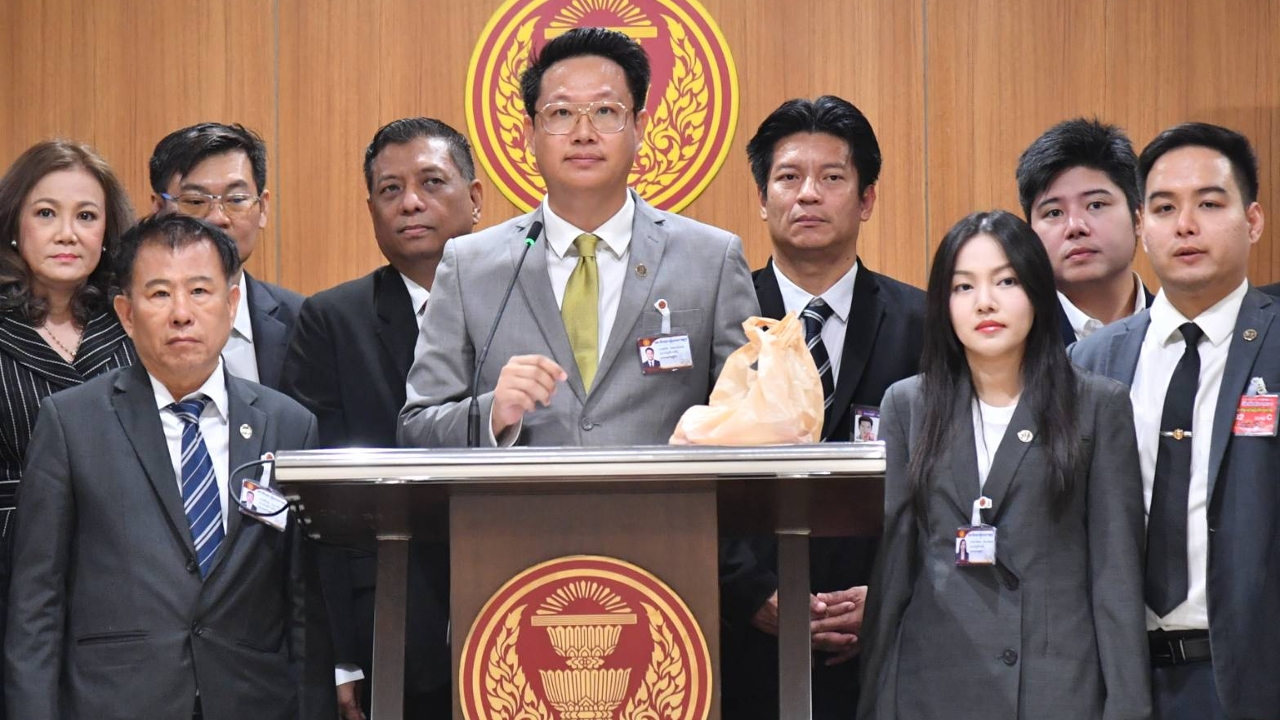
The Economic Party proposes imposing taxes on foreign workers and seriously combating corruption instead of raising VAT to 10%, warning that prices will increase and further burden all Thai people.
On 22 Apr 2026 GMT+7 at the Parliament, Mr. Chris Potranan, leader of the Economic Party, along with party list MPs Mr. Peeraphon Kanokwalai and Ms. Angsana Niamwanichkul and party members, jointly announced their opposition to the plan to raise the value-added tax (VAT) from 7% to 10%. They affirmed that this measure is substantiated and not merely political speculation, as it appears in official government documents related to the state's fiscal plan.
Mr. Chris stated that although previous attempts clarified that the VAT hike proposal was only a Senate commission study and the report had been withdrawn, the Economic Party conducted further checks and discovered relevant documents. The "Medium-Term Fiscal Framework" Dated 20 Nov 2025 GMT+7, issued by the Secretariat of the Cabinet, explicitly discusses the approach to raising VAT to 10%.
MP Chris emphasized that this issue is significant and should not be dismissed as mere rumor. If the government proceeds, it will immediately affect every household, especially during a time when Thailand's economy remains weak and people already face high living costs.
During the press conference, Mr. Chris used an example of a 100-baht convenience store item to illustrate that under the 7% VAT rate, consumers pay about 7 baht in tax, but if the rate rises to 10%, the price for the same item jumps to 103 baht. Although this seems a small increase, it effectively raises living costs across all areas—goods, services, and fuel prices.
Mr. Chris said that with the VAT increase, everything in the country effectively becomes 3% more expensive amid current economic conditions. The Economic Party estimates that if the VAT increase occurs, Thailand's economy might shrink by about 1%, down from a 2.4% growth in 2025 to only 1.4% this year, reducing purchasing power, production, employment, and potentially resulting in tax revenues falling below expectations.
Mr. Chris compared that in 2014, when VAT was at 7%, the government collected about 700 billion baht in VAT revenue, while in 2025, with the same rate, revenue increased to 950 billion baht. This indicates that the government can increase tax income without raising rates by promoting economic growth and higher incomes for the population.
He also noted that the government is currently discussing raising the public debt ceiling from 70% to 75%, allowing an additional borrowing of roughly 500 billion baht. This highlights Thailand’s fragile economic situation and that raising VAT would worsen burdens on the people.
Regarding claims that a 1% VAT increase would raise government revenue by about 100 billion baht annually, or a rise from 7% to 10% would add 300 billion baht per year, Mr. Chris argued that despite these figures sounding appealing, the government should not start by increasing taxes on citizens before addressing inefficient public spending and corruption-related leakages.
He pointed out that with the current annual budget expenditure around 3.78 trillion baht, expected to rise to 4.1 trillion baht next year, Thailand still suffers from corruption and budget leakages of no less than 500 billion baht annually. Therefore, if the government wants to increase revenue, the first step should be cutting expenses and plugging budget leakages, not shifting the burden onto taxpayers.
The Economic Party proposed two alternatives to raising VAT:
1. The government should begin collecting personal income tax from foreign workers in Thailand. Mr. Chris noted that currently, about 4 million foreign workers are legally employed, and including undocumented workers, the number might reach 10 million. Their average income is about 12,000 baht per month or 144,000 baht per year, below the 150,000 baht tax exemption threshold. Thus, many do not pay income tax despite using Thailand's roads, hospitals, schools, and public services just like Thai citizens. The party proposes removing the 150,000-baht exemption for foreign workers and taxing income from the first baht, potentially increasing state revenue by about 30 billion baht annually.
2. Intensify serious anti-corruption efforts. Mr. Chris stated that if corruption leakages of 500 billion baht could be halved, the state would save or gain an immediate 250 billion baht. Combined with the 30 billion baht from taxing foreign workers, this nearly equals the expected revenue from a 3% VAT increase.
"The Economic Party believes that if the government wants tax fairness, it must start with fairness at home. If it plans to increase taxes on Thais, it should first tax foreign workers who live and use public infrastructure in Thailand. And if the government wants more revenue, it must first examine how much is leaking from its own spending," said Mr. Chris. Mr. Chris added.
The Economic Party insists that Thailand is not ready to raise VAT now, as it would further increase living costs, reduce consumption, lower employment, and weaken the economy. The party calls on the government to abandon the VAT hike plan and instead seek revenue from fairer sources and reform inefficient public spending.