

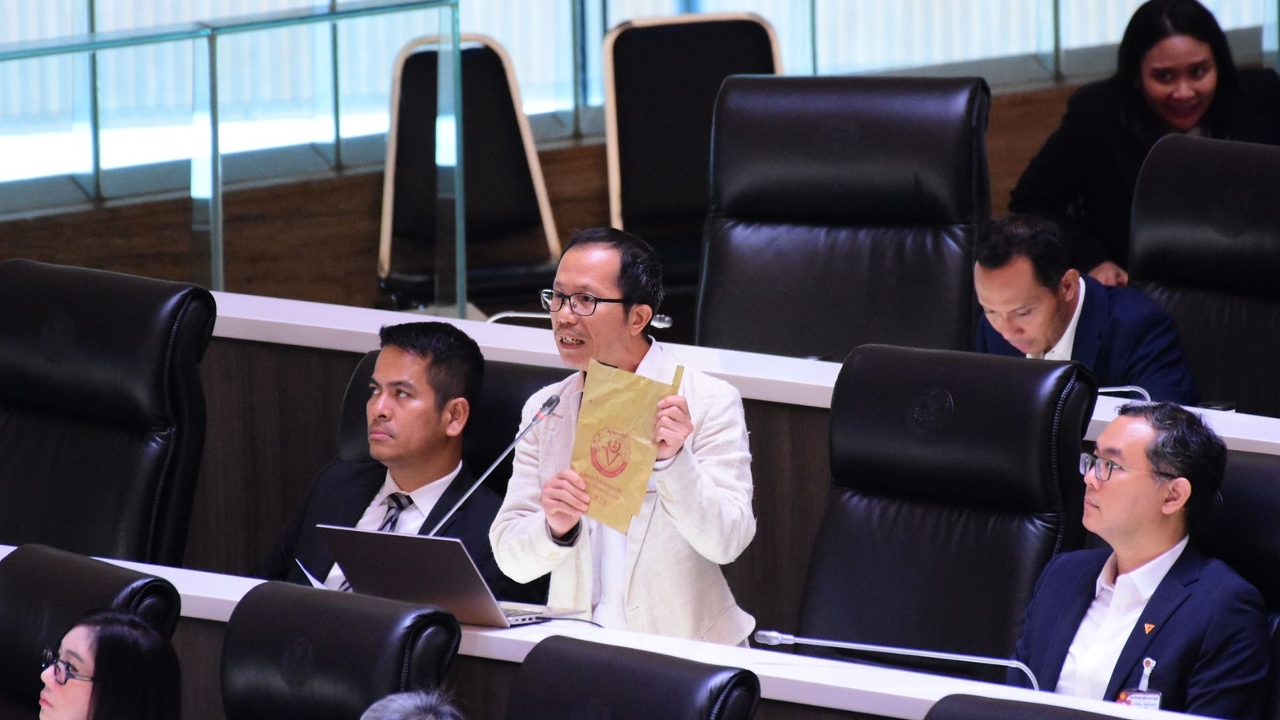
People's Party MP submits a motion to address the decline in agricultural product prices. "Lao Fang" laments the severe crisis, noting mango prices are lower than the cost of mango packaging bags, and criticizes government measures as insufficient and untimely in addressing the crisis.
On 22 Apr 2026 GMT+7, during the House of Representatives session, Mr. Lao Fang Bandittherdsakul, a party-list MP of the People's Party, proposed a motion requesting the House to establish a special committee to study solutions for the declining prices of agricultural products and to provide relief to farmers affected by the conflict in the Middle East. Opening the motion, he stated that since early 2026, prices of many agricultural products—including onions, cabbage, potatoes, garlic, and others—have fallen sharply and continuously, severely affecting farmers' livelihoods. The causes are not only normal market mechanisms but also ineffective government regulation, unclear and incomplete product standards, and excessive import volumes. Moreover, the conflict in the Middle East has further increased farmers' production costs, especially oil and chemical fertilizer prices. Therefore, he proposed this motion for the House to establish a special committee to study solutions and forward recommendations to relevant agencies.
MP Lao Fang continued that he had visited and talked with farmer groups across Thailand. Farmers are currently facing severe price declines for many products, causing widespread hardship. Despite this, farmers have received little assistance. Although some government campaigns exist, these efforts are minimal compared to the farmers' difficulties. He cited mangoes as a particularly critical example: currently, the price of mango packaging bags is higher than the mangoes themselves. Bags cost 2 to 2.5 baht each, while mangoes sell for less than 1 baht per fruit. Sadly, some mango growers are cutting down their trees because continuing cultivation leads to losses.
This crisis has impacted farmers' quality of life. With the new school term underway, Mr. Lao Fang believes that while ministers' children and others here will attend the best schools and receive excellent education, farmers' children face hardship. For instance, a family he met reported that last year, their child was admitted to university but had to suspend studies due to mango price declines and financial losses preventing tuition payment. They hoped to resume studies after selling mangoes this year, but losses continued, possibly forcing another year of suspension. This exemplifies the challenges Thai farmers face.
Mr. Lao Fang further criticized government actions as painfully inadequate. For example, the Department of Internal Trade claimed to assist mango growers in Phitsanulok by purchasing 30 tons of mangoes at an increased price of 1.5 baht per kilogram, spending 45,000 baht. However, Phitsanulok produces over 50,000 tons of mangoes. Helping 30 tons represents only 0.06% of the problem. The total losses for mango growers in Phitsanulok exceed 450 million baht, but government aid amounts to merely 45,000 baht—only 0.0001% of their losses. This excludes other crops facing similar price crises as mangoes, which he also discussed.
Besides product price issues, Thai farmers face high cultivation costs, yet government support is superficial. Agricultural machinery receives no support, and infrastructure improvements are lacking. Farmers must buy their own water pumps for irrigation. Additionally, increased imports of agricultural products since 2020 contrast with declining exports. Problems with foreign-owned wholesale centers within the country remain unaddressed seriously.
Amid these problems, the Middle East war exacerbates the situation by driving up oil and fertilizer prices, increasing farmers' production costs. The government is neglecting farmers, who buy fuel at the same prices as the general public. Fertilizer subsidies are limited to no more than 2,100 baht per farmer, while actual fertilizer costs exceed 20,000 baht, with some cases reaching hundreds of thousands.
He invited consideration of foreign countries' policies subsidizing fuel for farmers, which include providing coupons, price reductions, and compensation payments, enabling farmers to purchase fuel at lower prices than others. Similarly, foreign countries maintain sufficient fertilizer reserves for farmers and have stopped fertilizer exports. In contrast, Thailand continues to export fertilizer abroad.
Mr. Lao Fang proposed a three-phase approach to address the crisis: the immediate need to provide farmers with sufficient funds for living and next season's cultivation costs; medium-term solutions to find alternatives, reduce costs, and accelerate subsidies for technologies suited to Thai farmers, along with cultivation cost subsidies; and long-term structural reforms to ensure farmers can earn profits—something other countries have implemented but Thailand has yet to achieve.