

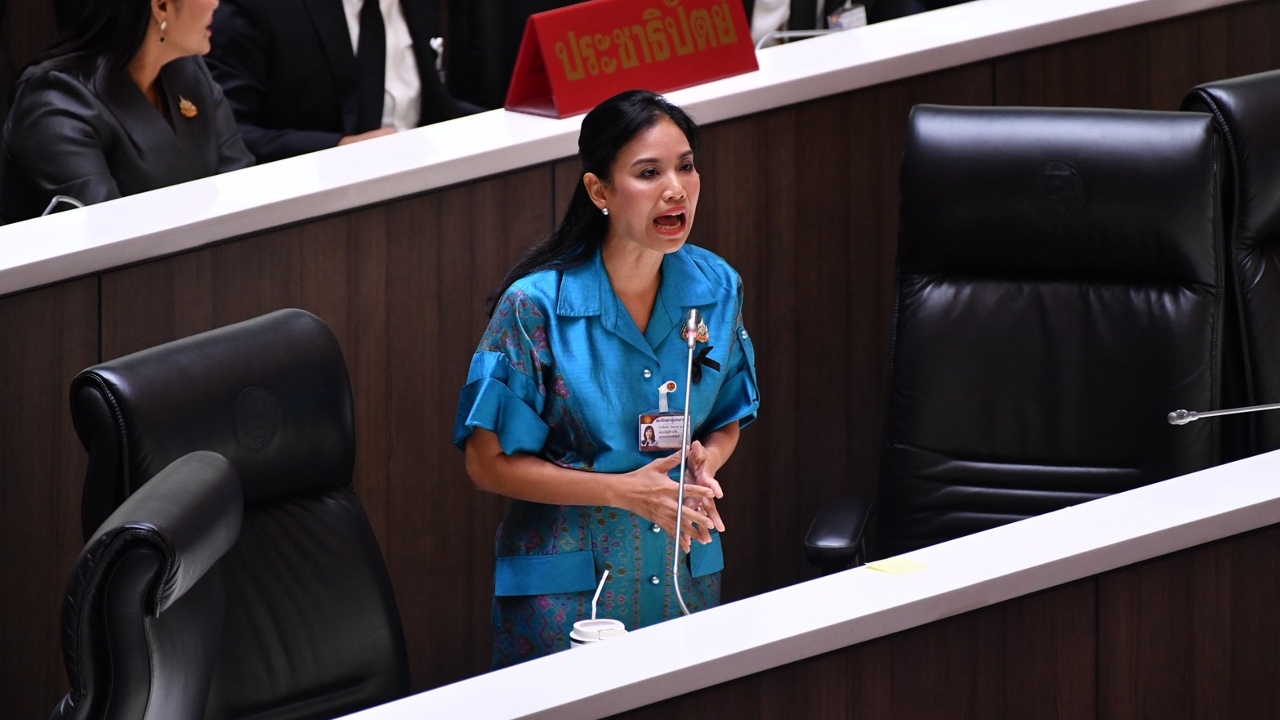
Radklao proposed five approaches to the Commerce Minister for sustainably solving the palm oil problem, pointing out that government policies have worsened the price decline.
On 22 Apr 2026 GMT+7 at the Parliament, Radklao Intawong Suwankiri, a party-list MP from the Democrat Party, spoke in the House of Representatives reflecting on the palm oil price crisis affecting over 300,000 farming households nationwide. She questioned the Commerce Ministry's policy management after domestic palm oil prices fell contrary to the global market.
Radklao stated that the current situation reflects "three key phenomena" that have caused Thai palm oil prices to plunge rapidly, which include
1. Market shock from the crude palm oil (CPO) export control policy announced on 7 Apr 2026 GMT+7, which immediately dropped the farmgate price from nearly 9 baht to about 7 baht per kilogram, causing farmers’ income to fall over 21% in less than two weeks.
2. Price suppression policy due to unclear communication, causing market panic. Small operators lacked clear information while middlemen exploited this gap to push purchase prices down.
3. Drought exacerbation from El Niño effects lowered oil content in palm fruits below standards, used as an excuse to further reduce prices.
Additionally, MP Radklao highlighted structural weaknesses in Thailand’s palm oil industry, especially the grading system still relying on visual and experiential assessments rather than precise scientific tools. She proposed five policy directions for sustainable problem-solving:
1. Adjust policies to be flexible and aligned with actual costs, considering reasonable income guarantee measures or stock quota systems alongside market mechanisms to prevent government distortion of prices.
2. Raise farmgate standards by supporting budgets to install standardized oil content measuring devices with real-time data linked to a central system for transparency and fairness.
3. Establish an integrated palm oil regulatory agency, similar to Malaysia’s Palm Oil Board (MPOB), to manage the system cohesively.
4. Accelerate development of the Sustainable Aviation Fuel (SAF) industry, seen as a long-term solution to absorb excess palm oil, noting the global market could grow to 29.7 billion USD while current production capacity remains insufficient.
5. Promote investment and reduce dependence on SAF imports. Currently, Thailand imports 100% of SAF, though some local producers have started investing, their capacity only meets about 5% of domestic demand.
Radklao expressed concern that external crises like wars or droughts may be uncontrollable, but crises caused by careless government policies and missed opportunities in new industries like SAF are preventable and fixable. "The government should not close doors for Thai farmers just as the global market is opening," Radklao concluded.