

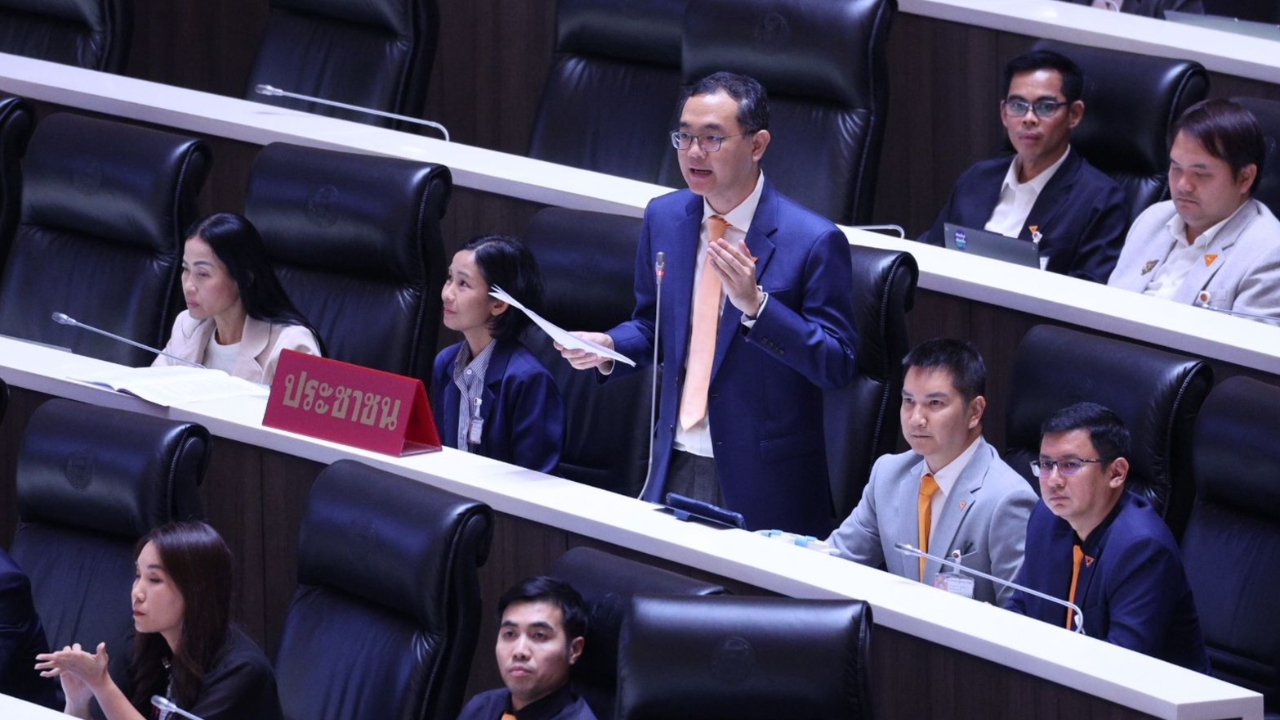
MP Isariya from the Prachachon Party questioned the government's 'old car for new car' policy, noting its ambiguity and demanding a clear explanation on whether it aims to reduce fuel consumption or to promote domestic vehicle production in the country. It is tagged as: [government policy, automotive industry, fuel consumption, Thailand]
On 22 April 2026, Isariya Paireepairit, a party-list MP from the Prachachon Party, spoke during a motion proposing the House of Representatives establish a special committee to study and monitor Thailand's progress toward net-zero greenhouse gas emissions by 2050. He referred to the government's current 'old car for new car' policy, which is promoted as a green economic stimulus measure. It is tagged as: [parliament, climate policy, green economy, Thailand]
Isariya raised several concerns about the policy, highlighting that its objectives remain unclear—whether it seeks to reduce fuel consumption or to encourage locally produced vehicles. It is tagged as: [policy analysis, fuel reduction, automotive production, Thailand]
1. Private passenger cars should not be included in the 'old car for new car' policy because the market for BEVs (which use no fuel) and HEVs (which use less fuel) is already functioning effectively. Evidence includes BEV bookings at the 2026 Motor Show, which accounted for about 60% of total vehicle reservations. It is tagged as: [electric vehicles, market trends, automotive policy]
Early government incentives for EVs in Thailand helped spark interest in electric vehicles when prices were high. Subsidies of 100,000 to 150,000 baht per vehicle made early adoption easier and helped establish the EV industry. However, now that market forces have lowered EV prices to around 400,000–500,000 baht, government subsidies are no longer necessary and funds should be redirected to other measures. It is tagged as: [electric vehicle subsidies, market development, government incentives]
2. The main problem with Thailand's fuel shortage is diesel, not gasoline. Average daily sales in Thailand show diesel at 81.63 million liters compared to gasoline at 35.10 million liters—diesel consumption is nearly 2.3 times higher. Therefore, the government should prioritize reducing diesel use rather than gasoline. It is tagged as: [fuel consumption, diesel, gasoline, Thailand]
Hence, the government should focus on vehicles such as pickup trucks, trucks, and passenger buses, encouraging their transition to alternative energy sources instead of focusing on passenger cars. It is tagged as: [vehicle types, alternative energy, government focus]
3. Thailand has many old pickup trucks still in use, many of which evade tax renewal. These old pickups have high fuel consumption, emit significant CO2, and produce visible black smoke pollution. It is tagged as: [vehicle emissions, old vehicles, pollution, Thailand]
According to the Department of Land Transport, only 0.71% of private cars fail annual inspections, whereas pickups have a higher failure rate of 2.51%. It is tagged as: [vehicle inspection, emissions testing, statistics]
The government should focus on these old pickups to simultaneously achieve three goals: reduce fuel use, lower carbon emissions, and decrease black smoke pollution. It is tagged as: [policy recommendations, pollution control, fuel efficiency]
Isariya noted that although electric pickups are beginning to appear on the market, technical limitations remain, including lower payload capacity due to battery weight, shorter driving range per charge compared to fuel vehicles, long charging times, and much higher prices—electric pickups cost over 1 million baht, while diesel pickups start around 500,000 to 600,000 baht. It is tagged as: [electric vehicles, technical challenges, pricing]
It is therefore unsurprising that in March 2026, only 71 new registrations of fully electric pickups, buses, and trucks occurred, compared to 26,000 new registrations of passenger cars and private sedans. It is tagged as: [vehicle registration, electric vehicles, market data]
4. The government should incentivize upgrading pickups to newer models. Since fully electric pickups are not yet ready, Isariya proposed three feasible approaches with increasing subsidy levels. It is tagged as: [policy proposals, vehicle upgrade, subsidies]
Trade in an old diesel pickup for a new diesel pickup—while still diesel-powered, newer engines consume less fuel due to improved technology and emit less carbon. It is tagged as: [vehicle replacement, diesel technology, emissions reduction]
Trade in an old diesel pickup for a hybrid electric vehicle (HEV) pickup—using a gasoline-electric hybrid engine to reduce diesel use, representing a compromise between traditional fuel and fully electric vehicles. It is tagged as: [hybrid vehicles, transition technology, fuel reduction]
Trade in an old diesel pickup for a fully electric vehicle (BEV) pickup—which uses no fuel and emits no CO2 or pollutants. It is tagged as: [electric vehicles, zero emissions, automotive policy]