

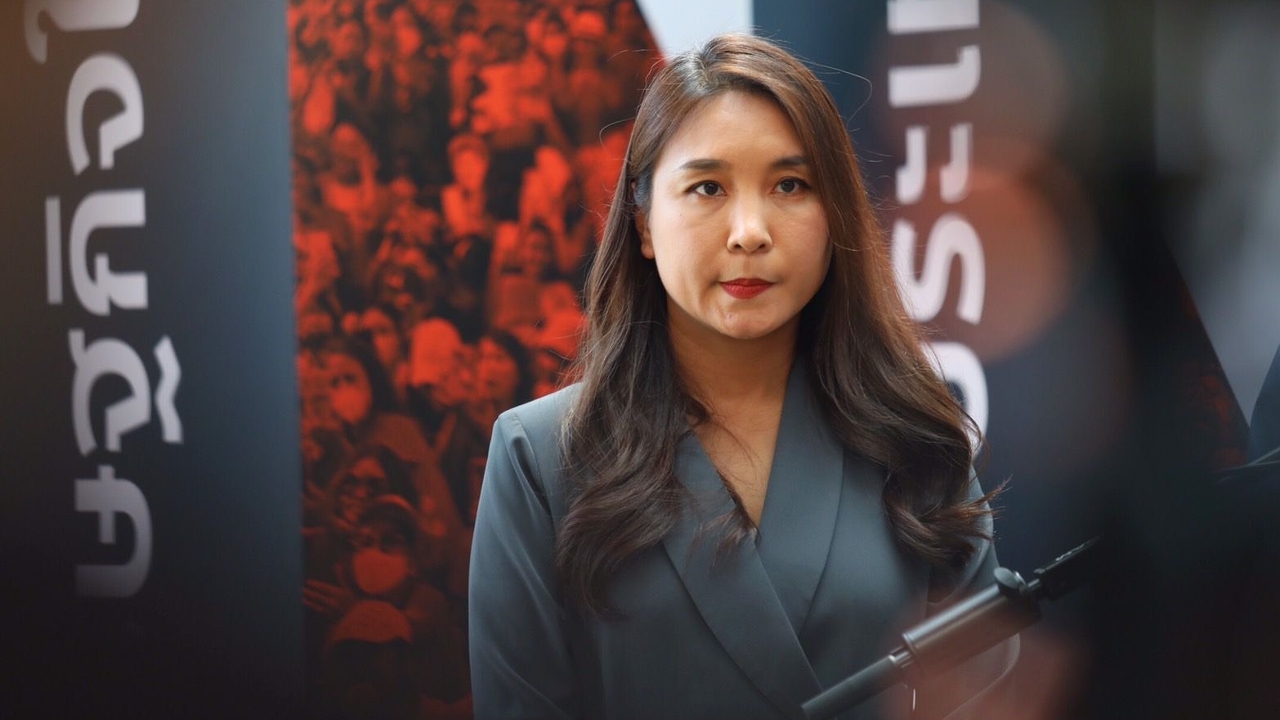
Sirikanya intercepts the government's plan to borrow 500 billion baht, questioning why it stubbornly denies raising the debt ceiling when figures clearly show it will exceed 70%. She warns that borrowing to randomly distribute money must stop, and funds should instead be invested to build the future and grow the economy.
On 23 April 2026 GMT+7, Ms. Sirikanya Tansakul, a party-list MP from the Prachachon Party, spoke about rumors that the government plans to issue a 500 billion baht loan decree. She noted that although government officials have expressed differing views, Deputy Prime Minister Akniti recently admitted to the media that the borrowing will indeed take place. Regarding the government's denial of raising the public debt ceiling from 70% to 75%, a review of the actual figures shows the government cannot avoid eventually expanding the debt ceiling.
Ms. Sirikanya added that although public debt stood at 66% as of February 2026, the government still plans to borrow nearly 500 billion baht to cover the 2026 budget deficit, pushing the debt-to-GDP ratio to 67%. If another 500 billion baht loan decree is issued, the debt will immediately exceed the 70% ceiling. Therefore, before the Cabinet approves the loan, the government must announce a debt ceiling expansion. She expressed confusion over why the government still denies this to the public.
Concerns over the price to pay
She also voiced concern that the "price to pay" for this borrowing will be very high, particularly the rapidly rising interest burden. Currently, interest payments for 2026 are 270 billion baht, or 9% of state revenue, projected to rise to 12% in 2027. One criterion for Investment Grade bonds is that interest payments should not exceed 10% of revenue. If the government borrows another 500 billion baht, it must prepare debt service payments—principal and interest—totaling over 520 billion baht, rising to 640 billion baht by 2030. This increasingly consumes the national budget, potentially hindering other development areas.
"We must be confident that borrowing will truly revive the economy—restoring growth to full potential and expanding Thailand’s economic capacity beyond before. This is the only way to increase government revenue so interest payments won’t drag down the budget. But if it fails, as during the COVID period, we may face prolonged high debt and low growth," she said. Ms. Sirikanya stated.
Suggesting focus on future-building projects
She proposed the government shift from merely reactive, short-term relief programs to visionary projects that build the future. She emphasized that randomly distributing money, like the 'Khon La Khrueng' (Half-Half) program, may miss the mark. Instead, funds should restructure the real economy; for example, rather than subsidizing traditional solar farms, money should develop smart grid transmission lines to support liberalized clean energy. Or, if pursuing a car trade-in program, it should include conditions to build a modern automotive industry focused on domestic value-add and technology transfer, not just assembly imports.
Ms. Sirikanya concluded that this might be the last off-budget borrowing opportunity the country’s fiscal position will allow. She urged the government to use taxpayers’ money as efficiently as possible and to look beyond short-term fixes, so future budgets won’t be consumed by debt repayment, leaving no funds to develop the country’s potential further.