

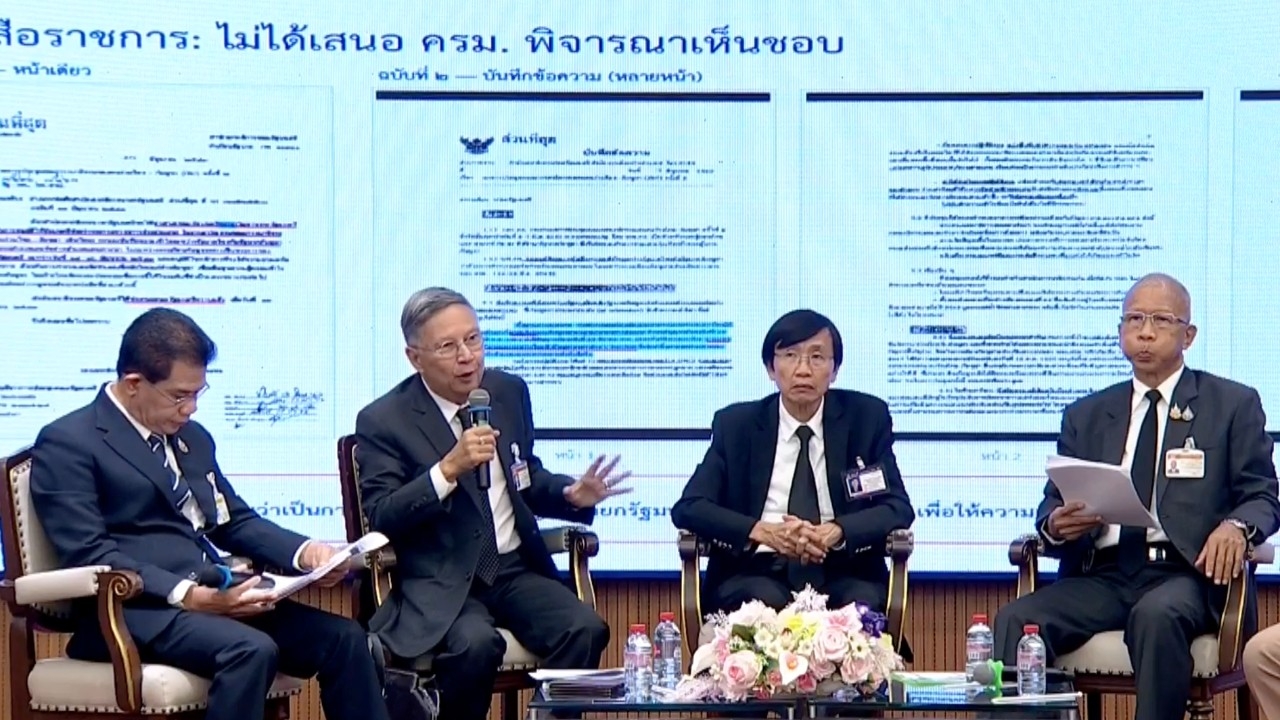
The special committee on MOUs 2000 and 2001 held a forum to hear opinions on the pros and cons of canceling both MOUs and advised the government to exercise caution when entering treaties with Cambodia. Kamnoon stressed that MOU 43 conflicts with the constitution and relevant laws as well.
On 23 Apr 2026 GMT+7, Mr. Mongkol Surasajja, President of the Senate, presided over the opening ceremony of the seminar titled “MOUs 2000 and 2001: Reflecting on the Past, Assessing the Present, and Looking Toward Thailand’s Future.” The event was organized by the special committee studying the pros and cons of canceling MOUs 2000 and 2001 to resolve Thai-Cambodian border issues. Experts and academics were invited to exchange views.
Mr. Mongkol stated that understanding the Thai-Cambodian border issue is crucial, rooted in border demarcations established during the Siam-France era, which used multiple inconsistent maps. This resulted in historical legacies causing ongoing border disputes between the two nations. Additionally, overlapping maritime claims in the Gulf of Thailand, where both sides assert conflicting continental shelf rights, led to the creation of the “Memorandum of Understanding between the Government of the Kingdom of Thailand and the Government of the Kingdom of Cambodia on Land Boundary Survey and Demarcation (MOU 2000)” and the “Memorandum of Understanding on Overlapping Continental Shelf Claims (MOU 2001).” These served as frameworks for border management and joint marine area development. However, both MOUs sparked extensive debate in international law, political science, and economics, amid public concerns over impacts on national borders and natural resource rights. Therefore, this study must be conducted carefully, thoroughly, and factually, with input from all sectors—including legislative, executive, security agencies, academics, experts, and affected citizens. He expressed confidence that the seminar would serve as a constructive platform to foster correct understanding of the MOUs’ origins, content, intentions, and impacts, and to consider approaches that maximize national benefit based on sovereignty, international law, and peaceful dispute resolution.

Mr. Noppadon Inna, Chair of the Special Committee studying the benefits and drawbacks of canceling MOUs 2000 and 2001 to solve Thai-Cambodian border issues, said that past observations noted benefits in retaining both MOUs. Thus, the Senate committee has conducted a thorough study, including field visits to seven border provinces along approximately 798 kilometers of Thai-Cambodian border. MOU 2000 pertains to land boundary surveys and demarcation following border demarcations from 1904 and 1907, which have long-standing problems. The area divides into regions with clear boundary markers and complex mountainous areas along the Phanom Dong Rak range.
Meanwhile, MOU 2001 concerns maritime boundary delimitation. The committee has carefully studied all aspects, and the seminar invited several distinguished speakers to provide information supporting the preparation of reports to the Senate and government.
The seminar then proceeded with discussions on “MOUs 2000 and 2001: Reflecting on the Past, Assessing the Present, and Looking Toward Thailand’s Future,” featuring academics and experts on legal issues related to both MOUs.
Mr. Kamnoon Sitthisaman, former senator, viewed that MOU 43 violates laws in four respects: Section 244 paragraph one of the 1997 constitution combined with Section 3, as the treaty with a foreign country was not approved by Cabinet resolution. The Cabinet resolution on 13 June 2000 merely acknowledged the minutes of the 1st Thai-Cambodian Joint Border Commission (JBC) meeting and the Prime Minister’s directive to draft MOU 43. One day later, the Foreign Minister signed the MOU within seven days, with approval only from the Prime Minister, equivalent to a single minister's approval, which needed Cabinet endorsement first. Signing for acknowledgment is not the same as a Cabinet resolution, violating the 1988 Prime Minister’s Office regulations, Cabinet resolutions from 1992, and the 2nd JBC meeting minutes stipulating that draft JBC agreements require government-level approval before signing. He emphasized that MOU 2000 is like a corpse no government should allow to remain because it will become corrupt and that if the current government, which acknowledges these errors, does not act, it will face significant risks.
Mr. Suwanchai Saengsukiam, honorary advisor to the special committee, stated that historically the border demarcation maps were prepared by the French at a 1:200,000 scale without Siam’s border demarcation committee approval. The Siam-France treaties of 1894 and 1907 demarcated 74 markers based on watershed boundaries using geographical features. The problem arose along the Phanom Dong Rak range, from Marker 1 to the Ubon Ratchathani land pass covering 196 kilometers, where no boundary markers were installed. Over time, marker displacement and deterioration led to MOU 2000 to reduce border conflicts. However, disputes persisted, leading to multiple clashes between the two sides. Despite over 26 years of surveying, only 45 markers were completed. Cambodia's constitution declares any treaty violating territorial integrity void and mandates use of a 1:100,000 map scale, equivalent to 1:200,000. Thus, one side must reject MOU 2000 as unconstitutional. He believes the MOU should not be maintained because if it remains, Cambodia will gradually encroach into Thai territory. He urged the government to be meticulous when drafting treaties with Cambodia to avoid future problems due to Cambodia’s provocative and distortive behavior. The MOU can be canceled due to serious violations by the opposing side but requires a three-month prior notice to Cambodia and forbids the JBC from negotiating, as that would imply acceptance of the violations’ insignificance.
Admiral Pallop Tamisanon, special committee member, said that MOU 2001 concerns maritime benefits in the Gulf of Thailand, notably the Pattani Basin located centrally towards Thailand’s side. It is estimated to hold over 10 trillion baht worth of natural gas and oil. Private companies have been granted concessions but must delay operations until both sides agree on maritime boundaries, which remain unresolved due to continental shelf disputes. Cambodia claims rights and issued two royal decrees in 1972 encroaching into Thailand’s waters between Ko Kut island and the coast, clearly violating Thailand’s sovereignty. In 1973, Thailand declared its continental shelf under a royal decree drawing equal-distance lines from Ko Kut and Koh Kong islands. He recommended the government cancel both MOUs 44 and 43 and return to negotiations on land and maritime boundaries using the 1995 JBC and JTC frameworks based on the Siam-France treaties and maritime law. Thailand must clearly state its position per the joint statement of 27 Dec 2025, which serves as a ceasefire and border closure agreement until land and maritime boundary talks conclude. Simultaneously, Thailand should prepare for possible conflicts and maritime armed incidents and the likelihood that Cambodia may bring the case to the International Tribunal for the Law of the Sea. He also cautioned to be wary of “masked agents” during any negotiations with Cambodia.
Meanwhile, Navy Captain Asst. Prof. Saman Dai Ramy, honorary advisor to the special committee, noted that international agreements depend on political, economic, social, and public environments. Since Cambodia gave its 1982 UNCLOS ratification in February 2026, he studied the Philippines-China South China Sea dispute, where despite the court not ruling on maritime boundaries, the case impacted maritime borders. Thailand and Cambodia have both declared maritime boundaries, complicating negotiations. Cambodia’s ratification pledges to suspend maritime disputes when appropriate, making court adjudication possible. Cambodia has issued three baseline declarations to create maritime boundaries covering Thailand’s entire coastline. Whether to cancel or maintain MOU 2021, no progress is evident, though negotiation methods and boundary definitions remain unchanged. Thailand can declare straight baselines and demonstrate it acted fairly and correctly, aiming to prove Cambodia acted unfairly in maritime boundary delimitation. Thailand must prepare to substantiate its just maritime boundaries so all parties recognize and accept them.
