

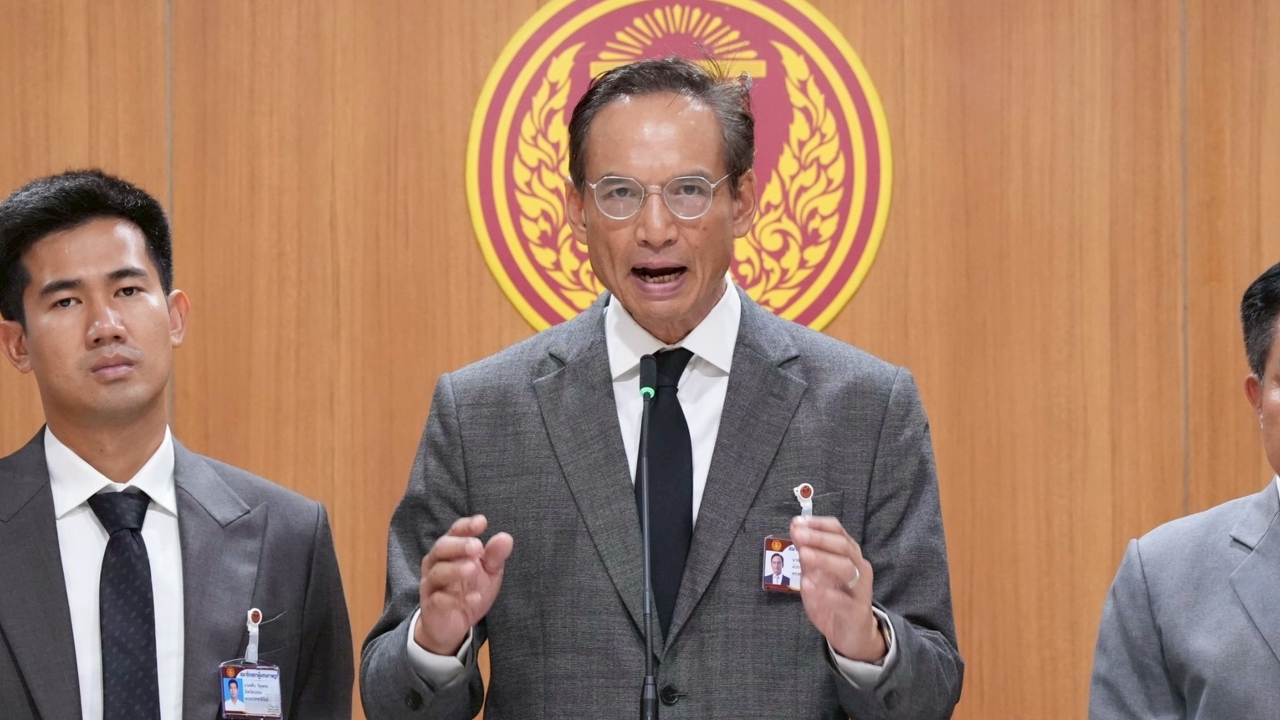
Korn expressed disappointment with Akniti and Eknat's unclear explanation of the refining cost reduction formula, urging them to stop being deferential to big business and instead protect the interests of the public. He pointed out that issuing the debt-raising Royal Decree is a peculiar plan, and called on the government to stop citing the public's hardship as a justification for wanting to spend money.
23 Apr 2026 GMT+7 Mr. Korn Chatikavanij, Deputy Leader of the Democrat Party, held a press conference at the Parliament building following a live question session on issues related to the public's economic livelihood, stating that after hearing explanations from the Minister of Finance and the Minister of Energy, some issues were answered clearly, but others remained unsatisfactory.
The first issue raised was the energy problem regarding oil prices, as Mr. Akniti Nitithanprapas, Deputy Prime Minister and Minister of Finance, chairs the committee studying the suitability of setting fuel oil cost prices (the COTR) to examine whether the current pricing process—including refining fees, marketing fees, and other formulas—is fair to the public. While this committee was formed, the Minister of Energy responded to questions, expressing the view that the current refining fees charged by refineries are unfair to the public, which led to a proposal to reduce the refining fee by 2 baht since late March and an announcement in Parliament to lower it by 5 baht.
"The fact, according to the calculation formula cited by the Minister of Energy, is that the discount is not just 2 baht, but should be 8.50 baht per liter. The claimed assistance to the public so far has actually been a discount that is still far too low."
Meanwhile, excess profits that refineries have already earned, amounting to tens of billions of baht over nearly two months, raise the question of what mechanisms the government will use to return those excess profits to the public. It is now clear that the excess profits discussed are not merely our speculation, as the Ministry of Energy has acknowledged that excess profits have indeed occurred. Since the government is aware of this excess profit over the past two months, it has a duty to recover those excess profits for the benefit of those harmed, namely the public.
Mr. Korn also questioned the committee's work, asking what new oil price calculation formula will be used going forward. The answer so far appears to be that there will be no change to the refining fee calculation formula; the old formula remains. The concern today is that once the crisis eases, the special discount negotiated by the Ministry of Energy with refineries will disappear, returning to a refining fee system based on Singapore prices as before. If another crisis occurs, the same problem will recur as it did in 2021-2022. Thus, the committee’s results remain unsatisfactory, and there should be a clear conclusion for the public about which pricing system, based on a fairer cost structure, should be used. Currently, there still appears to be deference to major business interests rather than concern for the public's benefit.

The second issue is the fiscal situation, where the government is preparing to issue a Royal Decree (P.R.K.) to borrow money. Mr. Korn considers this a peculiar plan, revealed to the media by the Deputy Prime Minister responsible for legal affairs, who admitted the Ministry of Finance was unaware of it and was not consulted. He further stated that there is currently no necessity to issue such a debt-raising P.R.K. Mr. Korn believes that someone with authority within the government, and he trusts that Deputy Prime Minister Pakorn Nilprapunt (Deputy Prime Minister for Legal Affairs) did not initiate this on his own, ordered the legal team to prepare for a major issue that will affect the country's fiscal status and public funds by as much as 500 billion baht, without consulting the Minister of Finance or ministry staff.
Mr. Korn expressed concern because no government ever feels its funds are sufficient, and there is always some group of citizens suffering hardship. If the government is sincere, it is natural for politicians to want more funds but they should not justify this by citing the public's hardship, which contradicts constitutional law under Section 172. This section clearly states that beyond the regular budget deficit, the government may borrow additionally only in cases of emergency necessity. He thus questioned Mr. Akniti whether the current situation truly is unavoidable, as Mr. Akniti cited past instances in 2009 and 2020 when P.R.K.s were issued. Mr. Korn did not deny those cases, noting the 2009 situation was a joint effort, and in 2020 was due to the COVID-19 pandemic. However, this year’s GDP growth is forecast at 1.5 percent. He asked whether this qualifies as an emergency, suggesting it would be better to reserve borrowing for times when the country has no other options.