

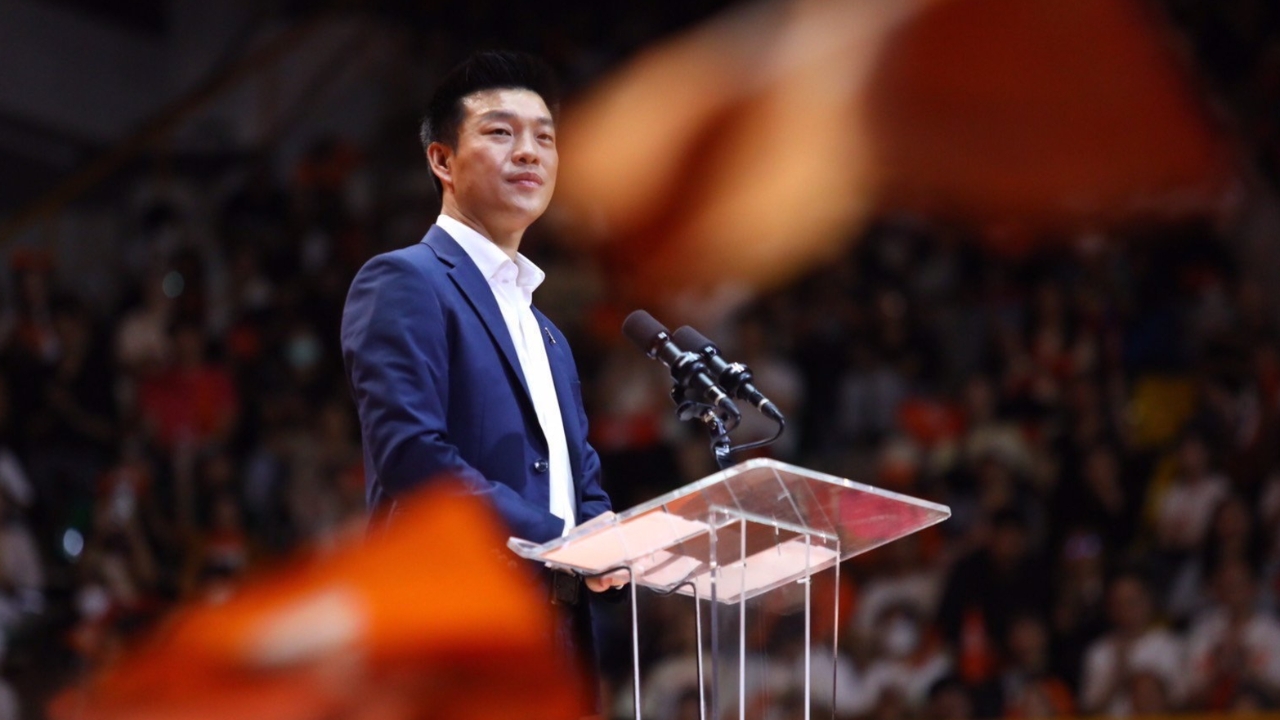
“Natthapong” stressed that the petition to propose an amendment to Section 112 is within the lawful constitutional authority and duties. He pointed out that regardless of the Supreme Court's decision tomorrow, he affirms that the 10 People’s Party MPs should continue to perform their duties as members of the House of Representatives.
On 23 April 2026, Mr. Natthapong Ruangpanyawut, leader of the People’s Party, posted on X regarding the Supreme Court’s scheduled panel meeting to consider the petition filed by the National Anti-Corruption Commission (NACC) against 44 former Move Forward MPs tomorrow (24 Apr 26) for serious ethical violations related to their petition to amend Section 112 of the Criminal Code. He said it remains to be seen whether the Supreme Court will accept the petition for consideration and whether the 10 People’s Party MPs will be ordered to suspend their duties. He affirmed, “We will never cease performing our duties as representatives.”
I began my journey with the Future Forward movement driven by a dream and determination that politics is a matter for ordinary people who can create change. Politics belongs to everyone; no matter where you are in the country, everyone can participate in the Future Forward movement to build a Thailand where ultimate power belongs to the people.
Throughout this journey, we have never walked a smooth path. We have faced legal warfare, including defamation suits, party dissolution, disqualifications, and various forms of harassment. But we firmly believe that our duties are carried out to protect the interests and taxes of the people, and to establish Thailand as a country governed by the rule of law where all citizens are equal and treated fairly.
“I affirm that the petition to propose amendments to Section 112 by the former Move Forward MPs at that time was within the constitutional authority and duties of representatives elected by the people. Using the House of Representatives to debate sensitive issues with maturity to seek solutions to conflicts over the past 10 years was never intended to overthrow or undermine the system, contrary to accusations from those in power.”
I invite everyone to consider fairly whether the use of “ethical standards” without clear criteria or applied inconsistently against the legislative duties of representatives serving the people poses a greater threat to our democracy.
While our cases proceed rapidly, numerous corruption cases involving public interests remain stagnant at the NACC. This raises the question: what are the actual standards used by the NACC in case evaluations?
I believe the real reason we face these charges today is not because of the bill proposals but because we represent the people who want change. Such change threatens those who hold power and interests in Thailand. When challenged, they fight back regardless of methods or concern for the country’s future.
“Tomorrow, regardless of the Supreme Court’s ruling, I affirm that all 10 of us MPs should continue performing our duties as members of the House of Representatives.”
First, our continued duties as MPs are performed under the constitution to protect the people’s interests. Continuing our duties will not harm public interests or government administration in ways that are irreparable.
Second, our duties as MPs are part of the essential powers of parliamentarians within the democratic system under a constitutional monarchy or parliamentary democracy.
Third, the 10 MPs involved in the case cannot act in the same manner as the NACC’s petition. That is, we cannot jointly propose a bill similar to or resembling the NACC’s petition again.
Finally, our continued duties will not affect the Supreme Court’s fact-finding or interfere with evidence, as both the Constitutional Court and NACC have already gathered the facts.
Conversely, if the Supreme Court orders all 10 MPs to suspend their duties, it will inevitably impact parliamentary governance. Other MPs or even the entire legislature may become fearful and reluctant to perform their roles as representatives who connect the people to parliament and government, simply because they exercised their constitutional rights to propose bills but faced legal cases resulting in suspension and possible lifetime disqualification.
Therefore, I emphasize that tomorrow’s outcome, whatever direction it takes, will not only affect a particular group of representatives but will impact the legislative power derived from the people. This issue is bigger than us, bigger than the People’s Party—it concerns the future of Thai democracy and all of us.
Natthapong Ruangpanyawut
Member of the House of Representatives, People’s Party
23 April 2026 GMT+7