

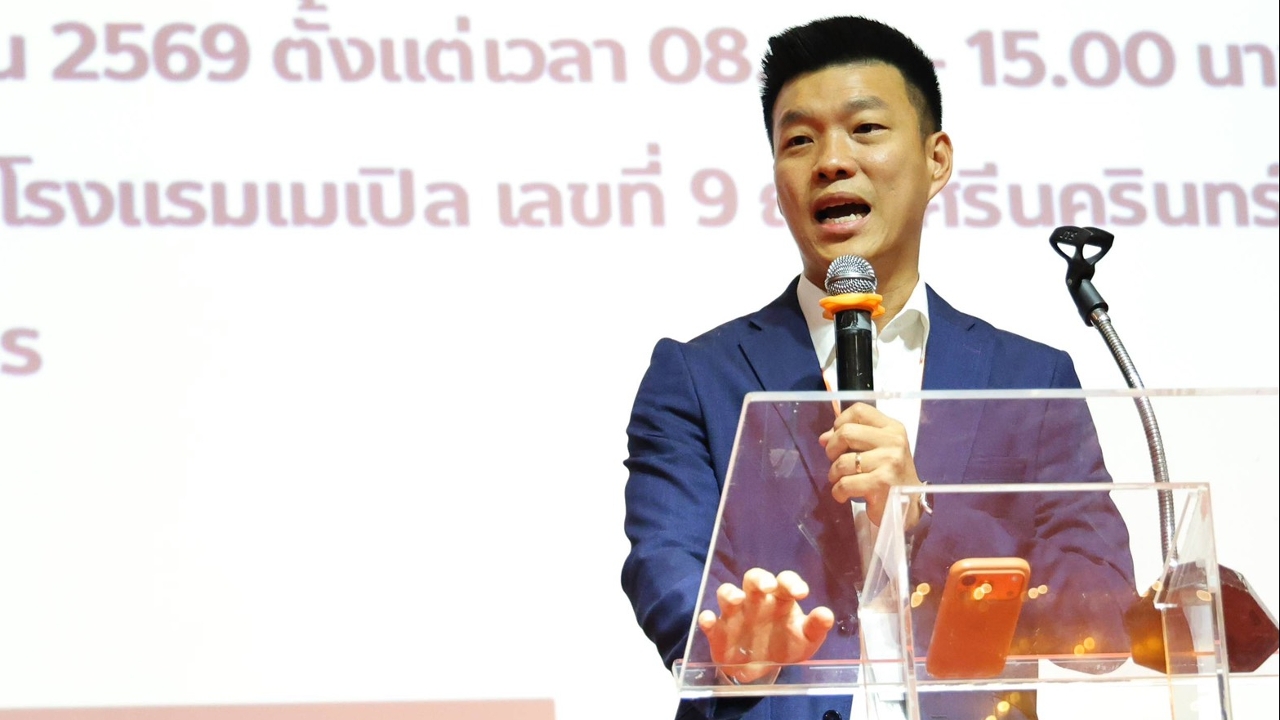
‘Teng’ points out that Anutin’s government appears strong externally but is internally fragile due to excessive ties to interest groups, and is preparing to form a shadow cabinet to challenge government oversight.
On 26 Apr 2026 GMT+7, Mr. Natthapong Rueangpanyawut, leader of the People’s Party, assessed whether the government led by Prime Minister and Interior Minister Anutin Charnvirakul would complete its full four-year term, and what traps might corner this administration. He noted that from an external perspective, the government appears strong and stable in many areas, with some analysts suggesting influence tied to senators or independent agencies. However, from another angle, beneath this apparent strength lies internal fragility.
Mr. Natthapong highlighted that the government’s fragility stems from the various power groups linked together, including major factions from other parties absorbed into the Bhumjaithai Party, misuse of authority by independent agencies, supporting business interests, and civil servants benefiting from the blue government. All these interests are interconnected. The oil crisis illustrates a vulnerability that exposes the government’s weaknesses. Despite having technocrat ministers, some issues, like the land bridge project, have not been openly criticized.
“Therefore, I believe this internal fragility, tied together by interest groups, means that future crises will expose the government’s weaknesses despite its outward strength. It is the opposition’s and People’s Party’s duty to show the public that under such a government, Thai society will become more fragile, and the government itself will not last,” he said. Natthapong stated.
Regarding the People’s Party’s effort to gather parliamentary signatures to establish an independent Supreme Court investigation committee to scrutinize the National Anti-Corruption Commission (NACC), Mr. Natthapong said he believes some opposition parties and certain senators have joined in signing with them, emphasizing that they are not working alone.
When asked whom they have spoken with, Mr. Natthapong stressed that behind-the-scenes talks have occurred with all sides, but since no official resolution has been made, revealing who has signed could breach negotiation etiquette. He confirmed discussions have taken place and expressed confidence they will secure the required number of signatures.
Mr. Weerayut Kanchuchat, deputy leader of the People’s Party, explained the idea behind forming a shadow cabinet. He said the party intends this mechanism to spearhead both government oversight and proposing better alternatives for the public. Weekly meetings will be held, aiming to inspire hope that Thailand can improve. They want to show how, if in government, they would offer better solutions. The shadow cabinet will be divided into four sectors: security, economy, quality of life, and state and legal reforms. This work will connect all party components—from party members, committee chairs, MPs, to grassroots networks—demonstrating how better policies could resolve local issues and how MPs can drive progress.
On the number and selection method for the shadow cabinet, Mr. Weerayut noted that structuring work into four broad sectors is more effective than dividing by individual ministries. The work links MPs and party leaders without fixed roles. For key but neglected areas such as SMEs, there will be a dedicated shadow cabinet team. Teams will align with current work structures since dividing strictly by ministry could overlook or unnecessarily combine issues. Hence, the four main sectors will have sub-teams.
Mr. Natthapong added that the People’s Party’s shadow cabinet will be officially detailed by the end of April. Regarding whether 10 MPs not suspended from duties will chair committees, he said the party is still working on this internally. Principally, whether new MPs, current ones, or these 10 MPs, the process is open and inclusive to all efficiently, which has been the case so far.