

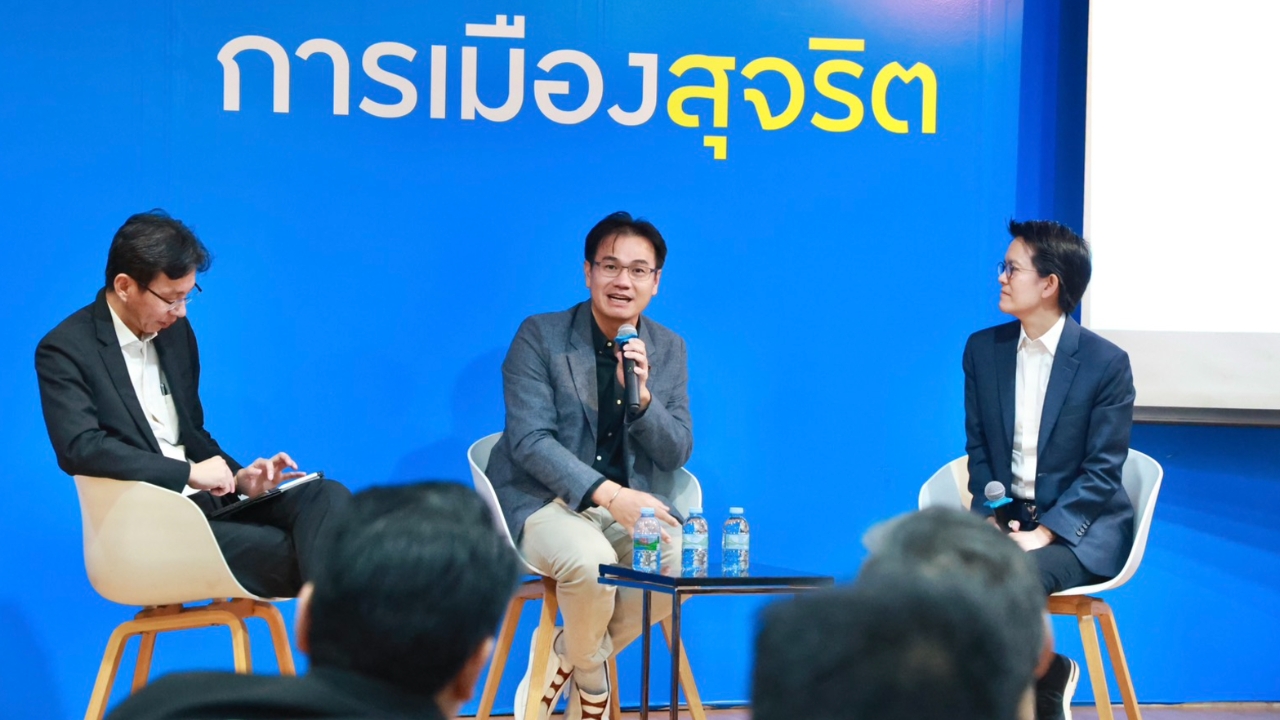
At the Democrat Party seminar titled “UNLOCK THE CITY - Smart Systems, Public Transport, and the Future of Cities,” two experts emphasized the need for centralized administrative authority, stressing that an effective transport system must be accessible, convenient, and safe for users.
On 27 April 2026, the Democrat Party (DP) held its second seminar on the topic UNLOCK THE CITY: Smart Systems, Public Transport, and the Future of Cities, as part of the 'New Sky Forum…A Platform to Discuss All Bangkok Problems: Can’t Do or Won’t Do?' The event featured Professor Dr. Ekachai Sumalee, Deputy Director of the Integrated Innovation Institute at Chulalongkorn University, and Dr. Sumeth Ongkittikul, a researcher at the Thailand Development Research Institute (TDRI). Both are experts in intelligent traffic systems and public transportation. Dr. Naritsara Limthanakul served as the moderator.

Professor Dr. Ekachai addressed traffic problem solutions, presenting his concept of transitioning Bangkok into a Smart City by applying modern transport technology and models. He proposed using 'new tools' to meet urban residents’ basic needs across three key dimensions: environmental, by reducing pollution from travel; safety, by increasing confidence in road and transport use; and mobility, by ensuring smooth, predictable journeys. Currently, travel in Bangkok is highly complex (multi-modal), with individuals using several transport types per trip. The main challenge is reducing per capita travel cost and time while genuinely improving convenience and savings. Key tools include the Internet of Things (IoT) and artificial intelligence (AI). IoT must interconnect all devices to provide real-time traffic status, such as bus seat availability. AI should serve as a brain analyzing massive data without omission to manage the complex traffic system beyond human control.

Regarding the future framework, development is divided into levels: Smart Travellers, who use apps to plan travel time (a skill growing among Bangkokians); Smart Vehicles, including the arrival of autonomous cars and vehicle-to-everything (V2X) communication; and the MaaS Model (Mobility as a Service), shifting from vehicle ownership to purchasing travel services via a single integrated platform connecting all transport modes (Integrated IT Approach). For Bangkok to be efficient, three main components are essential: 1. Integrated Data, requiring data from all sectors to be consolidated and shared publicly; 2. Decision Support System, which must promptly address accidents or unforeseen events to resolve traffic issues; and 3. Collaborative Infrastructure, ensuring expressways, trains, and roads work in harmony. Traffic congestion solutions lie not in building more roads but in managing information effectively.
The core is creating a new business model using the city as a living lab to attract technology investment. If all transport systems can be linked into one platform, it will not only ease traffic congestion but also create new business opportunities, enabling sustainable growth for Bangkok while reducing hidden economic costs lost in travel time.

Dr. Sumeth discussed structural problems of Bangkok’s public transport system and solutions. He identified the root cause as chaotic urban planning and uncontrolled urban sprawl. Traffic congestion began when the city expanded disorderly to address immediate problems, dispersing residential areas widely and sharply increasing travel demand. Expressways cost tens of billions of baht, while electric trains cost fifty to one hundred billion baht. Currently, most electric train systems operate at a loss because of limited government budgets leading to private investment, resulting in high fares and insufficient network coverage. Traditional bus systems, once Bangkok’s backbone, have lost over 30% of users due to management failures. The system shifted from fully private to state-run (BMTA), which ran at a loss, then back to private partnerships with fragmented, inconsistent contracts, causing route competition, lack of standards, and poor staff coordination. Although bus reform and electric buses (EV) began in 2022, and reform started in 2016, progress stalled due to inadequate infrastructure, such as substandard sidewalks. No matter how good the bus system is, poor pedestrian access to stations or stops renders it ineffective.

Comparing international models, in the UK, the government manages the network while private companies compete to provide services. The Netherlands uses an integrated concession system. Thailand still faces major 'decision-making power' problems because Bangkok residents do not control their city’s planning, oversight, or operations. Authority is fragmented across multiple central agencies without unified goals (Fragmented Governance). Therefore, the 'Big Moves' or solutions for tangible change include four main strategies:
1. Vision Alignment: Establish a single long-term goal rather than fragmented efforts.
2. Clear Accountability: Define responsibilities clearly, specifying which agency manages each part.
3. Connectivity Investment: Road expansion should not focus solely on vehicle lanes but also invest in sidewalks to ensure practical pedestrian connections.
4. Market Restructuring: Redesign the market framework to enable private sector development of efficient and sustainable services.
Traffic problems in Bangkok cannot be solved merely by adding new buses or trains. The fundamental solution lies in restructuring administrative power, centralizing authority at the local level, and creating a 'walkability ecosystem.' Mass transit performs best when people can access it conveniently and safely from the first step outside their home.