

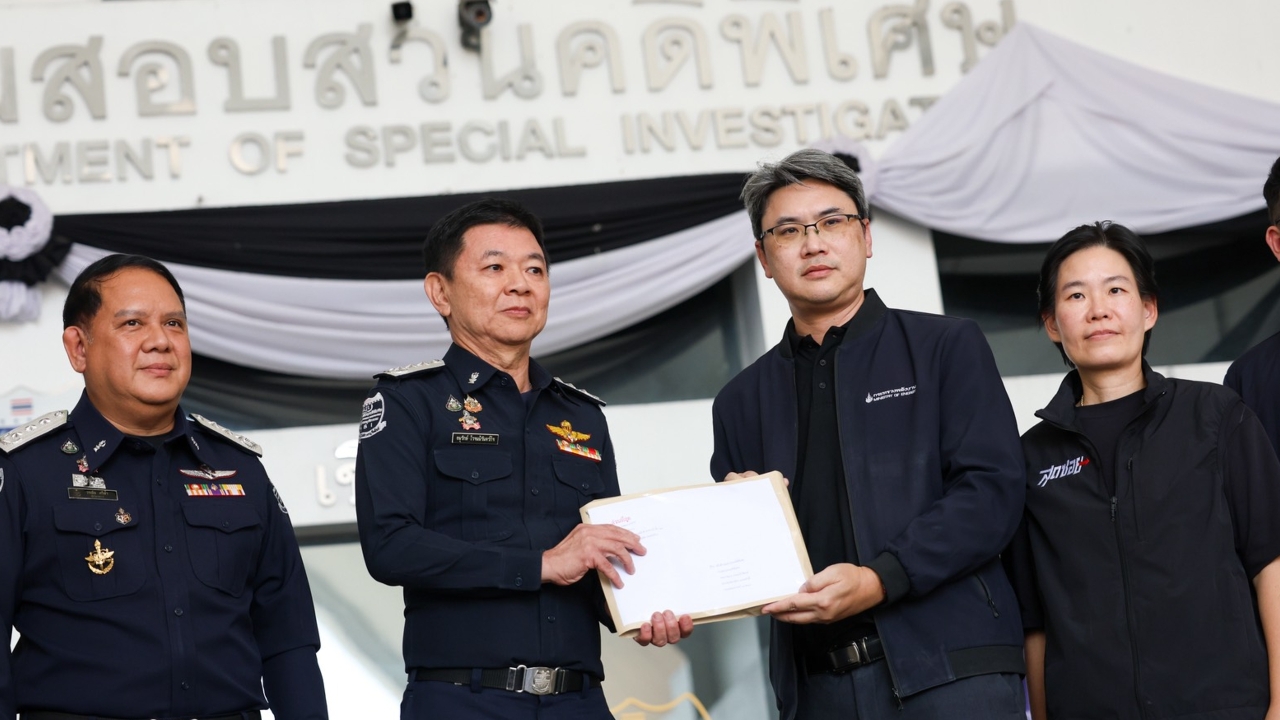
Energy Minister Aeknat assigns Thitiphat to lead a last-resort team in filing a complaint with the Department of Special Investigation (DSI) regarding irregularities in oil transport documents. There are 166 such documents from March alone. The DSI is preparing to consider whether to accept it as a special case or not.
At 16:00 on 27 Apr 2026 GMT+7. Mr. Aeknat Phonsan, Minister of Energy, has assigned Ms. Thitiphat Chotidechachainan. Former Member of Parliament for Bangkok, serving as chairperson. of the Intensive Energy Reform Inspection Committee (the last-resort team). Together with the legal team, they brought documents of irregular marine fuel transport invoices that do not comply with the Department of Energy Business's 2019 announcement on methods and conditions for transporting fuel by marine vessels to submit to the Department of Special Investigation (DSI). The documents were received by representatives including Police Lieutenant Colonel Anurak Rojaninirankit, Deputy Director-General of the DSI; Police Captain Waranan Srilam, Director of the Consumer Protection Division and DSI spokesperson; Police Captain Kriangkrai Suebsampan, Director of the Special Case Operations Division; and Police Lieutenant Colonel Seksan Sritulakarn, special case expert and head of the fuel-related prosecution center.
Ms. Thitiphat stated that today, she and the legal team from the Department of Energy Business submitted a complaint to the DSI, aware that the DSI is investigating oil tanker vessels. In the Energy Ministry's internal investigation, they reviewed oil transport documents from oil traders under Section 7, especially marine fuel transport invoices from March 2026 totaling 166 documents from six oil traders. These documents did not comply with the Department of Energy Business's 2019 announcement on transportation methods and conditions, constituting legal violations punishable by up to two years imprisonment, fines up to 200,000 baht, or both.
However, these marine fuel transport invoices originated from oil depot companies in Rayong and Chonburi provinces. The fuel was transported by sea to depots in Surat Thani, Chumphon, and Songkhla provinces. Since the 166 invoices did not comply with the announcement, this constitutes legal violations under the Fuel Trade Act of 2000, prompting today’s complaint.


Further detailed actions fall under the Ministry of Justice and the DSI's investigation. The irregularities in these 166 marine fuel transport invoices, as per the Department of Energy Business's 2019 announcement, require each transport document to include eight key details:
1. Name of the oil trader issuing and the origin location.
2. Date of issuance and transport document number.
3. Name of recipient and delivery destination.
4. Name and address of the transporter.
5. Vehicle registration used for transport; for marine transport, the vessel name must be specified.
6. Date of departure from the origin location.
7. Type and quantity of fuel transported.
8. Seal number (SEAL), electronic seal code, or system used to control and track the transport vehicle.
It was found that some marine fuel transport invoices lacked complete information, such as missing issuance dates, seal numbers, vessel names, or origin points where fuel was received. Such incompleteness requires legal action. Whether document forgery occurred remains under DSI investigation. Some destinations listed on these documents relate to oil depots in Surat Thani province, which are currently under DSI investigation.


Regarding the quantity of fuel involved, this will be subject to further DSI investigation. The oil depots in Surat Thani are governed by multiple laws and have complex supply routes from refineries to depots in Surat Thani and then to fuel stations. Prior to the energy crisis caused by fuel shortages, the Energy Ministry admits it may not have rigorously monitored these six oil depots.
According to the Department of Energy Business's announcement, when fuel moves from one trader to a buyer, a transport invoice must accompany it, whether by sea or land. Both buyer and seller must retain these documents for 60 days. If authorities have suspicions or find irregularities, they can request to review them. Hence, the ministry checked fuel transport invoices amid concerns about fuel stockpiling.
. Regarding whether this relates to delaying tactics in fuel stockpiling, some documents do show such irregularities, with transport taking an unusually long 2-3 days, especially in March 2026. If anyone is found guilty of hoarding fuel that causes the fuel fund to be used for subsidies, harming the public and requiring reimbursement, it should proceed according to the Energy Minister's stated policy.
Ms. Thitiphat further said, The 166 marine fuel transport invoices will be investigated to determine which oil transport companies or how many voyages and vessels operating in the Surat Thani sea are involved. The DSI will further investigate, as it already holds in-depth data. They will examine all aspects, including each depot's fuel reserves and transport documents, to share information with relevant agencies for further action.


Police Lieutenant Colonel Anurak said that upon the Department of Energy Business filing complaints against Section 7 oil traders for non-compliance with its announcement, the DSI will consider whether to accept the case as a special investigation, following procedures. The decision will follow the Special Case Committee's resolution on 9 April 2026, assessing if the criteria are met. Details linking to the oil depots in Surat Thani will be re-examined and submitted to the DSI Director-General accordingly.
Regarding prosecution, offenses by Section 7 oil traders appear less severe than those by the 'I-Mong' group. According to today’s complainants, the offense is non-compliance with the Department of Energy Business announcement, punishable by up to two years imprisonment or fines up to 200,000 baht under Section 56, paragraph one, combined with Section 30, paragraph one.
Next, the DSI will summon the six oil depots named in the complaint for witness testimony. Whether this links to the eight vessel-owning companies under DSI investigation remains to be seen; the DSI will review Department of Energy Business details. The DSI has already initiated investigation proceedings, which will be reviewed by the Special Case Management Division before assigning the responsible team.

The importance of marine fuel transport invoices is clear under the Department of Energy Business announcement, requiring eight detailed items. While this helps identify potential offenses, proving which company engaged in fuel hoarding in March 2026 requires multiple factors. Today's information contributes to the investigation. Anyone involved must be prosecuted accordingly. The investigation into Trillian Petro Trading Company Limited in Ang Thong province (linked to businessman Tue Cosmo) has already been accepted as a special case. Subsequent steps will include summoning involved parties for witness statements.
Police Captain Waranan commented on the progress of investigations into the eight vessel-owning companies linked to 60 million liters of missing fuel in the Surat Thani sea. Only two companies remain to be scheduled for interviews as they are currently abroad. Statements from the six interviewed companies mostly relate to monsoon and hydrological conditions, but facts will be verified further. .